

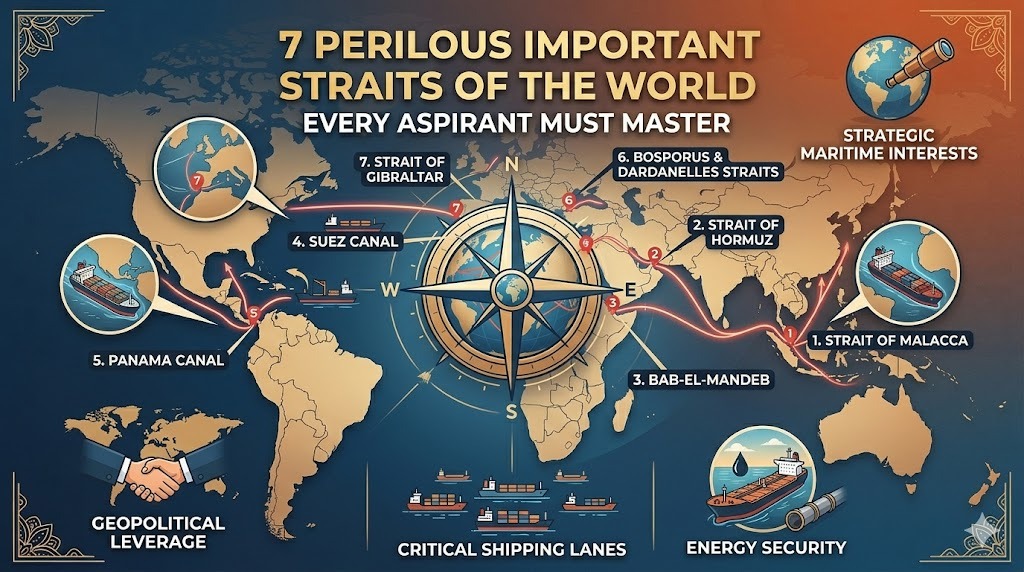
Geopolitics is heavily driven by geography, and nothing highlights this more than global maritime chokepoints. For civil services aspirants, map-based questions on water bodies are a recurring feature in the Civil Services Examination. Understanding the important straits of the world is not just essential for clearing the Prelims cutoff; it is also foundational for writing high-scoring answers in General Studies Paper II (International Relations).
A strait is a naturally formed, narrow waterway that connects two larger water bodies. When global trade flows through these narrow passages, they turn into geopolitical leverage points. Let’s dive deep into the important straits of the world and most critical maritime passages that dictate modern trade and international security.
Introduction to Global Chokepoints
More than 80% of global trade by volume is carried by sea. Within these maritime routes, certain narrow channels handle disproportionately massive amounts of cargo, oil, and liquefied natural gas (LNG). Disruptions at any major bottleneck can trigger global economic shocks, making the study of the important straits of the world indispensable for comprehensive exam preparation.
For a UPSC aspirant, analyzing these waterways requires looking beyond simple geography. You must understand the surrounding littoral nations, the regional security architectures, and how trade vulnerabilities affect India’s energy security and strategic calculus.
Detailed Explanation of the 7 Perilous Straits
The Strait of Malacca
1st important straits of the world : connecting the Andaman Sea (Indian Ocean) with the South China Sea (Pacific Ocean), this is the busiest chokepoint in Asia. It runs between the Indonesian island of Sumatra and the Malay Peninsula.
- Strategic Significance: Over 25% of global maritime trade passes through here. It is India’s gateway to the East and a primary focus of the “Act East” policy.
- The “Malacca Dilemma”: This term refers to China’s deep vulnerability regarding its energy imports. Since a huge portion of Chinese oil imports pass through this narrow corridor, any blockade here could cripple their economy. This is a vital conceptual link when studying the important straits of the world.
The Strait of Hormuz
2nd important straits of the world : connecting the Persian Gulf with the Gulf of Oman and the Arabian Sea, the Strait of Hormuz is arguably the most volatile maritime chokepoint on Earth. It separates Iran from Oman and the United Arab Emirates.
- Strategic Significance: It serves as the world’s most critical oil transit artery. More than 20% of global petroleum consumption passes through this narrow passage daily.
- India’s Vulnerability: India relies heavily on the West Asian region for crude oil imports. Any escalating geopolitical friction around Hormuz directly threatens domestic fuel prices and macroeconomic stability.
The Bab-el-Mandeb Strait
3rd important straits of the world : Known as the “Gate of Tears,” this strait connects the Red Sea to the Gulf of Aden and the Arabian Sea. It lies between Yemen on the Arabian Peninsula and Djibouti and Eritrea in the Horn of Africa.
- Strategic Significance: It forms the southern entrance to the Suez Canal route linking Asia to Europe.
- Security Concerns: Due to ongoing geopolitical conflicts, piracy, and regional instability, it remains highly volatile. Protecting freedom of navigation through the important straits of the world like Bab-el-Mandeb is a core priority for international naval task forces, including the Indian Navy.
The Bosporus and Dardanelles Straits (The Turkish Straits)
4th important straits of the world :The Bosporus Strait connects the Black Sea to the Sea of Marmara, while the Dardanelles connects the Sea of Marmara to the Aegean and Mediterranean Seas. Together, they divide mainland Turkey into European and Asian parts.
- Strategic Significance: This is the only maritime outlet for Black Sea littoral states like Russia, Ukraine, and Romania.
- Geopolitical Matrix: Under the 1936 Montreux Convention, Turkey regulates the passage of naval warships through these straits, making it a powerful geopolitical tool during international conflicts.
UPSC Nuggets: The Montreux Convention
The 1936 Montreux Convention Regarding the Regime of the Straits gives Turkey full control over the Bosporus and Dardanelles Straits. It guarantees the free passage of civilian vessels during peacetime but grants Turkey the authority to restrict the passage of naval warships belonging to non-Black Sea states during times of conflict.
The Strait of Gibraltar
5th important straits of the world :Connecting the Atlantic Ocean to the Mediterranean Sea, this vital passage separates Spain (Europe) from Morocco (Africa).
- Strategic Significance: It serves as the western gateway to the Mediterranean basin. Control and surveillance over this strait are critical for regulating trade, migration flows, and naval deployments between the Atlantic and southern Europe.
- Exam Point of View: Tracking the surrounding ports and nations is an essential part of mastering the important straits of the world for mapping modules.
The Taiwan Strait
6th important straits of the world : Also known as the Formosa Strait, this 180-kilometer-wide passage separates the island of Taiwan from mainland China, linking the South China Sea with the East China Sea.
- Strategic Significance: It is one of the most heavily militarized and contested waterways globally. It forms a crucial shipping route for major economies like Japan, South Korea, and Taiwan.
- Global Supply Chain Impact: Any conflict or blockade in the Taiwan Strait would completely disrupt the global semiconductor supply chain, severely impacting electronics manufacturing worldwide.
The English Channel and the Strait of Dover
The English Channel separates southern England from northern France, with the Strait of Dover forming its narrowest point, connecting the Atlantic Ocean to the North Sea.
- Strategic Significance: It is one of the world’s highest-density shipping lanes, facilitating massive intra-European trade.
- UPSC Perspective: While less volatile than Asian bottlenecks, understanding its location relative to European trade networks rounds out your knowledge of the important straits of the world.
Comparative Summary Table
| Strait | Water Bodies Connected | Surrounding Countries/Landmasses | Major Geopolitical Relevance |
| Strait of Malacca | Andaman Sea & South China Sea | Indonesia, Malaysia, Singapore | China’s “Malacca Dilemma”; India’s Act East gate |
| Strait of Hormuz | Persian Gulf & Gulf of Oman | Iran, Oman, UAE | Global oil lifeline; vulnerable to West Asian tensions |
| Bab-el-Mandeb | Red Sea & Gulf of Aden | Yemen, Djibouti, Eritrea | Suez Canal access point; prone to asymmetric threats |
| Bosporus Strait | Black Sea & Sea of Marmara | Turkey | Regulated by Montreux Convention; Black Sea transit |
| Strait of Gibraltar | Atlantic Ocean & Mediterranean Sea | Spain, Morocco | Gateway to Mediterranean; vital Euro-African corridor |
| Taiwan Strait | South China Sea & East China Sea | China, Taiwan | Semiconductor supply chains; geopolitical flashpoint |
| Strait of Dover | English Channel & North Sea | United Kingdom, France | High-density commercial shipping channel |
UPSC Questions Trend & Mapping Strategy
An analysis of past years’ question papers reveals that map-based queries generally focus on two dimensions: physical location matching and contemporary international disputes. Questions often ask aspirants to arrange water bodies from North to South or match a specific strait with its adjacent countries.
When preparing the important straits of the world, always keep an atlas open. Practice drawing rough mental maps of the Horn of Africa, Southeast Asia, and the Mediterranean basin.
[Persian Gulf] —> (Strait of Hormuz) —> [Gulf of Oman] —> [Arabian Sea]
Frequently Asked Questions (FAQs)
Q1: Why is the Strait of Hormuz considered the most volatile?
The Strait of Hormuz handles over one-fifth of global oil consumption. Because it is highly narrow and bordered by Iran, any regional geopolitical conflict can lead to immediate threats of a blockade, sending global energy prices soaring.
Q2: What is India’s strategy to counter the Malacca Dilemma?
India is actively developing its strategic infrastructure in the Andaman and Nicobar Islands. By bolstering its naval presence near the western mouth of the Malacca Strait, India enhances its maritime domain awareness and creates an effective counterweight in the Indo-Pacific.
Q3: How do environmental factors impact these straits?
Climate change, rising sea levels, and shifting weather patterns introduce new navigation hazards. Increased maritime traffic through the important straits of the world also raises concerns about oil spills, marine pollution, and eco-degradation in sensitive coastal zones.
Conclusion
Mastering the global maritime choke points gives you a distinct advantage in both Prelims and Mains. By linking geographical facts with international relations and economic realities, your answers become far more analytical and robust. Ensure you revise these locations periodically using blank maps to keep the spatial orientations fresh in your mind.
[…] Link 1: To understand the broader maritime context, read our deep dive on Important Straits and Waterways of the World for UPSC. […]
[…] learn about 7 Perilous Important Straits of the World Every Aspirant Must Master […]
[…] As disruptions in the Red Sea expose the risks of relying on a single maritime route, India’s focus has increasingly shifted toward alternative connectivity projects such as the India-Middle East-Europe Corridor (IMEC). Explore how this ambitious initiative aims to reshape global trade, its key challenges, and why it is strategically important for India in our detailed article on 7 Critical Realities of the India-Middle East-Europe Corridor: Promising Strategic Significance, Cha… […]