

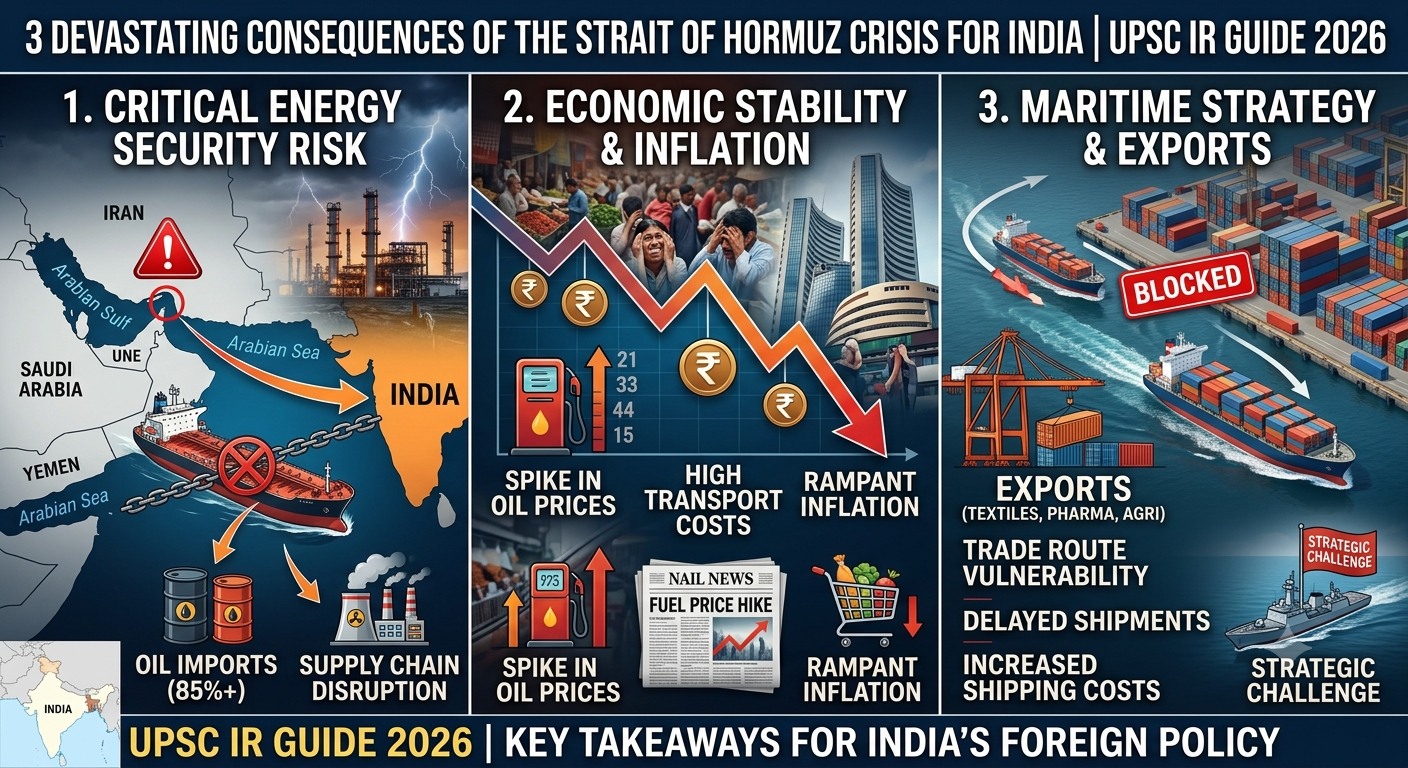
The ongoing Strait of Hormuz crisis in West Asia has escalated into one of the most critical geopolitical choke points in recent memory. For civil services aspirants, understanding the economic and security reverberations of this turmoil is paramount. In this article, we analyze how the supply disruptions impact India’s foreign policy, energy security, and strategic interests.
1. What Happened?
The Strait of Hormuz crisis intensified following military retaliations and sea-mine threats near critical maritime passages in the Persian Gulf.
- Naval Blockades & Chokepoint Strain: Major shipping lines have halted or drastically rerouted vessels through alternative oceanic routes.
- Energy Disruptions: Nearly 20% to 25% of the world’s daily petroleum and Liquefied Natural Gas (LNG) shipments normally navigate through this vital narrow passage.
- Global Trade Impact: Maritime insurance premiums have skyrocketed, directly driving up freight charges for crude oil and consumer imports bound for South Asia.
The current Strait of Hormuz crisis serves as a case study for GS Paper 2 (International Relations) and GS Paper 3 (Economy and Security).
2. Background: Strategic Vulnerability of Chokepoints
The Strait connects the Persian Gulf with the Gulf of Oman and the Arabian Sea. It serves as the sole maritime outlet for heavy petroleum exporters like Saudi Arabia, Iraq, UAE, Kuwait, and Iran.
Persian Gulf ---> Strait of Hormuz ---> Gulf of Oman ---> Arabian Sea / Indian Ocean
Historical precedent shows that whenever regional rivalries reach a boiling point, maritime chokepoints like Hormuz or Bab el-Mandeb become primary targets for asymmetric blockades.
Analyzing the ongoing Strait of Hormuz crisis highlights the fragility of global supply lines dependent on narrow sea lanes of communication (SLOCs).
3. 3 Strategic Impacts on India
I. Energy Security Vulnerability
India imports over 85% of its total crude oil requirements, a huge portion of which originates from the Persian Gulf producers. A prolonged Strait of Hormuz crisis strains domestic oil prices, risks inflation, and stresses the Current Account Deficit (CAD).
II. Safety of Indian Diaspora
Middle East nations host over 8 million non-resident Indians (NRIs). Escalations near maritime zones complicate civilian evacuation logistics and strain diplomatic resources.
III. Strategic Multi-Alignment Under Test
India maintains balanced relationships with major Gulf nations, Israel, and Iran. Managing strategic autonomy amidst the escalating Strait of Hormuz crisis forces New Delhi to navigate diplomatic pressure while protecting its national interest.
4. UPSC Relevance & Syllabus Mapping
Understanding the Strait of Hormuz crisis requires connecting regional events to syllabus heads:
- GS Paper 1 (Geography): Physical geography of global chokepoints (Bab-el-Mandeb, Strait of Malacca, Strait of Hormuz, Suez Canal).
- GS Paper 2 (International Relations): Bilateral and multilateral groupings, policies of developed and developing countries affecting India’s interests.
- GS Paper 3 (Economy & Security): Energy security, supply chain resilience, inflation, and maritime infrastructure defense.
UPSC Nuggets
- Strategic Petroleum Reserves (SPR): India’s Underground Rock Caverns for crude oil are located at Visakhapatnam (AP), Mangaluru (Karnataka), and Padur (Karnataka) managed by ISPRL.
- Operation Sankalp: Launched by the Indian Navy in 2019 to ensure the safe passage of Indian-flagged vessels through the Persian Gulf and the Gulf of Oman.
- Key Maritime Chokepoints Map:
- Strait of Hormuz: Persian Gulf $\leftrightarrow$ Gulf of Oman
- Bab el-Mandeb: Red Sea $\leftrightarrow$ Gulf of Aden
- Strait of Malacca: Andaman Sea $\leftrightarrow$ South China Sea
5. Key Takeaways for Aspirants
- Diversification of Energy: The current Strait of Hormuz crisis underscores why India must accelerate renewable energy transitions and diversify crude sources (e.g., Africa, Russia, South America).
- Maritime Domain Awareness (MDA): Deepening naval intelligence via platforms like the Information Fusion Centre-Indian Ocean Region (IFC-IOR).
- Diplomatic Balancing: Maintaining strategic autonomy while securing vital trade routes through collaborative groupings like I2U2 and MAHASAGAR initiatives.
Analyzing every aspect of the Strait of Hormuz crisis builds an integrated perspective suitable for Mains answer writing.
6. Prelims & Mains Angle
Prelims Practice Question
Q. Consider the following pairs of Maritime Chokepoints and connecting Water Bodies:
- Strait of Hormuz – Persian Gulf to Gulf of Oman
- Bab el-Mandeb – Red Sea to Gulf of Aden
- Strait of Malacca – Java Sea to Bay of Bengal
Which of the pairs given above is/are correctly matched?
(a) 1 and 2 only
(b) 2 and 3 only
(c) 1 and 3 only
(d) 1, 2, and 3
Answer: (a) Pair 3 is incorrect because the Strait of Malacca connects the Andaman Sea (Indian Ocean) to the South China Sea (Pacific Ocean).
Mains Practice Question
Q. “The fragile geopolitics surrounding critical ocean chokepoints exposes India’s energy vulnerabilities.” In light of the recent Strait of Hormuz crisis, critically analyze India’s energy diversification strategy and discuss maritime security measures needed to protect sea routes. (15 Marks, 250 Words)
7. Frequently Asked Questions (FAQs)
Q1. Why is the Strait of Hormuz strategically significant for India?
It acts as the primary sea route for crude oil imports from major Gulf exporters. Any escalation directly threatens India’s domestic energy security and economic stability.
Q2. What measures has India taken to mitigate such supply disruptions?
India maintains Strategic Petroleum Reserves (SPRs), expands its renewable energy footprint, and uses diplomatic multi-alignment to secure alternative energy partnerships.
Q3. How does the current crisis impact India’s trade routes?
Rerouting merchant shipping around the Horn of Africa or taking alternative detours increases transit time, insurance premiums, and freight costs significantly.
8. Conclusion
Navigating the regional fallout of the Strait of Hormuz crisis tests both diplomatic agility and strategic readiness. For civil services aspirants, connecting physical geography with international political developments helps build clear, high-scoring answers across Prelims and Mains. Keep tracking these developments in your daily current affairs schedule!
To fully understand the implications of the Strait of Hormuz crisis for India, it is essential to first examine the broader geopolitical landscape. If you are new to this topic, start with our analysis of the 5 Devastating Repercussions of the Strait of Hormuz Crisis: A Critical Geopolitical Analysis to understand its global impact.
And to stay updated with such current affairs stay tuned with dailyupscprep.in !