

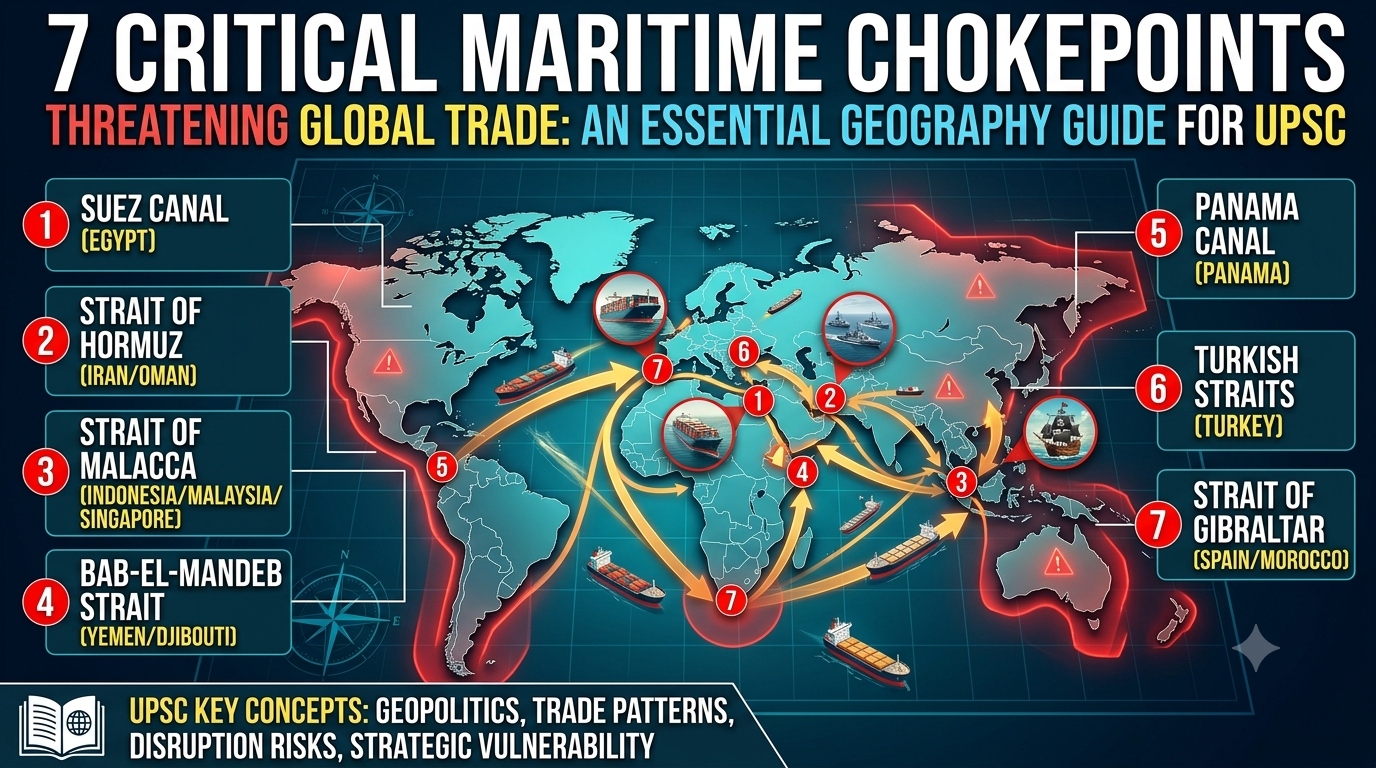
Maritime chokepoints are narrow channels along strategic sea routes that handle enormous volumes of international trade. Any disruption, conflict, or piracy event at these geographic bottlenecks immediately triggers a devastating supply chain crisis. Understanding these strategic waterways is crucial for geography, international relations, and security studies.
Whether analyzing supply lines in the Indo-Pacific or evaluating energy security in West Asia, mastering critical maritime chokepoints gives aspirants a distinct edge in both Prelims and Mains examination papers.
1. Introduction to Critical Maritime Chokepoints and Bottlenecks
A maritime chokepoint is a narrow passageway, such as a strait or canal, through which high volumes of global maritime traffic must pass. Because alternate shipping routes often add thousands of nautical miles and massive fuel costs, these passages possess geopolitical weight disproportionate to their physical size.
Nearly 30% of global crude oil and over 20% of global commerce transit through just a handful of these vulnerable waterways every single day. For India, which relies heavily on sea lines of communication (SLOCs) for over 90% of its trade volume and energy imports, securing critical maritime chokepoints is a core strategic priority.
2. Detailed Breakdown of Strategic Waterways
Here is a comprehensive breakdown of the world’s seven most strategically volatile and critical maritime chokepoints :
1. Strait of Malacca
- Location: Connects the Indian Ocean (Andaman Sea) to the Pacific Ocean (South China Sea), bounded by Malaysia, Singapore, and Indonesia.
- Strategic Significance: It is the shortest sea route between the Persian Gulf and East Asian markets (China, Japan, South Korea). Over 90,000 vessels traverse this waterway annually.
- Vulnerabilities: Heavy traffic, shallow waters at the Malacca Max depth, and lingering concerns over piracy make critical maritime chokepoints like Malacca vulnerable to strategic blockades—often referred to as China’s “Malacca Dilemma.”
2. Strait of Hormuz
- Location: Connects the Persian Gulf with the Gulf of Oman and the Arabian Sea, flanked by Iran to the north and Oman/UAE to the south.
- Strategic Significance: Widely regarded as the world’s most critical oil transit passage, handling over 20 million barrels of petroleum per day (roughly 20% of global petroleum consumption).
- Vulnerabilities: Regional conflicts in West Asia frequently threaten closure. Disruptions here immediately cause global energy price spikes, directly impacting India’s fuel security and foreign exchange reserves.
3. Bab-el-Mandeb Strait
- Location: Connects the Red Sea to the Gulf of Aden and the Arabian Sea, lying between Yemen on the Arabian Peninsula and Djibouti/Eritrea in the Horn of Africa.
- Strategic Significance: Acts as the southern gatekeeper to the Suez Canal. It is a vital artery for trade between Europe, the Mediterranean, and Asia.
- Vulnerabilities: Recent security instability, piracy, and asymmetrical drone attacks from non-state actors in the region demonstrate how geopolitical unrest at critical maritime chokepoints can reroute global shipping around the Cape of Good Hope, adding 10–14 days to global transit times.

4. Suez Canal
- Location: Artificial waterway in Egypt connecting the Mediterranean Sea to the Red Sea.
- Strategic Significance: Eliminates the need to navigate around the African continent, shortening the maritime route between Europe and South Asia by approximately 7,000 kilometers.
- Vulnerabilities: Physical blockages (such as groundings of mega-container ships) can paralyze global trade, locking up billions of dollars in cargo daily.
5. Turkish Straits (Bosphorus and Dardanelles)
- Location: Situated in Turkey, dividing Europe and Asia, connecting the Black Sea to the Aegean and Mediterranean Seas.
- Strategic Significance: The sole maritime route for Black Sea littoral states (including Russia, Ukraine, Romania, and Bulgaria) to access open ocean trade.
- Vulnerabilities: Regulated strictly by the 1936 Montreux Convention, which governs the transit of naval warships during times of war, making it a pivotal arena in Eurasian conflict dynamics.
6. Panama Canal
- Location: Isthmus of Panama, connecting the Atlantic and Pacific Oceans.
- Strategic Significance: Key corridor for trade between the eastern coast of the Americas and East Asia or western South America.
- Vulnerabilities: Unlike natural saltwater straits, the canal relies on fresh water locks. Severe climate-induced droughts directly lower water levels, restricting vessel draft and limiting daily transits, demonstrating environmental risks facing critical maritime chokepoints.
7. Lombok and Sunda Straits
- Location: Indonesian archipelago connecting the Indian Ocean to the Java/Celebes Seas and South China Sea.
- Strategic Significance: Primary alternative routes for deep-draft vessels (like Very Large Crude Carriers) that exceed the depth limitations of the Strait of Malacca.
- Vulnerabilities: Strategic bottlenecks within Indonesian territorial waters require constant diplomatic coordination under the United Nations Convention on the Law of the Sea (UNCLOS).
3. Real-World Geopolitical Examples
- The Red Sea Crisis: Recent geopolitical tensions in the Bab-el-Mandeb Strait forced international shipping conglomerates to bypass the Suez Canal entirely, rerouting vessels around the Cape of Good Hope, driving up freight costs and container rates globally.
- The Malacca Dilemma: China’s heavy reliance on the Strait of Malacca for energy imports has driven its Belt and Road Initiative (BRI) infrastructure developments, including land pipelines through Myanmar and Pakistan, designed specifically to bypass strategic critical maritime chokepoints.
- Operation Sankalp: The Indian Navy regularly deploys frontline warships in the Gulf of Oman and Persian Gulf to ensure the safe passage of Indian-flagged merchant vessels navigating high-risk transit corridors.
4. UPSC Questions Trend Analysis on critical maritime chokepoints
Maritime geography and geopolitical security consistently feature across Prelims and Mains papers.
Prelims Pattern Analysis
In UPSC Prelims (General Studies Paper-I), questions on physical and regional geography frequently ask candidates to match straits with the water bodies they connect, or order waterways sequentially from North to South / West to East.
UPSC Standard Sample Question (Prelims):
Q. Consider the following pairs:
- Strait of Hormuz – Connects Persian Gulf to Gulf of Oman
- Bab-el-Mandeb – Connects Red Sea to Gulf of Guinea
- Strait of Malacca – Connects Andaman Sea to South China Sea
How many of the above pairs are correctly matched?
(a) Only one
(b) Only two
(c) All three
(d) None
Answer: (b) Only two (Statement 2 is incorrect; Bab-el-Mandeb connects the Red Sea to the Gulf of Aden).
Mains Pattern Analysis
In GS Paper I (Geography) and GS Paper II (International Relations), questions focus on global strategic geography, energy security, and India’s maritime diplomacy (e.g., SAGAR vision, QUAD collaboration, and Indian Ocean naval posture).
💡 UPSC Nuggets: Rapid Revision Corner
- UNCLOS Framework: The 1982 UN Convention on the Law of the Sea establishes rules governing Territorial Waters (12 nautical miles), Contiguous Zones (24 NM), and Exclusive Economic Zones (200 NM).
- Transit Passage vs. Archipelagic Sea Lanes: Under UNCLOS, all ships enjoy the right of freedom of navigation solely for continuous and expeditious transit through critical maritime chokepoints.
- India’s Key Island Posts: The Andaman & Nicobar Command (ANC) guards the western entrance of the Malacca Strait, giving India vital leverage over Indian Ocean SLOCs.
- Nine-Dash Line: China’s expansive territorial claim over the South China Sea directly overlaps with international shipping lanes entering key regional straits.
5. Summary Table for Quick Revision (critical maritime chokepoints)
| Maritime Chokepoint | Primary Water Bodies Connected | Bordering / Littoral Nations | Core Strategic Value |
| Strait of Malacca | Andaman Sea & South China Sea | Malaysia, Indonesia, Singapore | Primary Asia-Pacific trade highway |
| Strait of Hormuz | Persian Gulf & Gulf of Oman | Iran, Oman, UAE | Global crude oil transit corridor |
| Bab-el-Mandeb | Red Sea & Gulf of Aden | Yemen, Djibouti, Eritrea | Gateway to Suez Canal & Europe |
| Suez Canal | Red Sea & Mediterranean Sea | Egypt | Shortest Asia-Europe shipping route |
| Turkish Straits | Black Sea & Aegean Sea | Turkey | Black Sea naval and trade outlet |
| Panama Canal | Atlantic Ocean & Pacific Ocean | Panama | Key Western Hemisphere trade corridor |
| Sunda / Lombok | Indian Ocean & Java Sea | Indonesia | Alternate route for deep-draft ships |
6. Frequently Asked Questions (FAQs) on critical maritime chokepoints
What makes a waterway a “chokepoint”?
A waterway is defined as a chokepoint when it is narrow, highly trafficked, and lacks easy or cost-effective alternative routing for international maritime commerce and military vessels.
How do maritime chokepoints impact inflation in India?
If passage through key strategic critical maritime chokepoints like Hormuz or Bab-el-Mandeb is blocked or threatened, insurance rates and fuel costs rise significantly. This increases freight rates, leading to imported inflation for commodities like crude oil and fertilizers in India.
What is India’s strategy to safeguard SLOCs?
India relies on its SAGAR (Security and Growth for All in the Region) vision, Net Security Provider posture in the IOR, multilateral naval exercises (like MALABAR), and strategic naval deployments near the Andaman and Nicobar Islands.
7. Conclusion
Mastering maritime geography and critical maritime chokepoints is essential for answering map-based Prelims questions and crafting well-rounded Mains answers on international relations and trade security. As geopolitical friction increases near global trade routes, keeping track of developments across critical maritime chokepoints will remain essential for UPSC preparation.