

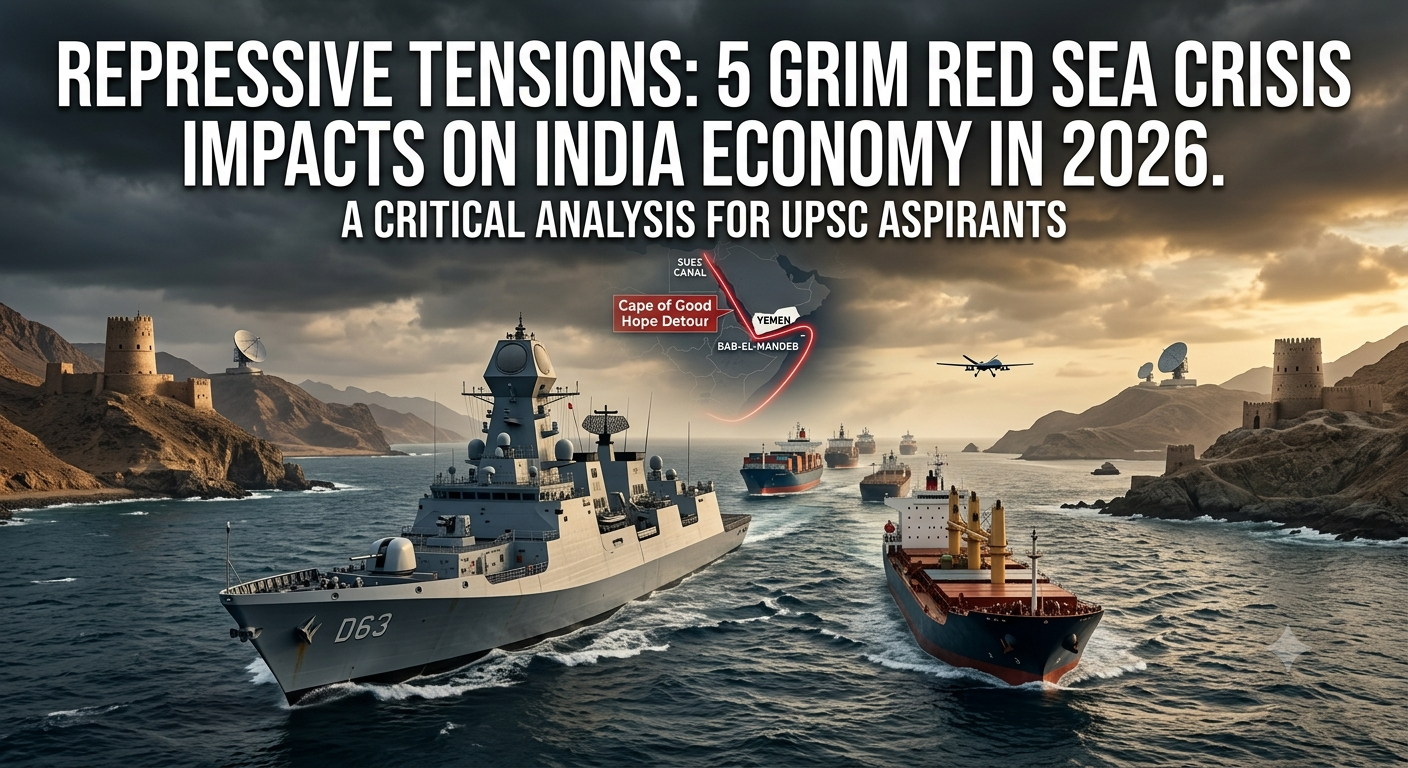
The global supply chain is facing an unprecedented bottleneck. As maritime tensions escalate, the Red Sea shipping crisis has emerged as one of the most critical geopolitical challenges of the year. For UPSC aspirants, understanding this crisis is not just about tracking daily news; it is about grasping the deep interconnectedness of global trade, maritime security, and domestic inflation.
With over 12% of global trade passing through the Bab-el-Mandeb Strait, any disruption here sends shockwaves across the continents. India, being heavily reliant on this route for its exports to Europe and the US East Coast, finds itself in a challenging spot. This article breaks down the multifaceted impacts of the Red Sea shipping crisis on India’s economy, its strategic responses, and the core analytical angles required for both UPSC Prelims and Mains.
1. What Happened? The Genesis of the Bottleneck
The crisis began as regional conflicts spilled over into vital maritime choke points. Drone and missile attacks on commercial vessels navigating the Red Sea forced major global shipping lines to alter their routes. Instead of taking the shorter Suez Canal route, ships are now forced to detour around the Cape of Good Hope at the southern tip of Africa.
This detour adds roughly 6,000 nautical miles to a typical journey from India to Europe. The Red Sea shipping crisis has consequently extended transit times by 14 to 20 days. This sudden shift has caused an acute shortage of shipping containers, sent freight rates skyrocketing, and disrupted the finely tuned “just-in-time” supply chains that modern global commerce relies upon so heavily.
2. Historical Background: The Geopolitical Context
To understand the current mess, we must look at the geography of the region. The Bab-el-Mandeb Strait, acting as the southern gate to the Red Sea, is a narrow choke point between Yemen and Djibouti. Historically, this region has been prone to piracy and geopolitical instability. The current escalation, however, is highly sophisticated, involving advanced drone technology that threatens commercial armadas.
For decades, the Suez Canal route has been India’s primary economic gateway to the West. Past disruptions, like the Ever Given grounding in 2021, showed how fragile this corridor is. However, the prolonged nature of the Red Sea shipping crisis makes it far more dangerous than temporary structural accidents, converting a localized security issue into a long-term global economic shock.
3. 5 Grim Impacts on India’s Economy
The economic fallout for India is widespread, affecting sectors ranging from agriculture to heavy manufacturing. Below are the five most significant impacts:
A. Skyrocketing Freight Rates and Insurance Costs
With ships taking the longer African route, fuel consumption has surged. Shipping lines have passed these costs down to exporters through heavy surcharges. Furthermore, marine insurance premiums for transit through the Middle East have shot up dramatically, making Indian exports far less competitive in Western markets due to the ongoing Red Sea shipping crisis.
Standard Route (Suez Canal)       | ~14-20 Days | Lower Fuel Costs
Detour Route (Cape of Good Hope)  | ~30-40 Days | Surging Freight & Insurance
B. Delayed Shipments and Inventory Crunches
Key Indian sectors like garments, textiles, electronics, and automotive engineering rely on strict delivery timelines. The extra two weeks at sea mean delayed realizations of payments for exporters and severe inventory shortages for domestic manufacturers awaiting crucial intermediate components.
C. Major Blow to Agricultural Exports
Perishable goods cannot survive prolonged transit without expensive refrigeration. India’s basmati rice, fruits, and buffalo meat exports to the European Union and parts of the Middle East have faced cancellations. The Red Sea shipping crisis has caused domestic gluts in certain commodities, hurting farmers’ realizations.
D. Pressure on the Fertilizer and Energy Imports
India imports significant quantities of crude oil and fertilizer inputs via these routes. While Russian oil flows have shifted patterns, any broad escalation increases landing costs. Increased fertilizer import costs directly translate to a higher government subsidy burden to keep domestic prices stable for farmers.
E. Rising Working Capital Crunch for MSMEs
Micro, Small, and Medium Enterprises (MSMEs) operate on tight margins. With delayed payments from Western buyers and rising input costs, these units face severe cash flow issues. The Red Sea shipping crisis is testing the resilience of India’s manufacturing backbone.
4. Importance for India and Strategic Responses
India cannot afford to be a passive bystander in this crisis. The Indian Navy has proactively deployed guided-missile destroyers and maritime surveillance aircraft in the Central and Arabian Sea regions. By escorting Indian-flagged merchant vessels and performing anti-piracy operations, India is signaling its role as a preferred security provider in the Indian Ocean Region (IOR).
Simultaneously, India is pushing for diplomatic resolutions and exploring alternative trade corridors. The long-term viability of projects like the India-Middle East-Europe Economic Corridor (IMEC) is being discussed with renewed urgency, as the Red Sea shipping crisis highlights the danger of relying on a single maritime choke point.
UPSC Nuggets
- Prelims Pointer: Map the Bab-el-Mandeb Strait, Suez Canal, Gulf of Aden, and the Horn of Africa. Note the countries bordering the Red Sea: Egypt, Sudan, Eritrea, Djibouti, Saudi Arabia, and Yemen.
- Mains GS Paper II (IR): Analyze how maritime security threats challenge India’s “SAGAR” (Security and Growth for All in the Region) vision.
- Mains GS Paper III (Economy): Evaluate the vulnerability of India’s export-led growth to global supply chain shocks.
5. UPSC Relevance: Prelims and Mains Angle ( Topic : Red Sea shipping crisis )
In the UPSC Civil Services Examination, international trade disruptions and maritime geography are highly favored topics.
Prelims Angle
Questions typically focus on geographical mapping. You must know the exact locations of global choke points. Expect matching questions connecting straits to the bodies of water they connect. The Red Sea shipping crisis makes the surrounding littoral nations highly probable topics for map-based questions this year.
Mains Angle
In GS Paper II, this topic fits perfectly into “Effect of policies and politics of developed and developing countries on India’s interests.” In GS Paper III, it links directly to infrastructure, ports, and economic growth. Aspirants should practice writing answers that balance the economic costs with India’s strategic naval responses in the Western Indian Ocean.
6. Key Takeaways for Aspirants
- Choke Points Matter: Global trade relies on incredibly narrow geographic passages; their vulnerability is India’s vulnerability.
- Strategic Autonomy: The Red Sea shipping crisis underscores why India must maintain an independent, robust blue-water navy to protect its economic sea lanes.
- Diversification is Critical: Relying heavily on one trade route leaves the nation exposed to asymmetric shocks. Diversifying trade infrastructure is an economic imperative.
7. Frequently Asked Questions (FAQs) on red sea shipping crisis
Q1: What is the Bab-el-Mandeb Strait?
It is a strategic strait located between Yemen on the Arabian Peninsula, and Djibouti and Eritrea in the Horn of Africa. It connects the Red Sea to the Gulf of Aden and the Indian Ocean.
Q2: How does the Cape of Good Hope detour affect Indian trade?
It increases the shipping distance by roughly 6,000 nautical miles, adding up to 20 days to transit times, which drastically inflates freight costs during the Red Sea shipping crisis.
Q3: What is India’s IMEC project?
The India-Middle East-Europe Economic Corridor (IMEC) is a planned ship-to-rail transit network aiming to connect India to Europe via the UAE, Saudi Arabia, Jordan, and Israel, acting as an alternative to traditional sea routes.
8. Conclusion
The Red Sea shipping crisis serves as a stark reminder of the volatility inherent in global maritime trade. For India, the crisis is an economic hurdle but also an opportunity to showcase its naval capabilities and lead conversations on maritime security governance. As UPSC aspirants, tracking these multi-dimensional impacts will help you formulate balanced, analytical answers that stand out in the mains exam.
As disruptions in the Red Sea expose the risks of relying on a single maritime route, India’s focus has increasingly shifted toward alternative connectivity projects such as the India-Middle East-Europe Corridor (IMEC). Explore how this ambitious initiative aims to reshape global trade, its key challenges, and why it is strategically important for India in our detailed article on 7 Critical Realities of the India-Middle East-Europe Corridor: Promising Strategic Significance, Challenging Obstacles & UPSC Relevance.
To stay updated with such current affair preparation stay tuned with dailyupscprep.in !