

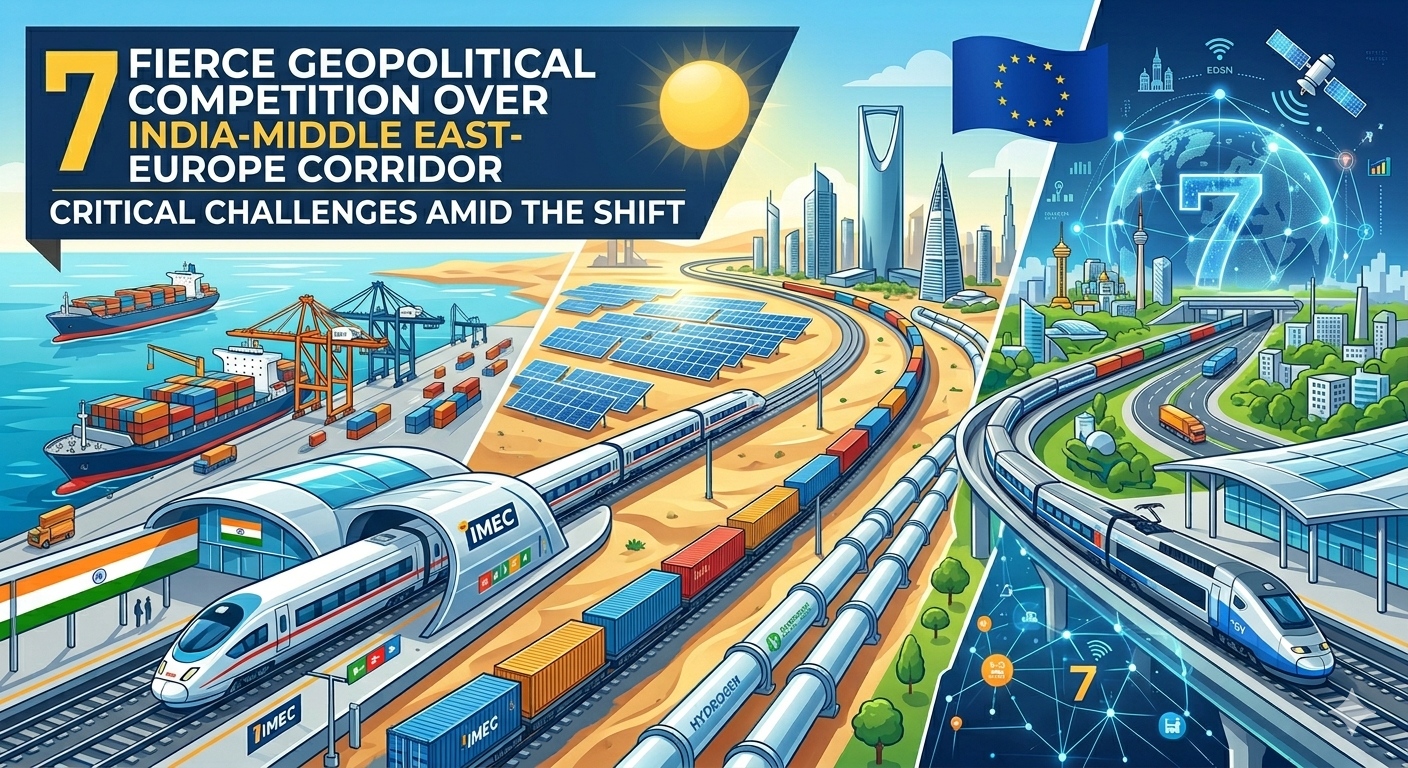
The global geopolitical landscape is undergoing a monumental transformation, driven by connectivity projects that redefine trade, diplomacy, and economic interdependence. At the absolute forefront of this paradigm shift stands the India-Middle East-Europe Corridor, an ambitious infrastructure network unveiled to seamlessly link India with the Arabian Gulf and Europe. This monumental initiative represents a powerful alternative to traditional continental trade routes. For strategic analysts and civil services aspirants alike, understanding the India-Middle East-Europe Corridor framework is absolutely essential to grasping modern international relations and economic diplomacy.
As a multimodal economic highway, the India-Middle East-Europe Corridor aims to radically stimulate economic development by fostering enhanced connectivity and integration among Asia, the Persian Gulf, and Europe. The project comprises two distinct corridors: the East Corridor, connecting India to the Arabian Gulf, and the Northern Corridor, linking the Gulf directly to Europe. By incorporating advanced rail, ship-to-rail, and road transport networks, the India-Middle East-Europe Corridor promises a highly reliable and cost-effective cross-border transit system that complements existing maritime and land-based transport routes across multiple continents.
The structural foundation of the India-Middle East-Europe Corridor rests on a profound collective vision among its major founding signatories, including India, the United Arab Emirates, Saudi Arabia, the European Union, France, Italy, Germany, and the United States. This powerhouse coalition intends to transform the movement of goods, digital data, and clean energy across borders. Far beyond simple infrastructure, the India-Middle East-Europe Corridor represents a reimagined geopolitical framework created to foster sustainable, transparent, and resilient economic growth, effectively rewriting the rules of global connectivity for the twenty-first century.
Strategic Significance for India: A Mighty Geopolitical Leap
For New Delhi, the strategic dividends of this framework cannot be overstated, offering a direct and highly optimized maritime-land channel to Western markets. By establishing the India-Middle East-Europe Corridor, India effectively circumvents the geographical bottlenecks and hostile terrestrial blockades historically presented by Pakistan and Afghanistan. This major breakthrough allows India to bypass traditional overland constraints, securing a reliable, high-speed economic gateway directly into Central Asia and Europe, thereby solidifying its status as an influential, unhindered global trading hub via the India-Middle East-Europe Corridor.
Furthermore, the economic benefits are deeply integrated with energy security and advanced digital infrastructure, positioning the nation at the center of modern supply chains. The India-Middle East-Europe Corridor incorporates an extensive network of subsea data cables and clean hydrogen pipelines alongside its transport lines. This multi-layered approach dramatically enhances digital connectivity and positions India as a major provider of renewable energy to Europe, fundamentally elevating India’s role through the India-Middle East-Europe Corridor from a regional participant to an indispensable architect of international trade and digital infrastructure.
On a diplomatic level, the project acts as a powerful institutional anchor that cements New Delhi’s strategic alignment with the Gulf nations. Through the active operationalization of the India-Middle East-Europe Corridor, India strengthens its existing ‘West Asia Link’ policy, transitioning transactional energy relationships into deep, long-term strategic partnerships. This massive infrastructure tie-up aligns seamlessly with the economic diversification goals of Middle Eastern partners, creating a highly resilient framework for long-term regional stability and shared prosperity anchored by the India-Middle East-Europe Corridor.
Countering China’s Belt and Road Initiative (BRI)
One of the most consequential geopolitical dimensions of this initiative is its role as a transparent, high-standard alternative to China’s predatory infrastructure expansions. The implementation of the India-Middle East-Europe Corridor offers a direct counter-narrative to Beijing’s Belt and Road Initiative, which has faced severe global criticism for its lack of transparency, environmental disregard, and debt-trap diplomacy. By offering a model based on financial sustainability and mutual respect, the India-Middle East-Europe Corridor presents a viable alternative for developing nations.
Unlike the unilateral, state-driven model favored by Beijing, this multilateral framework prioritizes transparent financing, local ownership, and strict adherence to international legal norms. The India-Middle East-Europe Corridor champions a decentralized, cooperative approach where every participating nation holds an equal stake in the development and governance of the network. This commitment to transparency and financial prudence within the India-Middle East-Europe Corridor serves as a direct rejection of predatory lending, offering an ethical template for large-scale cross-border infrastructure development globally.
Moreover, the strong, active backing of the United States and the European Union highlights a shared democratic commitment to maintaining an open, rule-based global order. Through the strategic framework of the India-Middle East-Europe Corridor, Western powers are actively pooling their immense financial resources and technological expertise to counter authoritarian dominance over global trade choke points. This collective effort ensures that the critical supply chains of the future routed through the India-Middle East-Europe Corridor remain democratic, diverse, and entirely free from coercion by any single dominant global superpower.
Redefining Middle Eastern Geopolitics
The Middle East has long been viewed through the narrow, volatile lens of conflict, oil dependency, and deep-seated regional rivalries. However, the conceptualization of the India-Middle East-Europe Corridor introduces an entirely new narrative of economic integration, cooperative diplomacy, and regional modernization. By positioning the Middle East as a vital, high-tech transit hub between East and West, the India-Middle East-Europe Corridor encourages regional actors to prioritize economic growth, shared infrastructure, and commercial cooperation over historical animosities.
Crucially, this mega-project acts as a structural catalyst for historical reconciliation, driving a new era of regional stabilization across West Asia. The underlying logistics of the India-Middle East-Europe Corridor incentivize deeper diplomatic coordination and normalization of ties among traditional regional adversaries, building directly upon the foundational momentum of recent diplomatic accords. By weaving shared economic destinies through physical rail lines and fiber-optic cables, the India-Middle East-Europe Corridor establishes an environment where regional stability becomes a shared financial necessity.
Additionally, for major Arab economies like Saudi Arabia and the United Arab Emirates, the project perfectly complements their ambitious national diversification strategies. The alignment with the India-Middle East-Europe Corridor accelerates their transition away from oil dependence by transforming their nations into world-class logistics, digital, and manufacturing hubs. This profound structural transformation via the India-Middle East-Europe Corridor injects long-term resilience into their domestic economies while positioning West Asia as an indispensable, highly integrated core of the modern global economic architecture.
Fierce Challenges and Geopolitical Roadblocks
Despite its immense and undeniable potential, this ambitious multinational corridor faces a complex landscape of severe geopolitical hurdles and logistical vulnerabilities. The sudden outbreak of major conflicts in West Asia highlights the volatile environment through which the India-Middle East-Europe Corridor must physically pass. Heightened security threats, regional instability, and shifting diplomatic ties present persistent risks that could easily disrupt project timelines, discourage private sector investment, and complicate cross-border operational agreements for the India-Middle East-Europe Corridor.
Beyond the immediate geopolitical friction, the project faces massive, unprecedented logistical and financial hurdles that demand long-term coordination. Building thousands of kilometers of interconnected railways, upgrading deep-sea ports, and standardizing customs protocols across multiple nations requires staggering capital investments. The India-Middle East-Europe Corridor demands seamless regulatory harmony, unified legal structures, and complex technological integration among nations with highly diverse administrative systems, turning standard operational alignment into a monumental task for the India-Middle East-Europe Corridor.
Furthermore, securing sustainable, long-term financing from private institutional investors remains a critical challenge for all member states involved. While governments have pledged strong political support, the actual realization of the India-Middle East-Europe Corridor depends heavily on mobilizing hundreds of billions of dollars in private capital. Mitigating risks associated with long payback periods, sovereign debt vulnerabilities, and fluctuating macroeconomic conditions is absolutely essential to turning the India-Middle East-Europe Corridor from a visionary blueprint into a functioning physical reality.
The Environmental and Technological Frontier
A defining attribute that sharply distinguishes this initiative from older, purely industrial trade routes is its profound, forward-looking commitment to environmental sustainability. The design parameters of the India-Middle East-Europe Corridor prioritize a green economy by embedding a specialized zero-emission transport architecture into its core design. By substituting long, carbon-heavy maritime routes with highly optimized rail links, the India-Middle East-Europe Corridor aims to drastically reduce the carbon footprint of global trade.
In addition to lowering transport emissions, the corridor is uniquely engineered to serve as a major channel for clean energy transmission. The physical pathways of the India-Middle East-Europe Corridor will host advanced pipelines engineered for exporting green hydrogen, alongside high-voltage electricity grids linking renewable energy fields. This innovative configuration allows solar and wind energy generated in India and the Middle East to flow cleanly into European markets, driving a global transition toward sustainable energy systems through the IMEC.
Simultaneously, the digital layer of this project establishes an ultra-high-capacity data bridge that will revolutionize global telecommunications and digital commerce. By laying down an extensive subsea and terrestrial fiber-optic network, the India-Middle East-Europe Corridor will dramatically reduce latency, secure data routing, and boost digital trade across continents. This digital transformation empowers small and medium enterprises, fosters cross-border innovation, and ensures that the digital economies of participating nations remain highly integrated.
UPSC Relevance: An Analytical Framework for Aspirants
For civil services aspirants, this multi-continental connectivity initiative represents an incredibly rich, high-yield topic across multiple papers of the UPSC exam. Within General Studies Paper II, the India-Middle East-Europe Corridor serves as a primary case study for analyzing bilateral and regional groupings, global institutional dynamics, and policies affecting India’s core national interests. Aspirants must thoroughly master its strategic objectives, diplomatic implications, and its direct influence on India’s evolving foreign policy.
In General Studies Paper III, the project crosses into critical areas like infrastructure development, economic planning, investment models, and global supply chain resilience. Examining the India-Middle East-Europe Corridor requires an in-depth understanding of project financing, public-private partnerships, environmental impact assessments, and trade facilitation mechanisms. Candidates must be fully prepared to evaluate how the India-Middle East-Europe Corridor stimulates domestic manufacturing, generates employment, and supports India’s macroeconomic goals.
Furthermore, for the Essay paper and international relations electives, this topic offers a superb conceptual foundation for exploring broader geopolitical themes. The narrative of the India-Middle East-Europe Corridor can be brilliantly utilized to analyze the shift from unilateral globalization to fragmented regional networks, the geopolitics of infrastructure finance, and the balancing act between major world powers. Mastering the nuances of the India-Middle East-Europe Corridor equips candidates with the analytical depth required to score exceptionally well in the examination.
The Road Ahead: Navigating Uncertainty
Turning this visionary, multi-layered blueprint into a fully functional operational channel demands unwavering political will, institutional agility, and sustained international cooperation. Signatory nations must immediately move beyond high-level diplomatic declarations and establish a formal, centralized governing body to oversee the India-Middle East-Europe Corridor. This dedicated international authority will be absolutely critical for resolving technical discrepancies, aligning customs procedures, and ensuring steady progress across all individual territorial segments of the India-Middle East-Europe Corridor.
In conclusion, while the structural, financial, and geopolitical challenges ahead are undoubtedly fierce and complex, the ultimate strategic rewards are profoundly transformative. The successful establishment of the India-Middle East-Europe Corridor has the potential to fundamentally reshape global trade, foster unprecedented regional integration, and solidify India’s position as a leading global economic power. For India, Europe, and the Middle East, the India-Middle East-Europe Corridor represents not just a path to shared prosperity, but a bold, defining leap into the future of global connectivity.
UPSC Nuggets & Structural Framework
Mains Analytical Edge: When writing answers on international connectivity corridors, always use a multi-dimensional matrix framework to fetch maximum marks. Break your analysis into Geostrategic, Geo-economic, and Geopolitical impacts.
| Dimension | Key Analytical Focus for Strategic Studies |
| Geostrategic | Bypassing hostile continental transit blocks; creating high-speed connectivity to Western markets; offering an ethical alternative to unilateral infrastructure expansion. |
| Geo-economic | Reducing transport time by 40% and costs by 30%; driving digital trade via ultra-capacity fiber networks; establishing clean green hydrogen trade corridors. |
| Geopolitical | Fostering structural stability in West Asia; deepening strategic alignments with major Gulf economies; establishing diverse supply chains. |
Frequently Asked Questions (FAQs)
Q1: What are the primary geographical components of IMEC? The corridor consists of two main segments: the East Corridor connecting India to the Arabian Gulf via maritime routes, and the Northern Corridor connecting the Gulf to Europe via an extensive rail and road network.
Q2: How does IMEC differ fundamentally from China’s BRI? Unlike the unilateral and often opaque financing models of the Belt and Road Initiative, IMEC is built upon a multilateral framework emphasizing transparent financing, debt sustainability, local ownership, and ecological standards.
Q3: What is the primary significance of IMEC for India’s West Asia policy? It upgrades India’s relations with crucial Gulf nations from transactional energy buyers and sellers to deep-tier structural macroeconomic partners, bypassing geographical barriers presented by hostile overland routes.
To deep dive more :
Link 1: To understand the broader maritime context, read our deep dive on Important Straits and Waterways of the World for UPSC.
Link 2: Learn how this corridor impacts maritime trade dynamics by reviewing our analysis of the Hormuz Strait Crisis and India’s Strategic Interests.
For such important UPSC preparation topics , Stay updated with dailyupscprep.in !
Download Handy Revision Notes: Get a concise, print-friendly PDF summary of the India-Middle East-Europe Economic Corridor (IMEC) for your GS Paper II preparation. Click Here to Download IMEC Quick Revision PDF