

Let’s look into how the crucial RBI monetary policy tackles India’s inflation surge :
The global economy is facing unprecedented disruptions, and India’s macroeconomic landscape is no exception. In its bi-monthly review meeting, the Reserve Bank of India (RBI) Monetary Policy Committee (MPC) unanimously decided to keep the policy repo rate unchanged at 5.25%. While maintaining a “neutral” stance, the central bank highlighted mounting risks from regional conflicts, escalating global commodity costs, and volatile food items. For civil services aspirants, dissecting this development is essential to understanding the complex mechanisms of inflation control and monetary targeting. Let us unpack the core elements of the RBI monetary policy and analyze its far-reaching consequences.
Event Summary: The June 2026 Policy Stance
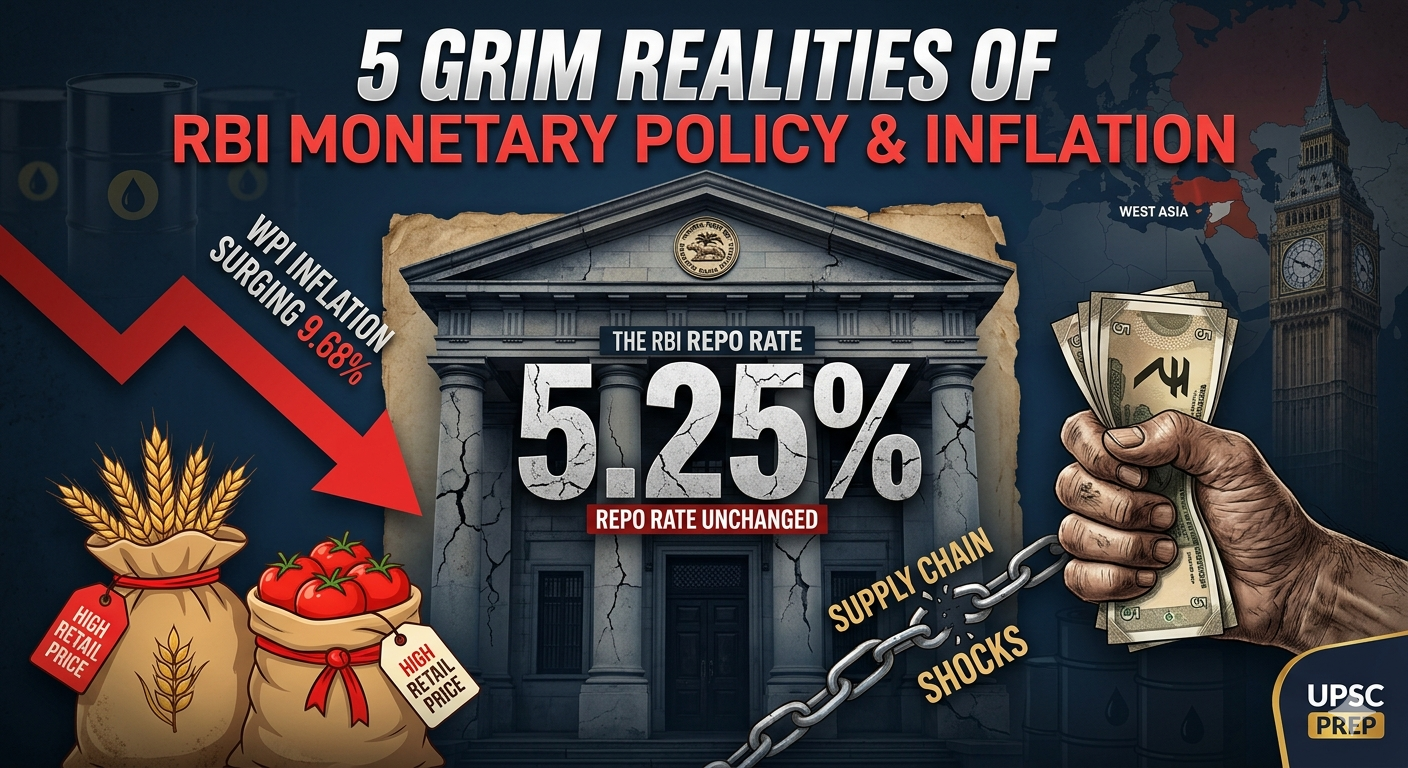
The central bank’s decision to pause rate hikes came alongside significant domestic price pressures. India’s Wholesale Price Index (WPI)-based inflation accelerated sharply to 9.68% year-on-year, driven heavily by spikes in mineral oils, crude petroleum, and manufactured metals. Concurrently, retail inflation measured by the Consumer Price Index (CPI) touched a 16-month high of 3.93%. The proximity of retail inflation to the medium-term target of 4% has forced the central bank to remain highly vigilant. The current framework of the RBI monetary policy aims to balance post-pandemic growth recovery with aggressive containment of supply-side price shocks without choking off systemic liquidity.
Key Macroeconomic Indicators at a Glance
| Indicator | Latest Figure (June 2026) | Significance for UPSC |
| Repo Rate | 5.25% (Unchanged) | Policy signal to commercial banking sectors |
| WPI Inflation | 9.68% | Shows producer-level input cost pressures |
| CPI Inflation | 3.93% | Reflects end-consumer retail burden |
| GDP Forecast (FY27) | 6.6% | Economic momentum amid global headwinds |
Economic Significance of the Policy Move
An unchanged repo rate signals that the central bank prefers stability over knee-jerk tightening. By keeping borrowing costs predictable, the RBI monetary policy supports ongoing corporate capital expenditure and domestic credit growth. However, the wider divergence between high wholesale inflation and rising retail prices points toward an incomplete pass-through of commodity costs to end consumers. In economics, this dynamic indicates that manufacturers are absorbing a major chunk of raw material costs, which might eventually squeeze corporate profit margins and slow down production lines across core industrial sectors.
Benefits of the Current Monetary Strategy
The primary advantage of a steady repo rate is the cushioning effect it offers to domestic businesses. It prevents a sudden rise in external commercial borrowing rates, ensuring that real estate, automobile, and manufacturing sectors retain operational momentum. Furthermore, the RBI monetary policy introduced innovative external measures, such as expanding the Fully Accessible Route (FAR) for foreign portfolio investments in government securities and relaxing individual investment caps for non-resident Indians. These strategic modifications are explicitly designed to attract foreign capital inflows, neutralize domestic currency depreciation, and build a robust foreign exchange cushion against global volatility.
Primary Concerns and Structural Bottlenecks
The foremost concern remains exogenous inflation fueled by the West Asia conflict. Brent crude prices averaging high levels significantly damage India’s import bill, because the nation imports over 80% of its crude requirements. When global supply chains fracture, the structural limits of the RBI monetary policy become apparent, as monetary tools are naturally less effective against supply-side disruptions. Additionally, localized food pressures such as a 48.4% surge in tomato prices and erratic monsoon projections threaten to un-anchor rural inflation expectations and weaken rural household consumption patterns.
Government and Regulatory Response
To augment monetary measures, the central government has aligned its fiscal policies to control essential commodity hoarding and optimize buffer stocks. While the RBI monetary policy manages systemic liquidity and currency defense through targeted dollar interventions, the executive wing focuses on supply-chain logistics and duty rationalization. The recent revision of the CPI base year to 2024 offers a more accurate representation of modern consumption bundles. Coordinated fiscal-monetary steps, such as temporary fuel or fertilizer subsidy cushions, help minimize fiscal slippages while protecting vulnerable populations from extreme inflationary cycles.
UPSC Angle: Analytical Insights for Mains
For General Studies Paper III (Indian Economy), aspirants must evaluate the fine balance between growth and inflation targeting. The mandate of the statutory Monetary Policy Committee (MPC) is to maintain price stability while keeping growth in mind. When writing answers, emphasize that the RBI monetary policy cannot work in isolation during geopolitical crises. Aspirants should discuss the limits of inflation targeting when price pressures originate from imported oil shocks rather than excessive domestic demand, highlighting the strategic shift toward a “neutral” policy stance rather than absolute hawkish tightening.
UPSC Nuggets: High-Yield Pointers
Monetary Policy Committee (MPC): Constituted under Section 45ZB of the amended RBI Act, 1934. It is a 6-member body with three internal members and three external members appointed by the Central Government.
Inflation Targeting Framework: India adopted a flexible inflation targeting (FIT) framework with a target of 4% +- 2%. The headline CPI is used as the primary anchor.
WPI vs. CPI: WPI measures price changes at the wholesale stage and does not capture services. CPI captures retail goods and services consumed by households. The base year for the newly revised WPI series is 2023, and the CPI has been updated to a 2024 base year.
Prelims and Mains Practice Questions
Prelims Question
Q. Consider the following statements regarding the Monetary Policy Committee (MPC):
- It is chaired ex-officio by the Union Finance Minister.
- It decides the RBI’s benchmark interest rates by a consensus, where the Governor has no veto or casting vote.
- Its decisions are legally binding on all commercial banks in India.
Which of the statements given above is/are correct? A) 1 and 2 only B) 3 only C) 1, 2, and 3 D) None of the above
- Answer: B) 3 only
- Explanation: The MPC is chaired ex-officio by the Governor of the RBI, not the Finance Minister. In case of a tie, the Governor enjoys a casting vote. The policy repo rate decided by the MPC serves as a mandatory benchmark for the banking system.
Mains Question
Q. “Exogenous shocks pose a severe limitation on the efficacy of domestic inflation targeting frameworks.” In light of the recent global disruptions, critically analyze the challenges faced by the RBI’s Monetary Policy Committee in balancing growth and price stability. (150 Words, 10 Marks)
8. Frequently Asked Questions (FAQs)
What is the primary focus of the latest RBI monetary policy?
The latest RBI monetary policy focuses on keeping the repo rate steady at 5.25% to sustain domestic growth momentum while implementing defensive capital control measures to stabilize the rupee against imported inflation.
Why is WPI inflation significantly higher than CPI inflation right now?
WPI is deeply sensitive to global input commodities like crude oil, base metals, and chemicals. Supply blockades raise these wholesale inputs immediately, whereas retail CPI increases at a slower pace because manufacturers delay passing the full burden onto consumers.
9. Conclusion
Navigating an economy through global supply chain fragmentation requires a delicate hand at the monetary helm. The latest iteration of the RBI monetary policy demonstrates a measured, cautious equilibrium safeguarding corporate credit pipelines while fortifying external sectors against currency depreciation. For UPSC civil services preparation, understanding these structural interlinkages between global geopolitical crises, domestic WPI jumps, and central banking tools forms the cornerstone of scoring well in macroeconomic questions.
To have a deep analysis over the topic of RBI monetary policy ,students can also refer to :
Link to an analysis of the West Asia Geopolitical Crisis and its energy impact on India.
Link to a detailed guide on the structure, evolution, and history of the Monetary Policy Committee.
Link to an evergreen explainer on the differences between CPI, WPI, and Core Inflation.