

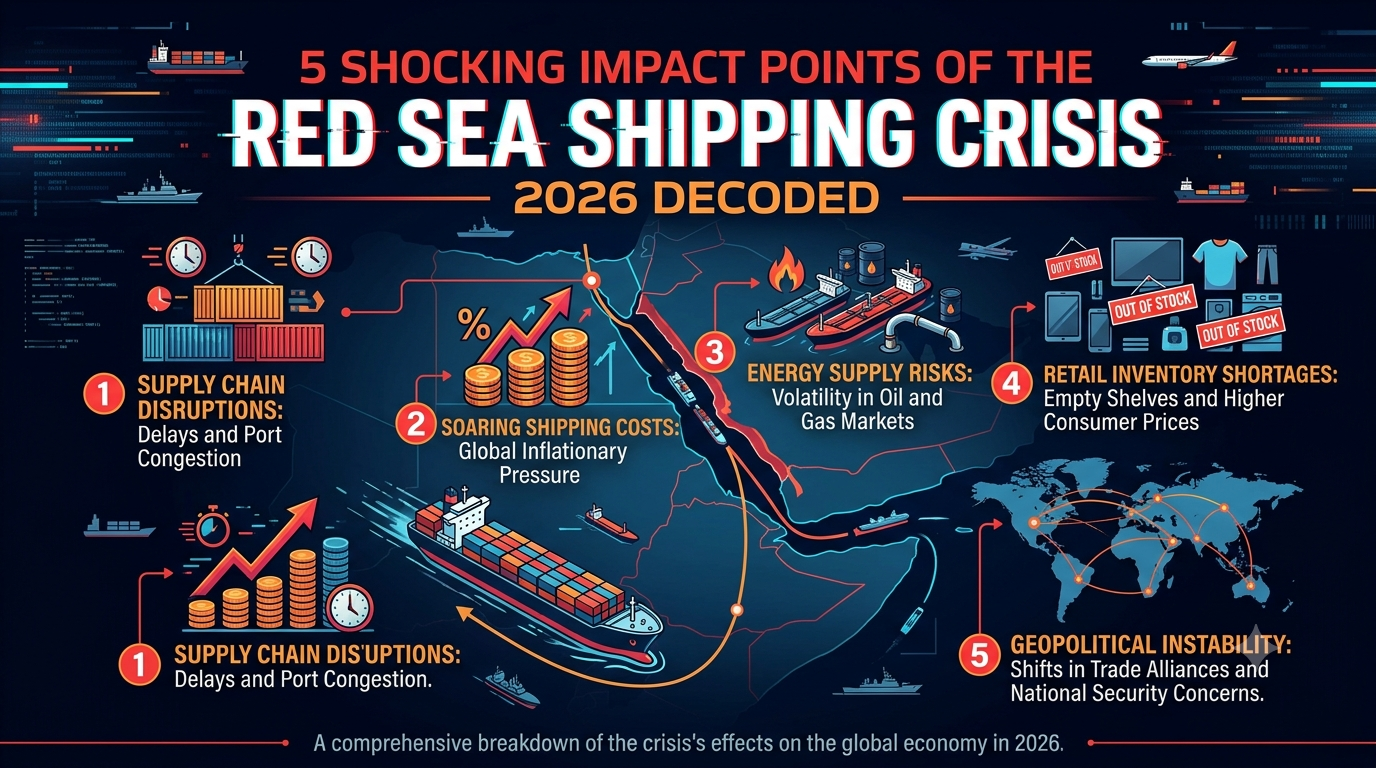
Introduction: The Tectonic Shift in Global Maritime Routes
Red Sea Shipping Crisis 2026: The global maritime trade landscape is experiencing one of its most severe disruptions in recent history. Escalating hostilities involving naval strikes, missile skirmishes, and drone warfare along the Bab-el-Mandeb Strait have sent shockwaves across global supply chains. For India, which relies heavily on Western sea lines of communication for both energy imports and merchandise exports, the ongoing situation represents a critical strategic challenge. Navigating these turbulent waters requires an analytical understanding of how maritime chokepoints dictate global economic stability.
Understanding the operational dynamics behind the Red Sea Shipping Crisis 2026 is now vital for policy analysts and competitive examination candidates alike.

1. Recent Development: What Happened in the Red Sea?
In recent weeks, repeated drone attacks and targeted missile strikes on commercial cargo vessels near the Bab-el-Mandeb Strait have forced major international shipping cartels to suspend passage through the Suez Canal route. Maritime insurance premiums have skyrocketed by over 300%, compelling logistics companies to re-route container ships around Africa’s Cape of Good Hope.
This detour adds approximately 3,500 to 4,000 nautical miles and 10 to 14 days of additional voyage time per transit. The compounded freight charges, elevated fuel consumption, and delayed vessel turnaround times have collectively triggered a worldwide logistical bottleneck.
Maritime Route Comparison:
* Suez Canal Route: ~18 Days (Mediterranean – Indian Ocean)
* Cape of Good Hope Route: ~30-32 Days (+3,500 Nautical Miles)
The cascading consequences of the Red Sea Shipping Crisis 2026 extend far beyond commercial shipping, directly threatening energy security across Asia and Europe.
2. Deep Dive Background: Why Bab-el-Mandeb Matters
The Bab-el-Mandeb Strait meaning “Gate of Tears” in Arabic is a narrow chokepoint situated between Yemen on the Arabian Peninsula and Djibouti and Eritrea in the Horn of Africa. Connecting the Red Sea to the Gulf of Aden and the Indian Ocean, it handles nearly 12% to 15% of total global seaborne trade, including roughly 8% of global liquefied natural gas (LNG) and 10% of global seaborne oil.
| Strategic Feature | Geographical / Trade Significance |
|---|---|
| Width at Narrowest | ~20 km (12 Nautical Miles) |
| Primary Waterway Link | Red Sea to Gulf of Aden / Indian Ocean |
| Global Trade Share | ~12%–15% of global maritime commerce |
| Primary Cargo Types | Crude Oil, Refined Petroleum, LNG, Food |
Historically, any instability around this maritime corridor compromises the efficiency of the Suez Canal. When passage through Bab-el-Mandeb becomes perilous, the entire Red Sea corridor ceases to be a viable trade route.
The historical fragility of this region underscores how vulnerable global commerce remains when alternative routes are limited during the Red Sea Shipping Crisis 2026.
3. Key Stakeholders Involved in the Conflict
The geopolitical chessboard surrounding the Red Sea features a complex blend of state actors, non-state militias, and international naval coalitions:
- State Actors: Regional nations adjacent to the Red Sea, alongside global superpowers dependent on uninterrupted maritime commerce.
- Non-State Militias: Insurgent groups operating along key coastlines, utilizing low-cost asymmetric tactics such as anti-ship cruise missiles and unmanned aerial vehicles (UAVs).
- International Naval Coalitions: Combined maritime task forces deployed to ensure freedom of navigation and protect commercial merchant vessels.
- Commercial Shippers & Insurers: Global maritime syndicates forced to recalibrate risk assessments, freight tariffs, and trade routes.

As conflict dynamics evolve, international law and maritime conventions are being tested by the realities of the Red Sea Shipping Crisis 2026.
4. Importance for India: Economic & Strategic Impact
India’s external trade footprint relies heavily on open sea routes through West Asia and Northern Africa. The current maritime turmoil impacts India across three main fronts:
Energy Security & Import Bills
India imports over 85% of its crude oil requirements. Delays in crude shipments from West Asia and Europe inflate landed costs and increase domestic fuel price volatility.
Export Competitiveness
Key Indian export sectors such as agriculture, textiles, engineering goods, and pharmaceuticals—face higher freight rates and extended shipping schedules to European and North American destinations.
Naval Diplomacy
The Indian Navy has increased its presence in the Arabian Sea and Gulf of Aden, deploying guided-missile destroyers to conduct anti-piracy patrols and escort merchant vessels.
Indian Trade Impact Highlights:
* Freight Costs: Increased by 40% – 60% on European sector
* Voyage Duration: Extended by 10-14 days via Cape of Good Hope
* Primary Sectors Affected: Textiles, Tea, Spices, Engineering Goods
Maintaining maritime stability in the Western Indian Ocean remains vital as India manages the economic effects of the Red Sea Shipping Crisis 2026.
UPSC Nuggets from Red Sea Shipping Crisis 2026 (Quick Revision Sheet)
- UNCLOS (1982): United Nations Convention on the Law of the Sea defines the legal status of territorial waters, contiguous zones, Exclusive Economic Zones (EEZ), and international straits.
- Right of Transit Passage: Applies to international straits like Bab-el-Mandeb, guaranteeing continuous and expeditious navigation for foreign ships.
- Operation Prosperity Guardian: A multinational security initiative established to safeguard maritime commerce in the Red Sea.
- Key Chokepoints to Remember:
- Strait of Hormuz: Persian Gulf <-> Gulf of Oman
- Bab-el-Mandeb: Red Sea <-> Gulf of Aden
- Suez Canal: Red Sea <-> Mediterranean Sea
- Strait of Malacca: Andaman Sea <-> South China Sea
5. UPSC Relevance: Prelims & Mains Angle (Red Sea Shipping Crisis 2026)
This issue connects directly to multiple areas within the UPSC Civil Services Examination syllabus:
Prelims Angle (GS Paper 1)
- Map-based questions testing geographical features surrounding the Red Sea (e.g., bordering countries: Egypt, Sudan, Eritrea, Djibouti, Yemen, Saudi Arabia).
- Identification of key maritime chokepoints, marine currents, and international waters.
Mains Angle (GS Paper 2 & GS Paper 3)
- GS Paper 2 (International Relations): Impact of West Asian instability on India’s strategic autonomy and foreign policy choices.
- GS Paper 3 (Economy & Security): Supply chain resilience, energy security, inflation dynamics, and maritime security in the Indian Ocean Region (IOR).
UPSC Syllabus Mapping:
* GS-II: India & its Neighborhood, Important International Institutions
* GS-III: Infrastructure (Ports, Shipping), Security Challenges in IOR
Candidates must analyze how structural maritime disruptions like the Red Sea Shipping Crisis 2026 influence India’s broader macroeconomic policy.
6. Key Takeaways & Way Forward (Red Sea Shipping Crisis 2026)
To build long-term maritime resilience against regional disruptions, India and global economies should focus on:
- Diversifying Trade Routes: Investing in alternative multi-modal corridors like the International North-South Transport Corridor (INSTC) and India-Middle East-Europe Economic Corridor (IMEC).
- Strengthening Naval Diplomacy: Expanding information-sharing mechanisms through the Information Fusion Centre – Indian Ocean Region (IFC-IOR).
- Domestic Strategic Reserves: Expanding Strategic Petroleum Reserves (SPR) to cushion against temporary seaborne supply shocks.
Developing robust strategic responses will remain essential as nations adjust to the realities of the Red Sea Shipping Crisis 2026.
Frequently Asked Questions from Red Sea Shipping Crisis 2026 (FAQs)
Q1. What is the Bab-el-Mandeb Strait, and why is it strategically vital?
The Bab-el-Mandeb Strait connects the Red Sea to the Gulf of Aden and the Indian Ocean. It acts as a critical gateway for vessels traveling between Asia and Europe via the Suez Canal.
Q2. How does maritime disruption in the Red Sea affect domestic inflation in India?
Longer transit times around Africa increase shipping costs, insurance premiums, and fuel usage. These extra costs raise import prices for raw materials and energy products, contributing to imported inflation.
Q3. What alternative maritime routes exist when the Red Sea is disrupted?
Vessels typically re-route around the Cape of Good Hope at the southern tip of Africa. While safer during Red Sea conflicts, this route adds significant time, distance, and operational cost.
Conclusion
The vulnerabilities exposed by ongoing maritime conflict demonstrate how fragile global trade networks remain. For India, safeguarding key trade corridors while pursuing strategic autonomy is crucial for long-term economic stability.
Understanding international maritime law, trade routes, and geopolitical chokepoints helps aspirants grasp how global developments directly shape domestic policy during the Red Sea Shipping Crisis 2026.