

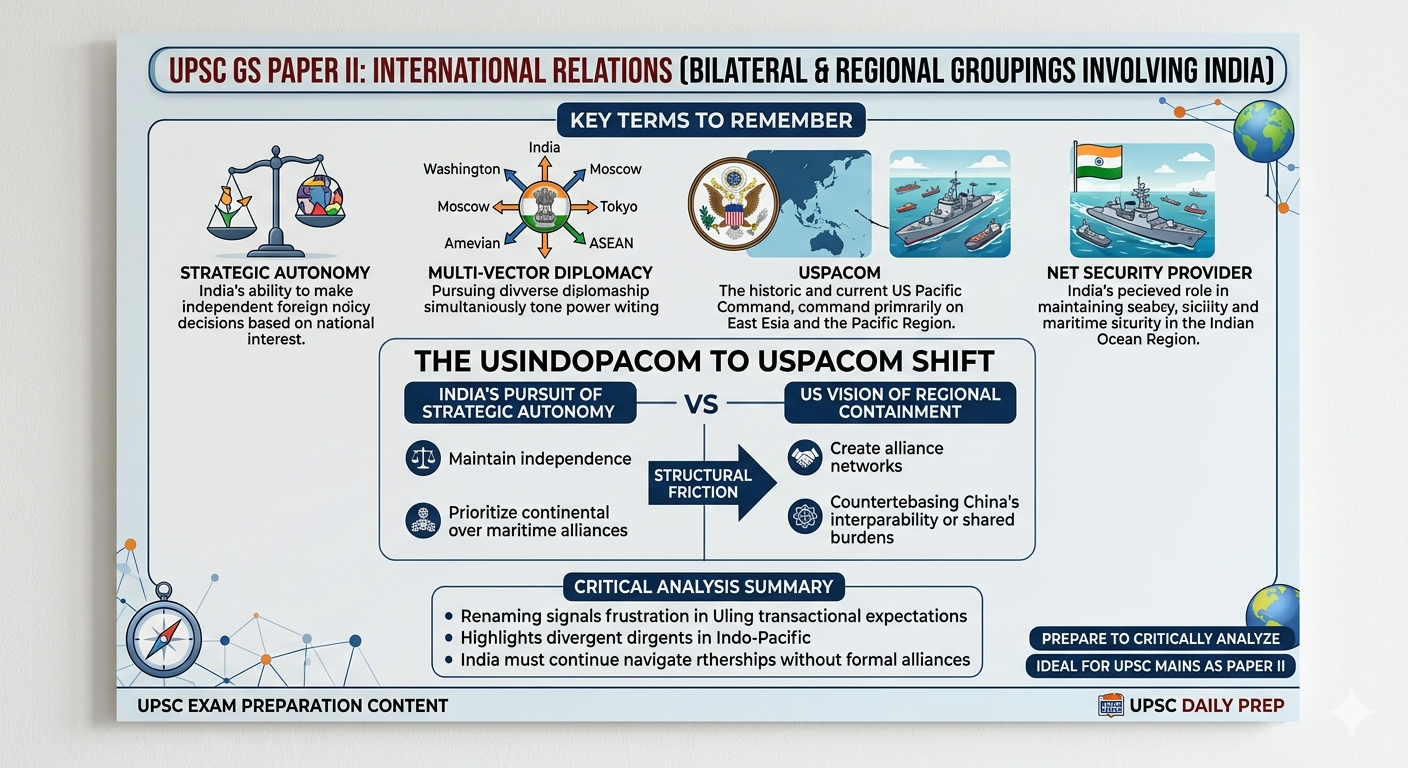
The geopolitical corridors of Washington and New Delhi have been hit by an administrative earthquake. In a surprising institutional turn, the Pentagon has officially decided to drop the “Indo-Pacific Command” label and restore its historic designation as the US Pacific Command (USPACOM). While the United States Department of Defense has downplayed this shift as a minor historical calibration rather than a structural pivot, geopolitical analysts are reading deep between the lines. This move directly impacts how the global community views the ongoing US Indo-Pacific strategy. 3 Shocking Reasons Behind USPACOM Renaming and Its Brutal Impact on US Indo-Pacific Strategy
For UPSC aspirants, this development is a goldmine for GS Paper II (International Relations). It challenges long-held assumptions regarding the strategic partnership between India and America. In this comprehensive breakdown, we will dissect why this renaming occurred, analyze the underlying friction points, and unpack the overarching consequences for India’s maritime sovereignty.
Recent Development: The Return to USPACOM
On June 19, 2026, the Pentagon confirmed it is restoring the USPACOM designation, reverting a landmark 2018 administrative rebranding that symbolised India’s elevation in American grand strategy. Officially, the military theater’s area of responsibility (AOR) remains untouched, extending from the Pacific shores of America to the western maritime borders of India. However, removing “Indo” from the command’s title signals an institutional reassessment of the US Indo-Pacific strategy.
The transition reflects growing transactionalism under the current US administration, raising doubts about whether India has delivered on its expected military and strategic commitments.
Historical Background: The “India Assumption”
To understand this shift, we must look back to 2018 when the US Pacific Command was renamed the US Indo-Pacific Command (USINDOPACOM). The primary catalyst was the meteoric rise of China’s economic, maritime, and technological footprints across the Indian Ocean Region (IOR). Washington heavily bought into the “India Assumption” the belief that India, with its massive population, rapid economic growth, and prime geographic position, would serve as the ultimate net security provider to anchor the US Indo-Pacific strategy.
Over the past eight years, billions of dollars flowed through defense corridors via foundational pacts like LEMOA, COMCASA, and BECA. Yet, strategic divergence remained highly visible.
The 3 Shocking Reasons Behind the Reassessment
The decision to rollback the name is not merely semantic; it points to structural friction between the two democracies. Here are the three primary reasons driving this change:
I. The Strategic Deliverables Deficit
Washington has increasingly grown frustrated with what it perceives as New Delhi’s hesitation to convert shared strategic rhetoric into joint military action. While India actively participates in the Quad and joint naval exercises, it maintains a strict policy of strategic autonomy, resisting any formal military alliance that binds it to a Western-led containment policy against Beijing. This reluctance has led American policymakers to question the utility of the US Indo-Pacific strategy.
II. Multi-Vector Diplomacy and Shifting Alignments
India’s foreign policy is inherently multi-aligned. New Delhi continues to cultivate robust ties with Russia and actively participates in organizations like the BRICS and the Shanghai Cooperation Organisation (SCO). The recent diplomatic maneuvers across Eurasia, coupled with India’s refusal to echo Western narratives on global conflicts, have signaled to Washington that India will not act as a transactional counterweight. This has forced a tactical pause in the US Indo-Pacific strategy.
III. Regional Interlocutors Re-emerging
Recent diplomatic developments in the Middle East and South Asia have altered Washington’s regional dependence. For example, Pakistan’s role as a key diplomatic facilitator between the US and Iran during the recent maritime standoffs has reminded American planners of alternative regional architectures. As a result, Washington no longer views India as the exclusive pillar of Asian stability, altering the calculus of the US Indo-Pacific strategy.
Key Stakeholders and Their Postures
The renaming ripples across multiple global capitals, each responding through distinct geopolitical lenses:
- United States: The Pentagon maintains that operational capabilities are unchanged, but political circles are clearly leaning toward a more transactional relationship with Asian partners.
- India: New Delhi remains confident in its indigenous naval expansion and multi-vector technology diplomacy, viewing its sovereignty as non-negotiable.
- China: Beijing views this institutional friction as a vindication of its stance that Western-led security architectures are fundamentally fragmented.
This divergence changes how middle powers engage with the US Indo-Pacific strategy.
Severe Impact on India and Strategic Implications
While the renaming does not diminish India’s geographic or economic weight, it signals a significant psychological shift. New Delhi must prepare for an American foreign policy that evaluates bilateral ties through direct, immediate returns rather than long-term strategic potential. This shifts the operational dynamics of the US Indo-Pacific strategy.
Crucially, defense co-production, technology transfers, and intelligence sharing under initiatives like iCET may face tougher scrutiny in Washington. India will have to increasingly rely on its internal capabilities, such as the India Semiconductor Mission, to build technological and economic resilience while managing maritime threats on its own. This reality check ensures India can withstand shifts in the US Indo-Pacific strategy.
UPSC Prelims and Mains Angle
Prelims Pointer
Focus on the geography of the command’s jurisdiction. USPACOM’s boundary runs from the west coast of the US to the western border of India. Keep an eye out for questions tracking maritime choke points like the Strait of Malacca, Sunda Strait, and Lombok Strait, which are core pillars of the US Indo-Pacific strategy.
Mains Pointer
When writing answers about Indo-US ties, avoid overly optimistic language. Balance your answers by explaining how India’s insistence on strategic autonomy sometimes clashes with Washington’s expectation of alliance-like commitments, a friction clearly mirrored in the evolution of the US Indo-Pacific strategy.
FAQs on USPACOM and Indo-Pacific Geopolitics
Q1: What is the main difference between USPACOM and USINDOPACOM?
Ans: Operationally, their geographical jurisdiction is identical. Politically, USINDOPACOM explicitly integrated India into America’s primary maritime defense nomenclature, whereas USPACOM focuses on the traditional Pacific theater.
Q2: Does this mean the Quad is defunct?
Ans: No. The Quad remains highly active, and defense technology cooperation continues. However, the renaming underscores a more transactional expectation from its members regarding the execution of the US Indo-Pacific strategy.
Q3: How should India respond to this change?
Ans: India will likely double down on its multi-vector technology diplomacy, local defense manufacturing, and deepening bilateral naval ties with like-minded regional partners like France, Japan, and ASEAN nations.
Conclusion
The renaming of the command back to USPACOM serves as a pragmatic reminder that in international relations, there are no permanent friends, only permanent interests. India’s quest for technological and maritime sovereignty means it will continue to walk the tightrope of strategic autonomy, choosing cooperation over alignment. As the geopolitical landscape of 2026 continues to fragment, New Delhi’s position within the US Indo-Pacific strategy will remain dynamic, demanding keen observation from every UPSC aspirant.