

The Supreme Court of India is often regarded as one of the most powerful constitutional courts in the world. At the heart of this extraordinary authority lies a single provision: Article 142 of the Indian Constitution. Designed by the framers to deliver “complete justice,” this provision allows the top court to pass any decree or order necessary to resolve a dispute. However, growing concerns regarding judicial overreach have sparked intense debate. Understanding Supreme Court Article 142 powers is crucial for anyone analyzing the balance between judicial intervention and the doctrine of separation of powers.
1. What is Article 142?
Article 142(1) of the Constitution of India empowers the Supreme Court to pass such decrees or make such orders as are necessary for doing “complete justice” in any cause or matter pending before it.
Article 142(1): “The Supreme Court in the exercise of its jurisdiction may pass such decree or make such order as is necessary for doing complete justice in any cause or matter pending before it…”
Unlike ordinary statutory powers restricted by procedural codes, Supreme Court Article 142 powers grant the judiciary an inherent mechanism to bypass legislative or administrative delays to protect fundamental rights and ensure equitable outcomes.
2. Historical Background and Evolution of Supreme Court Article 142 powers
During the Constituent Assembly debates, leaders like Dr. B.R. Ambedkar emphasized that the apex court must not be constrained by procedural technicalities when justice is at stake.
Initially, the judiciary exercised restraint, treating this power as supplementary to statutory laws. Over time, landmark rulings expanded its scope:
- Prem Chand Garg Case (1962): The Supreme Court ruled that orders under Article 142 must not directly violate explicit statutory provisions.
- Union Carbide Corporation Case (1991): The court held that its power under Article 142 is non-statutory and unlimited by existing laws, allowing it to bypass procedural statutes to provide immediate relief to victims.
- Supreme Court Bar Association Case (1998): The court clarified that Supreme Court Article 142 powers cannot override substantive statutory provisions; it can supplement law, not supplant it.
3. Key Features of Article 142
- Doing Complete Justice: Acts as an equitable remedy when existing statutory laws fall short or remain silent.
- Enforceability: Orders passed under Article 142 are enforceable throughout the territory of India in a manner prescribed by Parliament.
- Fact-Finding & Discovery: Article 142(2) grants the court power to secure the attendance of persons, discover documents, or punish for contempt.
- Inherent Power: It functions as a constitutional safety valve against systemic paralysis, ensuring that Supreme Court Article 142 powers remain an vital legal instrument.
4. Constitutional and Legal Basis for Supreme Court Article 142 powers
Article 142 sits within Part V (The Union) of the Constitution under Chapter IV (The Union Judiciary).
While Article 32 guarantees the right to constitutional remedies, Article 142 provides the practical mechanics to implement those remedies fully. However, it must be read alongside Article 141 (which makes Supreme Court judgments binding on all courts) and Article 144 (which mandates civil and judicial authorities to act in aid of the Supreme Court). The application of Supreme Court Article 142 powers reflects this integrated constitutional design.
5. Major Advantages of Article 142
- Fills Legislative Vacuums: When Parliament has not enacted legislation on critical social matters, the court steps in (e.g., Vishaka guidelines for workplace safety).
- Protecting Human Rights: Delivers rapid relief in environmental degradation and human rights violation cases.
- Flexibility: Adapts to complex, modern legal dilemmas where rigid procedural frameworks might fail.
- Institutional Accountability: Forces executive agencies to act in public interest using Supreme Court Article 142 powers.
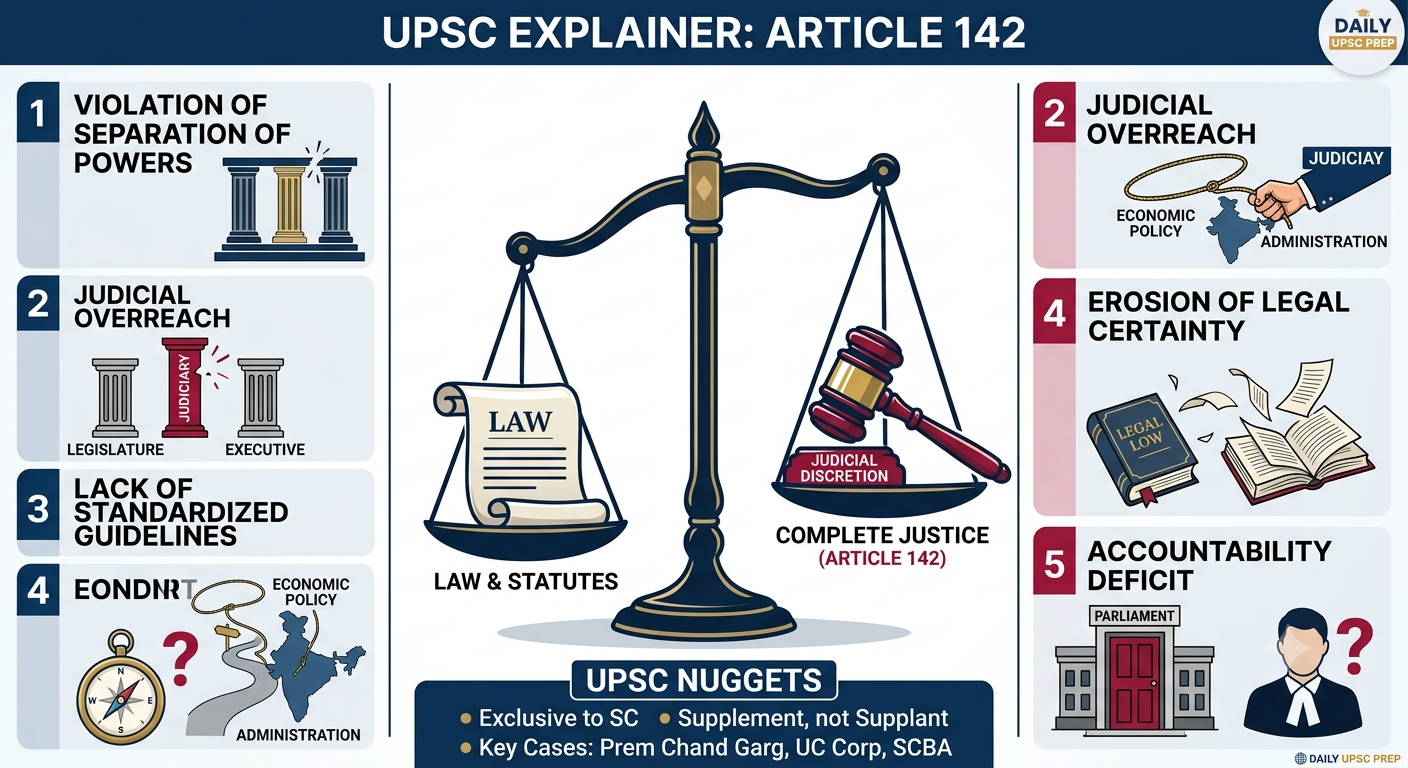
6. 5 Devastating Challenges and Concerns of Supreme Court Article 142 powers
Despite its utility, the unrestrained exercise of this power presents serious constitutional issues:
- Violation of Separation of Powers: Bypassing Parliament undermines the constitutional domain reserved for the legislature.
- Judicial Overreach: Arbitrary bans (such as the 2016 liquor ban along national highways) can cause severe economic disruptions.
- Lack of Standardized Guidelines: Absence of clear criteria leaves decisions vulnerable to judicial subjectivity.
- Erosion of Legal Certainty: When final statutes are routinely bypassed, legal predictability is compromised.
- Accountability Deficit: Unlike elected lawmakers, judges are not directly accountable to the electorate for policy outcomes generated by Supreme Court Article 142 powers.
UPSC Nuggets
- Prelims Pointer: Article 142 applies strictly to the Supreme Court of India. High Courts do not possess powers under Article 142 (though they possess inherent powers under Article 226 and Section 482 of CrPC/BNSS).
- Mains Keyword: Judicial Activism vs. Judicial Overreach, Separation of Powers, Rule of Law.
- Key Case Law: Shilpa Sailesh v. Varun Sreenivasan (2023) — The Supreme Court held that it can use Article 142 to grant a divorce on the ground of “irretrievable breakdown of marriage,” bypassing the mandatory waiting period under the Hindu Marriage Act.
7. Importance for UPSC Aspirants
Understanding Article 142 is critical across multiple GS papers:
- GS Paper II (Governance & Polity): Directly linked to topics like the Structure, Organization, and Functioning of the Judiciary, Separation of Powers, and Judicial Review.
- GS Paper IV (Ethics): Useful for analyzing judicial ethics, equity versus equality, and institutional integrity.
- Mains Answer Writing: Offers strong illustrative examples when discussing the fine line between judicial activism and judicial overreach, centered around Supreme Court Article 142 powers.
8. Summary Table: Key Judgments on Article 142
| Case Name | Year | Core Ruling / Significance |
| Prem Chand Garg v. Excise Comm. | 1962 | Article 142 cannot directly infringe upon Fundamental Rights or explicit statutes. |
| Union Carbide Corp. v. Union of India | 1991 | Article 142 operates beyond statutory prohibitions to ensure complete justice. |
| SC Bar Association v. Union of India | 1998 | Article 142 is supplementary; it cannot replace existing substantive laws. |
| Shilpa Sailesh v. Varun Sreenivasan | 2023 | SC can dissolve marriages directly under Article 142 on irretrievable breakdown grounds. |
9. Frequently Asked Questions (FAQs)
Q1. Can High Courts exercise powers under Article 142?
No, Article 142 is exclusively vested in the Supreme Court of India. High Courts exercise extraordinary writ jurisdiction under Article 226.
Q2. Is Article 142 superior to fundamental rights?
No, the Supreme Court has repeatedly affirmed that powers under Article 142 cannot override or abrogate Fundamental Rights guaranteed under Part III of the Constitution.
Q3. How does Article 142 relate to judicial overreach?
When the court uses Article 142 to make policy decisions or law-making interventions traditionally reserved for the executive or legislature, critics term it judicial overreach. The deployment of Supreme Court Article 142 powers must always balance necessity with judicial restraint.
10. Conclusion
Article 142 remains an essential tool for upholding equity, fairness, and fundamental rights in India’s constitutional framework. While it empowers the Supreme Court to remedy administrative inertia and legal gaps, its unbridled use risks weakening the doctrine of separation of powers. A balanced approach where judicial activism is tempered by self-restraint is essential to preserve constitutional harmony.