

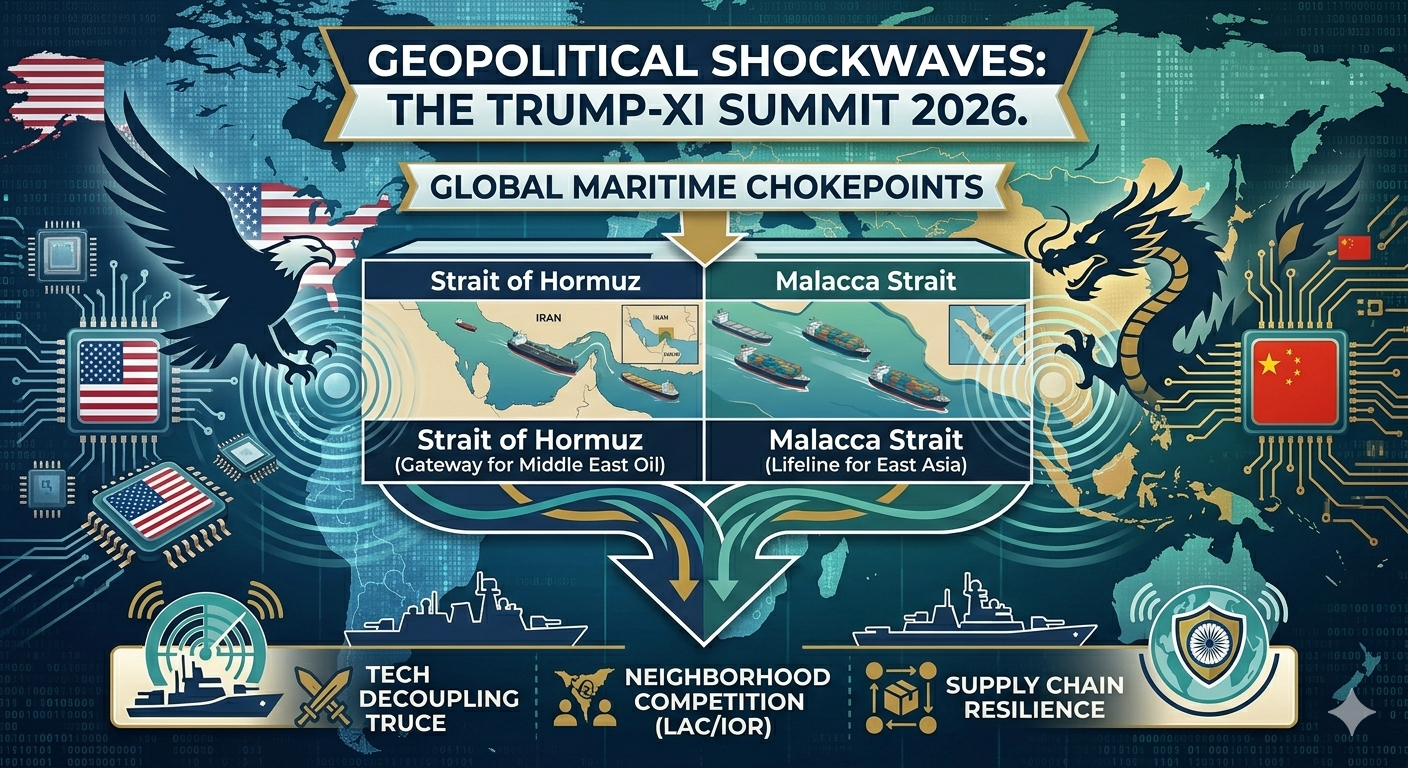
The world order just shifted on its axis. The Trump-Xi Summit 2026 in Beijing has sent seismic waves across the global diplomatic landscape, leaving foreign policy analysts scrambling. For anyone serious about decoding international relations, this isn’t just another bilateral meeting it is the blueprint of a shifting multipolar world. As global powers realign their economic and security strategies, the agreements made during the Trump-Xi Summit 2026 will dictate trade routes, tech decoupling, and maritime security for the next decade. If you are tracking GS Paper 2 or preparing for the upcoming civil services interview, ignoring this structural realignment is a luxury you cannot afford.
Let us dissect the three most critical dimensions of the Trump-Xi Summit 2026 and analyze exactly how these changes will impact India’s strategic autonomy and neighborhood foreign policy.
The Tech-Decoupling Truce and Supply Chain Resilience
For the past few years, the weaponization of critical technology has been the primary fault line between Washington and Beijing. However, the Trump-Xi Summit 2026 unexpected breakthrough came in the form of a partial “Tech Truce.” Both nations agreed to establish predictable boundaries regarding semiconductor export controls and AI governance.
While this sounds like a stabilization of ties, it actually accelerates a deeper, more structured fragmentation of global supply chains. For India, this means the “China Plus One” strategy is evolving. Global manufacturing giants are no longer just looking for an alternative out of panic; they are building institutional backups. The Trump-Xi Summit 2026 outcomes show that while the US and China want to avoid an outright economic meltdown, their deep-seated distrust remains unresolved.
India’s Production Linked Incentive (PLI) schemes must now pivot swiftly. We are entering an era where technology standards will be bifurcated. The semiconductor corridors discussed during the Trump-Xi Summit 2026 mean that middle powers like India, Japan, and South Korea must secure their own critical mineral supply chains without relying entirely on western standardizations or Chinese processing dominance.
📌 UPSC Nuggets: Strategic Alliances & Supply Chains
GS Paper 2 Relevance: Bilateral, regional, and global groupings and agreements involving India and/or affecting India’s interests.
Key Concept: Strategic Autonomy India’s historical policy of maintaining independent foreign policy choices without aligning permanently with any single superpower bloc.
Prelims Pointer: Keep a close eye on the Supply Chain Resilience Initiative (SCRI) launched by India, Japan, and Australia to counter China’s dominance, and how it interlocks with the Quad’s Critical and Emerging Technologies Working Group.
2. The Maritime Trade Conundrum: Indo-Pacific vs. The Strait of Hormuz
Geopolitics is fundamentally driven by geography and trade security. During the Trump-Xi Summit 2026, intense closed-door negotiations took place regarding freedom of navigation in the South China Sea and stabilizing commercial shipping lanes. Interestingly, this summit coincided with rising anxieties surrounding the Strait of Hormuz crisis, making maritime choke points the focal point of global discussions.

China’s aggressive naval expansion and its ‘String of Pearls’ strategy in the Indian Ocean continue to challenge India’s position as a net security provider. The Trump-Xi Summit 2026 clearly demonstrated that the US is willing to negotiate bilateral maritime red lines with China to protect its own commercial interests. This leaves India with a critical realization: we cannot rely solely on external security umbrellas like the Quad to manage our immediate maritime neighborhood.
As the Trump-Xi Summit 2026 recalibrates the balance of power in East Asia, India must double down on its SAGAR (Security and Growth for All in the Region) initiative. Deepening naval partnerships with ASEAN nations and expanding logistics agreements in the western Indian Ocean are no longer optional they are essential countermeasures to safeguard our exclusive economic zones.
The Neighborhood Impact: De-escalation or Deception?
The spiciest takeaway from the Trump-Xi Summit 2026 is the subtle shift in regional balance. When Washington and Beijing find a transactional equilibrium, smaller South Asian countries immediately feel the pull. Historically, nations like Bangladesh, Sri Lanka, and the Maldives have played the US and China off each other to secure infrastructure funding.
With the Trump-Xi Summit 2026 establishing a temporary status quo between the superpowers, China is expected to refocus its diplomatic and economic capital on its ‘Neighbourhood First’ competitive ring. The China-Pakistan Economic Corridor (CPEC) and investments in Myanmar are likely to see a strategic push as Beijing seeks to secure alternative overland energy routes that bypass contested waters.
For an Indian civil services aspirant, analyzing this requires looking past the surface-level press releases of the Trump-Xi Summit 2026. A temporary peace between global superpowers often results in localized gray-zone warfare. India’s border management along the Line of Actual Control (LAC) and our diplomatic outreach in South Asia must remain hyper-vigilant. If the US scales back its active pushback against China in exchange for trade concessions, India could face asymmetric pressure along its continental boundaries.
The Mains Answer Writing Perspective: Structuring the Realignment
When writing an answer on global polarization or bilateral summits, avoid taking a simplistic partisan view. The Trump-Xi Summit 2026 is not a sign of absolute peace, nor is it the start of a cold war; it is a manifestation of competitive coexistence.
To score high marks in your descriptive answers, use the framework of the “Tragedy of Great Power Politics” while highlighting India’s pragmatic alignment. The Trump-Xi Summit 2026 proves that in modern diplomacy, nations can be economic partners while remaining structural adversaries. India’s foreign policy must mirror this realism by strengthening domestic manufacturing while keeping diplomatic channels open with all major global poles.
📝 UPSC Nuggets: Mains Answer Writing Value Addition
Keyword for Mains Enrichment: Minilateralism The transition from massive, rigid global institutions (like the UN) to smaller, targeted groupings (like the Quad, I2U2) to solve specific security and economic challenges.
Historical Parallel: Compare the current US-China dynamics with the 1972 Nixon-Mao rapprochement, analyzing how superpower updates fundamentally alter India’s strategic math.
Quote to Use: “In international relations, there are no permanent friends or permanent enemies, only permanent interests.” Lord Palmerston.
The Way Forward for India’s Foreign Policy
Ultimately, the Trump-Xi Summit 2026 serves as a stark reminder that the global order is transactional. India’s path forward lies in enhancing its internal economic strength achieving Atmanirbhar Bharat while acting as a bridge between the Global South and the developed world.
As the dust settles on the Trump-Xi Summit 2026, New Delhi must continue to diversify its defense acquisitions, build robust regional digital public infrastructures, and ensure that our continental and maritime borders are fiercely protected. The global power play has entered a complex new phase, and India must play its cards with calculated precision.
For such current affair updates and UPSC preparation stay tune with dailyupscprep.in