

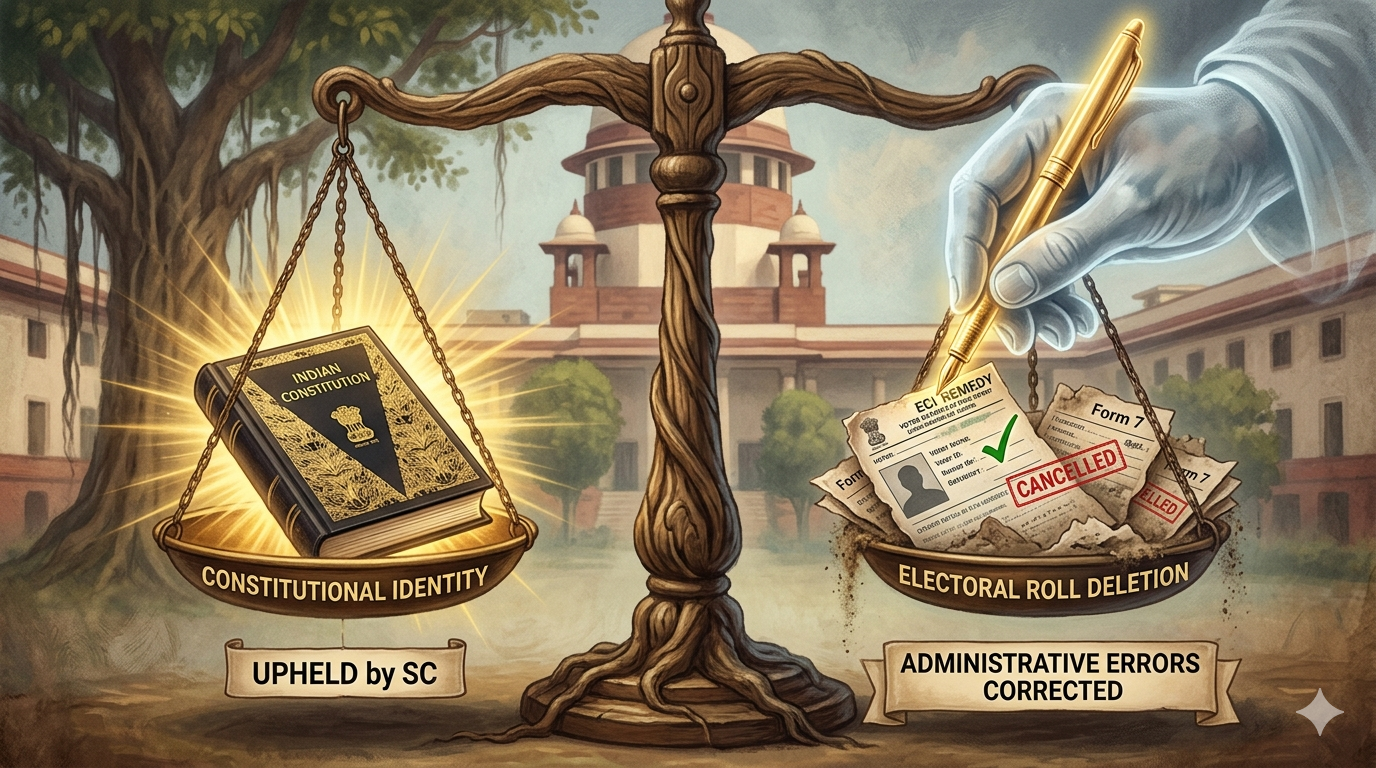
ECI’s electoral rolls are the foundation of India’s democratic process, yet for thousands of citizens, errors in these records can turn voting day into a nightmare. Imagine spending months preparing for the civil services examination, mastering every nuance of constitutional law, only to walk up to your local polling booth and find your name missing from the electoral roll. This is not a hypothetical scenario but a harsh reality many Indians face. In a landmark judgment, the Supreme Court of India recently clarified that mere non-inclusion or deletion from the electoral roll does not automatically extinguish an individual’s citizenship status, reinforcing critical constitutional protections for voters.
For any serious aspirant, tracking this development is critical. This historic ruling directly intersects with key parts of the UPSC syllabus, specifically Indian Polity, Governance, and the evolving dynamics of Fundamental Rights. In this detailed analysis, we break down why this specific verdict is a game-changer for the Indian democratic fabric and how the Election Commission of India (ECI) must now adapt to safeguard the UPSC CSE preparation ecosystem of active citizen awareness.
The Core Legal Issue: Citizenship vs. Electoral Enrollment
The highest court addressed a long-standing point of friction regarding the verification of a person’s legal identity within India. In its detailed breakdown, the bench clarified that the database maintained for the electoral rolls serves a specific administrative function, it is a mechanism for exercising the franchise, not a definitive registry for determining national identity or stripping an individual of their native status.

The distinction drawn between a citizen’s constitutional standing and their inclusion in local voting rosters is vital for your UPSC CSE preparation notebooks. The court strongly emphasized that administrative lapses, systemic errors, or clerical omissions by regional verification officers cannot be used as a tool to question an individual’s deep-rooted legal connection to the sovereign state. This distinction strengthens the shield around personal liberty and checks the arbitrary exercise of local bureaucratic authority.
The Directives to the Election Commission: Active Remediation Needed
While confirming that the Supplementary Invalidation Rules remain valid for keeping the database organized, the Supreme Court placed a heavy responsibility on the ECI. The poll body cannot simply look away when a legitimate voter finds themselves disenfranchised due to a sudden or unexpected deletion process. The court ruled that the ECI must establish clear, fast-track redressal windows to assist individuals whose names were mistakenly scrubbed from the active rolls.
For students focusing heavily on their UPSC CSE preparation, this underlines a major shift toward responsive governance. The judgment states that the ECI needs to actively help deleted voters restore their credentials, rather than forcing them through exhausting, multi-layered bureaucratic channels. This brings institutional accountability directly to the forefront of our discussions on electoral management.
UPSC Nuggets: The Daily Flashpoint
Core Fact Check for GS Paper II
- Constitutional Article: Article 324 grants the superintendence, direction, and control of elections to the ECI, while Article 326 establishes adult suffrage.
- Key Distinction: Electoral rolls are governed under the Representation of the People Act, 1950 (registration of voters) and the Representation of the People Act, 1951 (conduct of elections).
- Judicial Precedent Link: This ruling directly builds upon Anoop Baranwal v. Union of India (2023), reinforcing institutional transparency and protecting citizens from structural exclusion.
Strategic Mains Answer Writing Structural Frame
When writing an answer on electoral reforms or judicial activism, remember to structure your thoughts clearly to maximize your marks:
- Introduction: Briefly state the recent Supreme Court stance highlighting that electoral roll exclusion does not equal citizenship termination.
- Body Paragraph I: Discuss the administrative powers of the ECI vs. the constitutional rights of an eligible citizen.
- Body Paragraph II: Analyze the impact of this ruling on regional stability, trust in democratic institutions, and civil registry systems.
- Conclusion: Conclude with a balanced way forward emphasizing tech-driven, transparent correction windows to minimize structural errors.
Keeping these specific frameworks handy will keep your active UPSC CSE preparation fully aligned with the expectations of the evaluation board.
Why This Matters for the Interview Stage
In the personality test, the panel often looks for your ability to balance administrative efficiency with the protection of citizen rights. If asked about the challenges of managing large-scale national databases, you can confidently cite this case to show that while data cleanup is necessary, it must always feature a robust safety net. True democratic governance ensures that no valid voice is silenced by a clerical error.
A deep understanding of these institutional dynamics forms the foundation of a comprehensive UPSC CSE preparation strategy. Staying updated with daily constitutional developments is what separates an average answer from an exceptional, top-ranking response.
Summary of Key Takeaways
| Feature | Earlier Practice / Perception | New Supreme Court Mandate |
| Roll Exclusion | Often used as an excuse to question native status or identity. | Declared strictly administrative; does not impact citizenship status. |
| ECI Responsibility | Onus of proof and re-registration rested mostly on the individual. | ECI must actively provide easy correction facilities. |
| Systemic Checks | High tolerance for clerical mistakes during database cleaning. | Stresses that administrative processes cannot override basic rights. |
Using these concise reference points to organize your study notes will streamline your UPSC CSE preparation and help you review complex judicial decisions quickly before the exam.
Final Thoughts for Aspirants
As you navigate the complex terrain of current affairs, remember that landmark rulings are never just isolated news stories. They are living updates to the constitutional framework you are studying to manage. Pay close attention to how the Election Commission rolls out these correction systems in the coming months, as practical implementation details are highly favored by paper setters.
Keep refining your notes, stay analytical, and ensure that your comprehensive UPSC CSE preparation captures both the letter and the spirit of our changing laws.
For such important current affairs and information stay tuned with dailyupscprep.in