

Introduction & Recent Development
The integrity of public competitive examinations in India faces a critical test following a wave of widespread paper leak scandals. In response to growing public anxiety and student protests, the Union Cabinet, chaired by the Prime Minister, officially approved a critical draft legislation on July 24, 2026. This newly cleared legislation, known as the Public Examinations Amendment Bill 2026, seeks to plug existing legal loopholes and introduce severe criminal penalties against organized examination mafias.
Context: The Public Examinations Amendment Bill 2026 aims to drastically update existing statutory provisions by tightening penal action, introducing fast-track trial mechanisms, and ensuring institutional accountability across central recruitment and entrance tests.
The government plans to table the Public Examinations Amendment Bill 2026 during the ongoing session of Parliament to reassure millions of aspirants across the country.
Background: Evolution of Anti-Paper Leak Laws
Paper leaks in competitive examinations degrade meritocracy and impose devastating financial and psychological costs on millions of young aspirants. Historically, public examinations relied on fragmented state laws or provisions within general criminal codes like the Indian Penal Code (IPC) and the Bharatiya Nyaya Sanhita (BNS).
To create a dedicated national legal framework, Parliament previously enacted the Public Examinations (Prevention of Unfair Means) Act, 2024. While that statutory framework laid down initial definitions for “unfair means” and established basic penalties, subsequent high-profile exam leaks highlighted enforcement gaps and delays in trials. Organized crime syndicates exploited digital vulnerabilities, administrative leaks, and slow judicial processes to operate with relative impunity.
Recognizing these vulnerabilities, the Cabinet drafted the Public Examinations Amendment Bill 2026 to reinforce administrative deterrence and ensure swift judicial disposal of examination fraud.

Key Provisions of the Public Examinations Amendment Bill 2026
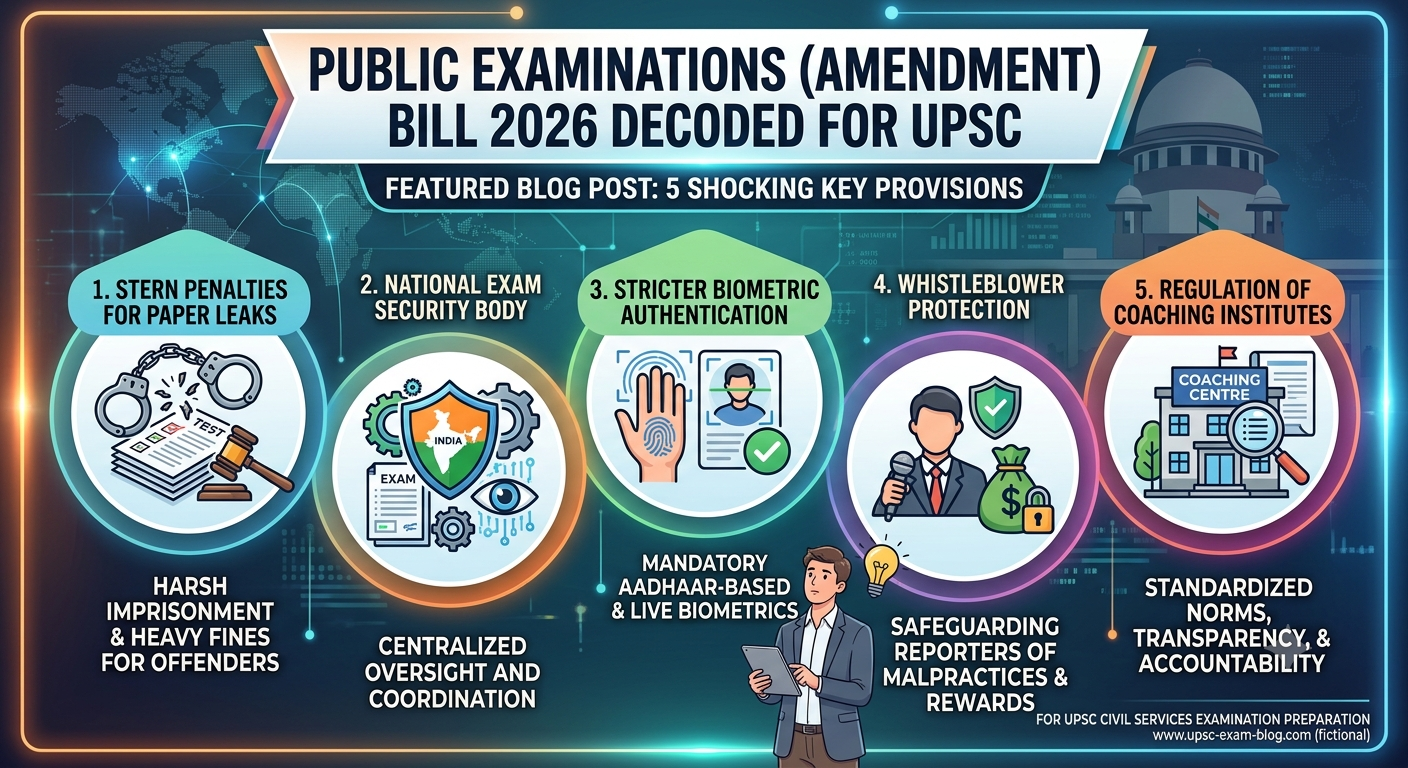
The Cabinet-cleared proposal introduces five major structural changes designed to dismantle organized paper-leak networks:
1. Enhanced Statutory Penalties
The proposed legislation elevates paper leaking and organized exam fraud to serious non-bailable, cognizable offences. Under the Public Examinations Amendment Bill 2026, individuals involved in organized paper leak syndicates face up to 10 years of rigorous imprisonment and fines reaching up to ₹1 crore.
2. Fast-Track Judicial Framework
A major bottleneck in deterrent justice has been prolonged litigation. The Public Examinations Amendment Bill 2026 mandates the creation of dedicated fast-track courts to handle examination fraud cases within stipulated timeframes.
3. Corporate and Service Provider Liability
If testing agencies or private technology partners are found complicit in compromised security, the Public Examinations Amendment Bill 2026 allows for blacklisting, heavy monetary penalties, and recovery of exam conduct costs from the defaulting entity.
4. Technologically Secure Examination Infrastructure
The Public Examinations Amendment Bill 2026 incorporates mandatory national standards for question paper encryption, biometric access logs, and real-time CCTV audit trails across all recognized exam centers.
5. Protection for Honest Candidates
The Public Examinations Amendment Bill 2026 explicitly differentiates between organized racketeers and genuine candidates, protecting honest students from unnecessary criminalization while focusing punitive action on systemic offenders.
Stakeholder Analysis
| Stakeholder | Key Impact / Role under the Bill |
| Aspirants / Students | Restores faith in meritocracy; provides predictable timelines for grievance redressal. |
| Exam Conducting Bodies (UPSC, NTA, SSC) | Mandates strict auditing standards, cyber security checks, and vendor oversight. |
| Private Tech Vendors | Enforces strict legal liability and severe financial penalties for security lapses. |
| Law Enforcement | Grants clear jurisdictional powers to investigate organized inter-state paper leak syndicates. |
The passage of the Public Examinations Amendment Bill 2026 is expected to fundamentally alter how third-party vendors interact with central examination agencies.
Impact on India’s Governance and Administrative Framework
The socio-economic consequences of paper leaks extend far beyond academic delays. They paralyze public recruitment, drain state resources through repeated re-examinations, and damage institutional trust.
By introducing strict legislative oversight, the Public Examinations Amendment Bill 2026 reinforces administrative transparency and good governance (GS Paper 2). Furthermore, establishing fast-track courts under the Public Examinations Amendment Bill 2026 reduces judicial backlog and ensures swift accountability, sending a clear warning to organized crime syndicates operating across state borders.
UPSC Nuggets (Exam-Ready Essentials)
- Nodal Ministry: Ministry of Personnel, Public Grievances and Pensions / Ministry of Education.
- Key Law Amended: Public Examinations (Prevention of Unfair Means) Act, 2024.
- Constitutional Provisions:
- Article 320: Functions of Public Service Commissions (UPSC/SPSCs).
- Seventh Schedule: Education (Concurrent List), Public Order (State List).
- Major Penalty Provision: Imprisonment up to 10 years and fines up to ₹1 crore for organized leak networks under the Public Examinations Amendment Bill 2026.
- Judicial Speed: Establishment of specialized fast-track courts for exam fraud trials.
UPSC Relevance: Prelims & Mains Angle
Prelims Angle
- Questions on the statutory powers of central agencies conducting examinations.
- Difference between cognizable/non-bailable offences under the Public Examinations Amendment Bill 2026 versus general criminal code provisions.
- Constitutional authority of Parliament to legislate on examinations under the Concurrent List.
Mains Angle (GS Paper 2 & GS Paper 4)
- GS Paper 2 (Governance): “Evaluate how the Public Examinations Amendment Bill 2026 addresses structural vulnerabilities in public service recruitment.”
- GS Paper 4 (Ethics): “Examine the ethical implications of systemic paper leaks on public trust and administrative integrity.”
Frequently Asked Questions (FAQs)
Q1. What is the primary objective of the Public Examinations Amendment Bill 2026?
The Public Examinations Amendment Bill 2026 aims to curb organized paper leaks, mandate fast-track courts, and impose stringent penal consequences on exam racketeers to protect meritocracy in public examinations.
Q2. Does the bill penalize student candidates directly?
The Public Examinations Amendment Bill 2026 focuses primarily on organized syndicates, cheating rings, complicit officials, and service providers rather than punishing honest candidates caught in administrative disruptions.
Q3. Which examinations fall under the purview of this law?
Public examinations conducted by central agencies like UPSC, SSC, RRBs, NTA, and IBPS come directly under the scope of the Public Examinations Amendment Bill 2026.
Conclusion & Way Forward
The Union Cabinet’s approval of the Public Examinations Amendment Bill 2026 represents a crucial legislative step toward restoring institutional credibility to competitive examinations. However, legislative measures must be accompanied by robust technological infrastructure, cyber security audits, and administrative vigilance to permanently eliminate paper leaks.