

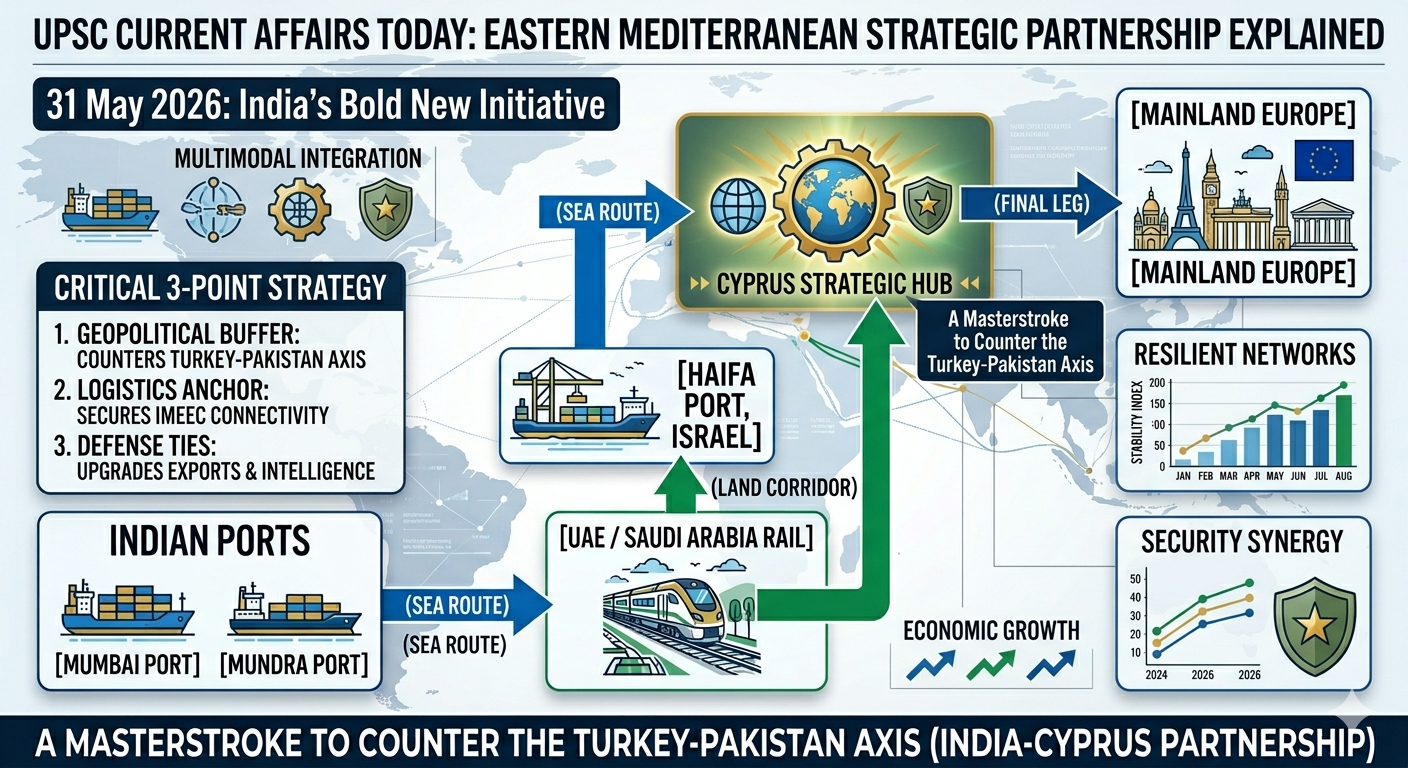
For UPSC current affairs today geopolitics is a game of shifting sands, and India has just made a decisive move on the global chessboard. During a high-profile state visit this month, New Delhi and Nicosia officially upgraded their bilateral ties. It is a calculated move that establishes an Eastern Mediterranean strategic partnership to safeguard India’s rising global ambitions.
For civil services aspirants, preparing for UPSC current affairs today this is not just another bilateral meeting to memorize for Prelims. This development carries massive weight for GS Paper II (International Relations) and GS Paper III (Security). As the global order fragments, India is aggressively expanding its strategic footprint beyond conventional boundaries. This historic agreement signals a dramatic shift in how New Delhi views its extended neighborhood and its maritime security.
Entering the Eastern Mediterranean Theater: Key Events, Strategic Importance, and Historical Impact
For decades, India’s primary maritime focus remained strictly confined to the Indian Ocean Region (IOR) and the immediate Indo-Pacific. However, the creation of an Eastern Mediterranean strategic partnership completely rewrites that playbook. By formally aligning with Cyprus, India is intentionally positioning itself in one of the most volatile and hyper-contested maritime choke points in the world.
The Eastern Mediterranean Theater became a major conflict zone due to its strategic location connecting Europe, Asia, and Africa. Control over this region was important for trade routes, military operations, and political influence. Key events included naval battles, territorial invasions, and alliances between regional and global powers. Its importance shaped military strategies and influenced the broader outcome of historical conflicts.
[Indo-Pacific Footprint] ──► [West Asian Corridors] ──► [Eastern Mediterranean Foothill]
This geographic leap is a direct response to India’s expanding economic and trade footprints. The Mediterranean is no longer a distant sea; it is an active theater where Indian interests must be defended. By establishing deep institutional ties here, New Delhi is ensuring that its voices and commercial ships cannot be easily blockaded by hostile regional actors. This could be a important topic for UPSC current affairs today
A Direct Counterbalance to the Turkey-Pakistan Axis: Strategic Significance and Regional Impact
In international relations, the enemy of your enemy is a vital partner. For years, Turkey has consistently used global forums to criticize India’s domestic policies, particularly concerning Kashmir, while actively strengthening its military and political alliance with Islamabad. Building an Eastern Mediterranean strategic partnership is India’s sophisticated diplomatic response to this hostile posture. Important thing you need to understand for UPSC current affairs today is :
Strategic Note: Just as China attempts to encircle India via the “String of Pearls” in the Indian Ocean, India is deploying a “reverse encirclement” strategy by embedding itself firmly in Turkey’s backyard.
Cyprus has long faced severe territorial pressures and geopolitical tensions from Ankara. By upgrading this relationship, India provides Nicosia with an economic and defense heavyweight ally, while simultaneously securing a stable base of operations to monitor and neutralize the diplomatic maneuvers of the Turkey-Pakistan axis.
Charging Up the IMEEC and Maritime Logistics
You need to know for UPSC current affairs today that the success of the ambitious India-Middle East-Europe Economic Corridor (IMEEC) depends entirely on secure, predictable, and resilient sea lanes. The formalization of an Eastern Mediterranean strategic partnership serves as a crucial anchor for this multi-modal transport network. Cyprus occupies a sweet spot at the crossroads of shipping lanes connecting Asia, Africa, and Europe.

As global supply chains face constant disruptions in the Red Sea and Babel-Mandeb straits due to non-state actors, India requires robust alternative transit hubs. Integrating Cyprus into India’s Indo-Pacific Oceans Initiative (IPOI) under the “Trade, Connectivity, and Maritime Transport” pillar creates a seamless security umbrella for Indian goods entering mainland European markets.
Upgrading Defense Exports and Strengthening Domestic Industrial Ties
In UPSC current affairs today, This partnership goes far beyond signed papers and pleasant handshakes; it is backed by serious hardware. The establishment of an Eastern Mediterranean strategic partnership includes a comprehensive defense cooperation framework linking the Cyprus Defence and Space Industries Cluster (CyDSIC) directly with the Society of Indian Defence Manufacturers (SIDM).
Cyprus has explicitly expressed immense interest in procuring cutting-edge Indian defense systems, including indigenous drones and advanced missile systems. This aligns perfectly with India’s domestic push for Aatmanirbharta (self-reliance) in defense manufacturing and its goal to emerge as a leading global exporter of security equipment. This defense dimension adds hard muscle to what was previously a purely diplomatic relationship and is again important for UPSC current affairs today.
Combatting Round-Tripping and Modern Security Threats
Beyond the high-seas diplomacy in UPSC current affairs today, this geopolitical realignment also addresses critical economic and asymmetric vulnerabilities. The evolving Eastern Mediterranean strategic partnership tackles economic security by actively revising the Double Taxation Avoidance Agreement (DTAA) to eliminate harmful “round-tripping” practices where domestic funds are disguised as foreign direct investment to evade taxes.
Simultaneously, both nations have set up a specialized Joint Working Group on Counter-Terrorism and a dedicated Cybersecurity Dialogue. In an era where warfare is fought as much in cyberspace as on the battlefield, sharing real-time intelligence on cross-border terror networks and critical infrastructure protection forms the invisible bedrock of this trans-regional alliance.
UPSC Nuggets: Core Syllabus Pointers
o help you structure this topic effectively for your UPSC current affairs today, here is a breakdown of how this development integrates directly into the UPSC syllabus:
Mains analytical Framework (GS Paper II & III)
- Extended Neighborhood Policy: Analyze how India is shifting from a reactive diplomatic posture to proactive “thematic alignments” in regions like the Mediterranean.
- The Turkey-Pakistan Factor: Evaluate how India uses bilateral strategic partnerships with micro-states (like Cyprus or Armenia) to effectively neutralize hostile voting blocs at the United Nations.
- Maritime Domain Awareness (MDA): Detail how stretching Indian naval and logistics collaboration into the Mediterranean helps build comprehensive supply-chain resilience.
The Way Forward for India’s Foreign Policy
For UPSC current affairs today you need to know India navigates a highly polarized multipolar world, it can no longer rely on passive neutrality. The concrete realization of an Eastern Mediterranean strategic partnership proves that New Delhi is willing to venture far out of its traditional geographic comfort zones to secure its economic and political sovereignty.
By weaponizing defense exports, integrating digital payment architectures like the Unified Payments Interface (UPI) with European systems, and building resilient trade choke points, India is successfully crafting an elegant counterbalance to regional adversaries. For future civil servants, tracking how this Mediterranean gambit unfolds will be absolutely crucial as India continues to project its power onto the global stage.