

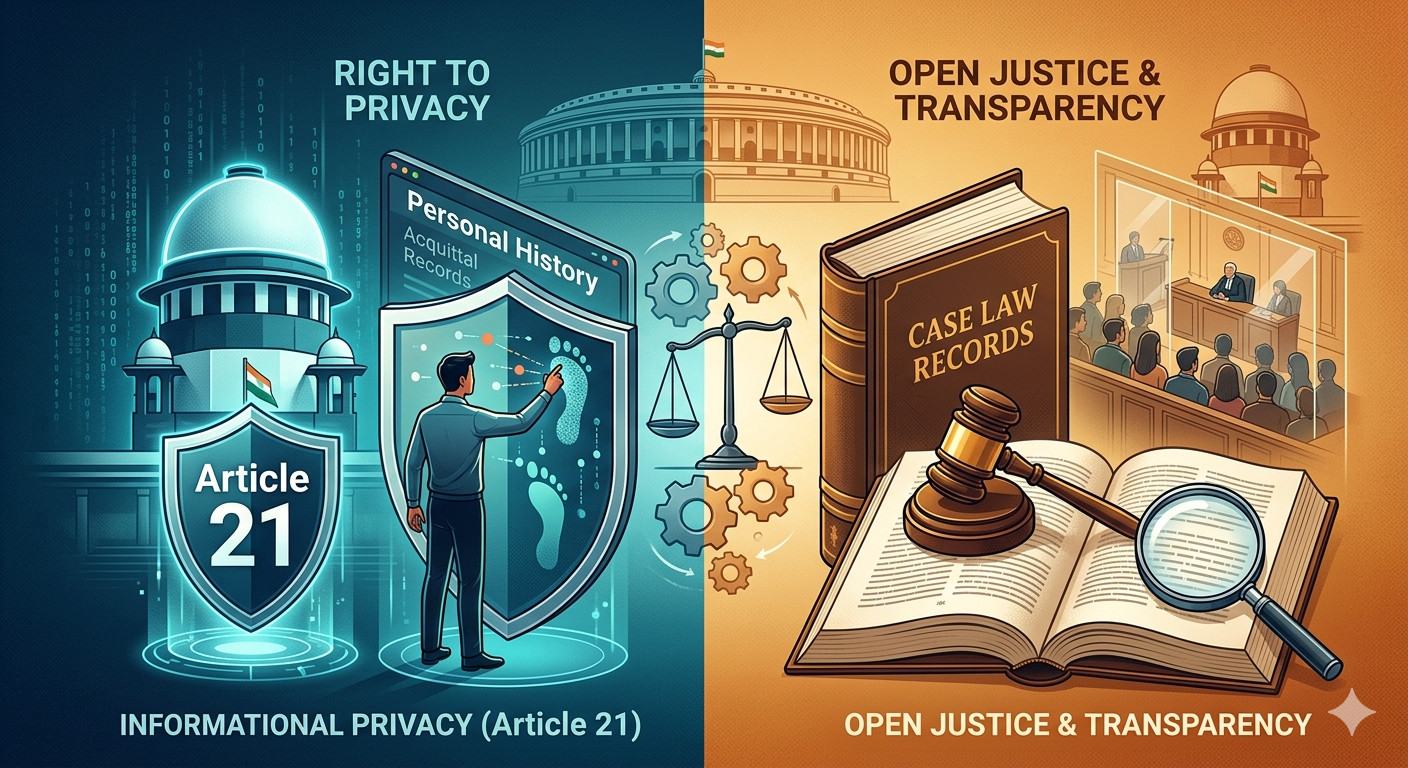
The internet never forgets, but should it be forced to? The Right to be Forgotten has transformed from a quiet privacy debate into an absolute legal earthquake that could dismantle how information exists online. A high-stakes constitutional battleground is exploding right now in the halls of open justice. For every serious student tracking fundamental rights, this isn’t just a passing news headline. It is a direct, structural collision between Article 21 and the foundational principles of public transparency. If you are tracking the shifting landscape of digital jurisprudence, understanding this friction is no longer optional. It is the exact kind of multi-layered, analytical territory that defines the modern examination matrix.
The Clash of Titans: Article 21 vs. Open Justice
At its absolute core, this controversy sets two non-negotiable constitutional pillars on a direct collision course. On one side stands the right to informational privacy, definitively recognized by the Supreme Court in the historic Justice K.S. Puttaswamy v. Union of India (2017) judgment. This principle dictates that an individual must retain control over their digital footprint, including the Right to be Forgotten when past records such as old, acquitted legal cases cause perpetual personal or professional harm.
On the flip side stands the unyielding pillar of open justice. Open justice is the bedrock of a democratic legal system, demanding that court proceedings, judicial records, and historical legal precedents remain entirely accessible for public scrutiny, research, and institutional accountability.

When an individual approaches a court demanding the de-indexing or complete deletion of a published judgment from online legal databases, they aren’t just asking for a digital cleanup. They are asking to alter a public archive. This structural friction is exactly why the Right to be Forgotten has become a high-stakes puzzle that the judiciary is struggling to solve uniformly across different High Courts.
5 Shocking Truths Transforming the Privacy Landscape
To fully grasp how deep this structural crisis of Right to be Forgotten goes, we have to unpack the core realities that make this issue an absolute minefield for policy makers and legal experts alike.
1. It is Not an Absolute Right
Unlike basic statutory protections, the Right to be Forgotten is heavily qualified. It does not give an individual a blank check to erase their entire past from the internet. The judiciary must balance every single erasure request against the larger public interest, freedom of speech, and the necessity of maintaining accurate historical records. If a piece of data involves public administration, financial fraud, or matters of systemic security, the right to erasure instantly collapses under the weight of public accountability.
2. The Direct Conflict with Public Archives
When a private legal database indexes a court judgment, it makes the law accessible to lawyers, researchers, and ordinary citizens. Requiring platforms to remove or de-index such judgments under the Right to be Forgotten can reduce public access to judicial records and may, in some circumstances, conflict with the principle of open justice. If courts begin masking names and erasing digital traces indiscriminately, judicial transparency could be significantly diminished.
3. A Glaring Lack of Statutory Uniformity
Right now, India’s approach to the Right to be Forgotten and data erasure is fragmented. While the Digital Personal Data Protection (DPDP) Act 2023 introduces provisions for data correction and erasure, its intersection with court records and media archives remains highly ambiguous. Various High Courts, from the Delhi High Court to the Kerala High Court, have delivered vastly differing orders on de-indexing requests, creating an unpredictable legal patchwork.
4. The Technical Nightmare of De-indexing
Even when a court orders the Right to be Forgotten to be enforced, execution is a technical battleground. De-indexing a specific URL from a search engine does not delete the content from the source server. The data still exists in the deep web. Tracking every mirror site, global search aggregator, and legal archive turns a single judicial order into an endless game of digital whack-a-mole.
5. High Risk of Institutional Misuse
If the boundaries of the Right to be Forgotten are not drawn with absolute precision, the mechanism risks becoming a tool for the powerful to sanitize their public histories. Public figures, corporate entities, or individuals involved in past administrative controversies could potentially exploit privacy loopholes to bury legitimate journalistic reporting, severely crippling press freedom and collective memory.
UPSC Nuggets: The Essential Exam Blueprint
💡 Prelims Core Pointer
- Constitutional Anchor: The Right to be Forgotten is an integral component of the Right to Privacy under Article 21 (Right to Life and Personal Liberty).
- Key Landmark Judgment: Justice K.S. Puttaswamy v. Union of India (2017) explicitly recognized informational privacy as a fundamental facet of Article 21.
- Statutory Framework: Section 12 of the Digital Personal Data Protection (DPDP) Act 2023 provides the right to correction, completion, and erasure of personal data, but exempts processing necessary for enforcing legal rights or performance of judicial functions.
- Global Precedent: Heavily draws inspiration from the European Union’s General Data Protection Regulation (GDPR) under Article 17 (“Right to erasure”).
📝 Mains Analytical Framework (GS Paper II & III)
When drafting an answer on the Right to be Forgotten, judicial transparency, or digital rights, structure your arguments around this core evaluation matrix:
Arguments Favoring the Right:
- Rehabilitation and Reform: Allows individuals who have been acquitted or completed their sentences to reintegrate into society without the permanent stigma of a digital footprint.
- Personal Autonomy: Protects citizens from targeted harassment, systemic workplace discrimination, and non-consensual data profiling based on obsolete or minor past events.
Arguments Opposing the Right:
- Erosion of Open Justice: Restricting access to verifiable judicial records limits public scrutiny and compromises legal research.
- Chilling Effect on Press Freedom: Forcing data removal can lead to over-compliance by platforms, resulting in the accidental censorship of legitimate, public-interest investigative journalism.
The Path Ahead: Balancing Privacy and Transparency
Resolving the gridlock over the Right to be Forgotten requires moving past reactionary, case-by-case adjudications. The executive and the judiciary must collaborate to build a systematic, predictable framework that defines exactly when privacy overrides public data availability.
One viable solution is the institutional adoption of data anonymization at the source. Instead of completely deleting historic court records or blocking search indexes, registries can mask sensitive personal identifiers such as names and specific addresses in cases involving family disputes, matrimonial maters, or complete legal acquittals. This approach successfully protects individual dignity without breaking the chain of legal precedent or violating the core tenets of open justice.
Furthermore, statutory bodies operating under the DPDP Act must clearly delineate the boundaries between private personal data and public information assets. Until a clear, statutory line is drawn, the conflict between individual privacy and collective transparency will remain one of the most volatile constitutional debates of our time. Staying ahead of these evolving structural shifts isn’t just about passing a test it’s about understanding the blueprint of India’s future digital democracy.
This post really highlights how digital rights are evolving. It’s striking to see the tension between an individual’s right to erase past records and the public’s right to access information. I’m curious how courts will handle situations where these two principles collide.