

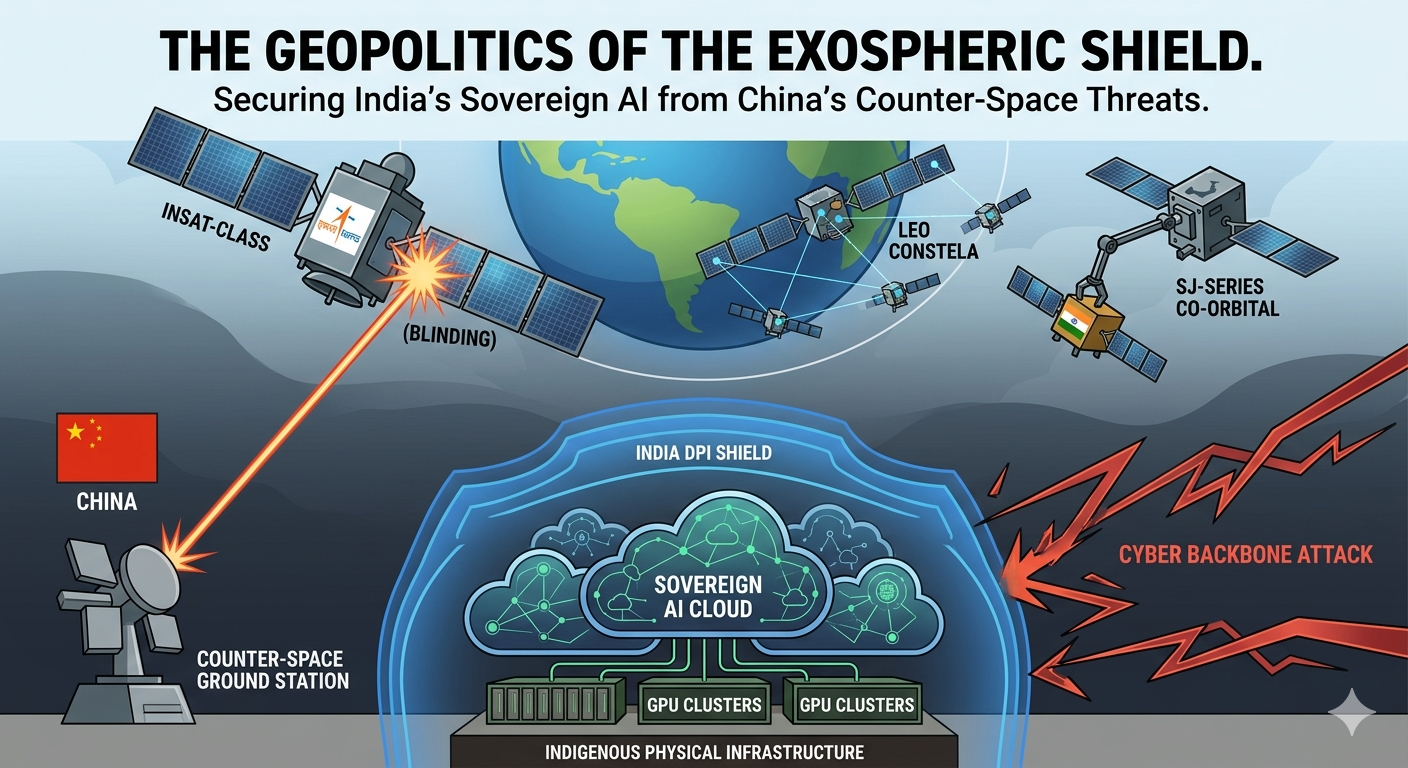
Recent strategic defense briefs highlighting China’s Counter-Space Power capabilities have sent shockwaves through New Delhi’s defense and technological establishments, The global security architecture just witnessed a silent, terrifying paradigm shift. While the mainstream media is busy parsing domestic political transitions, a much more dangerous shadow war is escalating right above our heads. For anyone tracking GS Paper 2 (International Relations) and GS Paper 3 (Security & Science & Technology), this isn’t just another headline; it is a structural crisis that exposes India’s space assets and its nascent digital infrastructure to unprecedented vulnerabilities and important UPSC topic
Covering China’s Counter-Space Power for exam :
The Kinetic Illusion: Beyond ASAT Missiles
When India successfully executed Mission Shakti in 2019, demonstrating its Anti-Satellite (ASAT) kinetic interception capability, the national security community celebrated a milestone. However, the nature of China’s Counter-Space Power has evolved past crude, debris-creating kinetic missiles like the DN-3 or SC-19. Today, the real threat is asymmetric, invisible, and co-orbital.
| Threat Category | Type / Examples | Characteristics & Impacts |
| Old Threat | Kinetic Destructive (e.g., ASAT Missiles) | Creates massive, long-lasting space debris fields.Highly visible and politically provocative. |
| New Threat | Directed Energy & Jammers | High-powered ground or airborne lasers used to “blind” optical sensors.RF jamming to disrupt communications. |
| New Threat | Co-Orbital Systems | Robotic arm satellites (like the SJ-series) designed to grapple and physically move space assets. |
| New Threat | Cyber Capabilities | Cyber-payloads engineered to hijack satellite Telemetry, Tracking, and Control (TT&C). |
China has successfully operationalized high-powered, ground-based directed energy weapons (DEWs) designed to dazzle, blind, or permanently damage the delicate optical sensors of Indian reconnaissance satellites without breaking them into physical pieces. Furthermore, Beijing’s experimental Shijian (SJ) series satellites are equipped with sophisticated robotic arms capable of physically grappling, de-orbiting, or repositioning rival space assets. This means a satellite can be quietly neutralised during a border standoff without a single explosion being detected, making China’s Counter-Space Power a silent tool of grey-zone warfare.
The Asymmetry: India’s Redundancy Deficit
In the cold calculations of space deterrence, numbers dictate survival. India possesses a relatively lean, highly efficient satellite constellation primarily optimized for civilian communication, remote sensing, and precision navigation (NavIC). This efficiency, however, creates an acute strategic vulnerability when pitted against China’s Counter-Space Power frameworks.
If China targets and neutralises five to six critical Indian satellites, it can effectively blind our armed forces’ real-time communication and intelligence capabilities along the Line of Actual Control (LAC). Conversely, because China possesses a massive, deeply distributed network of orbital assets with built-in redundancies, losing an equivalent number of satellites would barely degrade their operational readiness. Our lack of distributed constellations of smaller, rapidly deployable micro-satellites leaves our high-value space infrastructure exposed to highly targeted disruptions.
The Digital Tenancy Trap and Sovereign AI
The threat does not stop in the upper atmosphere; it descends directly into India’s digital core. While India has rightly earned international praise for its robust Digital Public Infrastructure (DPI) such as Aadhaar, UPI, and the Ayushman Bharat Digital Mission (ABDM) our technological architecture suffers from a structural flaw: “digital tenancy.” We own the brilliantly engineered application layers, but we rent the underlying physical infrastructure.
THE DIGITAL TENANCY DILEMMA – APPLICATION LAYER (Sovereign & Localized) UPI, Aadhaar, DigiYatra, ABHA
VULNERABLE FOUNDATION (Foreign Proprietary Hardware/Cloud) – High-end GPU processing clusters – Foreign-owned undersea cable routing – Proprietary foreign AI foundation models
True digital sovereignty requires independent control over the infrastructure layer specifically, high-end Graphics Processing Unit (GPU) clusters, sovereign cloud frameworks, and localized data centers like the newly conceptualized 1 GW Vizag Hyperscale Facility. If an adversary utilizes China’s Counter-Space Power to cripple our satellite-linked communication hubs while simultaneously launching advanced cyber-warfare campaigns against our cloud backbones, our sovereign AI capabilities could be paralyzed. Without indigenous semiconductor manufacturing and self-reliant hardware ecosystems, our digital platforms remain critically dependent on foreign supply chains.
The Regulatory Vacuum in the Exo-Atmosphere
Why is this militarization proceeding unchecked in China’s Counter-Space Power? The answer lies in a glaring gap within global governance: the international legal framework governing outer space is functionally obsolete. The Outer Space Treaty (OST) of 1967 strictly prohibits the placement of weapons of mass destruction (WMDs) in orbit, but it remains completely silent on ground-based lasers, cyber-sabotage tools, and dual-use co-orbital robotic satellites.

This massive regulatory vacuum allows state actors to aggressively develop multi-domain capabilities without violating any binding international law. For Indian policymakers, navigating this lawless frontier requires building a credible, multi-layered deterrence strategy. We cannot rely on global treaties to protect our assets when China’s Counter-Space Power leverages these gray areas to establish space dominance, underscoring the urgent need for India to rapidly expand its own counter-space and defensive electronics frameworks.
Strategic Way Forward: Building Space Resilience
To secure our digital future and safeguard our space frontier against China’s Counter-Space Power, India must immediately pivot from isolated space missions to a comprehensive ecosystem approach. The solution requires a major paradigm shift away from relying solely on large, expensive, monolithic satellites and moving toward deploying vast constellations of low-cost, mass-produced small satellites in Low Earth Orbit (LEO).

Concurrently, the government must aggressively expand the role of the private sector via IN-SPACe and the NewSpace India Limited (NSIL) framework to scale up domestic manufacturing and launch frequencies. Defensively, our ground infrastructure such as telemetry, tracking, and command (TT&C) stations must be hardened against sophisticated electronic warfare and cyber-intrusions. True strategic autonomy will only be achieved when our space defense capabilities, our semiconductor supply chains, and our sovereign AI infrastructure operate as a unified, impenetrable national security shield.
📌 UPSC Nuggets: Core Syllabus Integration ( China’s Counter-Space Power )
GS Paper 2: International Relations
- Militarization of Space: Evolving geopolitical dynamics in the Indo-Pacific; weaponization of the exo-atmosphere; asymmetric capabilities of regional actors; failures of global governance bodies like the UN Committee on the Peaceful Uses of Outer Space (COPUOS).
- Bilateral Relations: The shifting balance of power along the Line of Actual Control (LAC); implications of gray-zone warfare on territorial integrity and bilateral diplomacy.
GS Paper 3: Science & Technology, Cyber Security & Internal Security
- Space Technology: Anti-Satellite (ASAT) capabilities; Low Earth Orbit (LEO) vs. Geostationary Orbit (GEO) tactical advantages; co-orbital satellites and directed energy weapons.
- Digital Public Infrastructure (DPI) & Sovereignty: The distinction between application-layer security and infrastructure-layer vulnerability; data localization laws under the DPDP Act; challenges of building independent Sovereign AI.
- Defense Infrastructure: Hardening of Telemetry, Tracking, and Control (TT&C) ground stations; developing electronic counter-measures (ECM) and building redundant satellite architectures.
Q. “The transition from kinetic anti-satellite weapons to co-orbital and directed-energy capabilities has fundamentally altered the paradigm of space security.” In light of this statement, critically analyze the vulnerabilities facing India’s space-based assets and evaluate the structural reforms required to achieve true digital and architectural sovereignty. (250 Words, 15 Marks) (China’s Counter-Space Power related question)
Quick Prelims Pointer
Mission Shakti (2019): India’s successful kinetic direct-ascent anti-satellite (A-SAT) test, making India the fourth nation to demonstrate this capability.
IN-SPACe (Indian National Space Promotion and Authorization Center): A single-window, independent nodal agency under the Department of Space created to permit and oversee private sector space activities.
NavIC (Navigation with Indian Constellation): India’s independent regional satellite navigation system, utilizing a constellation of 7 satellites to provide accurate position information service over India and surrounding regions.
Outer Space Treaty (1967): Formally known as the Treaty on Principles Governing the Activities of States in the Exploration and Use of Outer Space, including the Moon and Other Celestial Bodies; forms the basis of international space law but does not ban conventional or cyber/laser weaponization.
These are all the important stuff you need to know about China’s Counter-Space Power and for getting to know about more such important current affairs stay tuned with Dailyupscprep.in