

Funding India’s Climate Future has emerged as one of the country’s biggest development challenges. While the global green economy is accelerating at an unprecedented pace, India’s clean energy transition continues to face a critical bottleneck: access to capital. According to the Reserve Bank of India’s (RBI) Report on Currency and Finance, the country needs additional green investments worth at least 2.5% of its GDP every year until 2030 to achieve its ambitious climate targets.
However, as of June 2026, mobilizing this massive pool of finance remains a formidable task. The financial ecosystem responsible for channeling hundreds of billions of dollars into green projects is under significant structural strain, raising concerns about whether India can sustain the momentum needed for a successful transition to a low-carbon economy.
For UPSC aspirants, this is far more than an environmental issue. It sits at the intersection of economic growth, financial stability, international cooperation, and governance, making it a highly relevant topic for GS Paper 3 and contemporary affairs.
The Glaring $90 Billion Annual Green Capital Deficit
The foundational roadblock in funding India’s climate future is the sheer, undeniable shortfall in green capital. Currently, tracked climate finance flowing into Indian projects sits at roughly $31 billion annually. While that sounds impressive on paper, it accounts for less than 25% of the estimated $120 billion to $150 billion needed every single year to meet our Nationally Determined Contributions (NDCs).

This multi-billion dollar deficit leaves high-impact sectors like green hydrogen, electric vehicle (EV) charging networks, and grid-scale battery storage starved for long-term, low-cost capital. Without a monumental surge in international blended finance and domestic institutional investments, bridging this massive $90+ billion annual gap will remain an mathematical impossibility.
The Absolute Absence of an Enacted Legal Green Taxonomy
You cannot regulate or fund what you cannot legally define. The biggest structural vulnerability in funding India’s climate future is the total absence of an officially enacted National Climate Finance Taxonomy. Without a standardized, legally binding definition of what constitutes an “environmentally sustainable project,” the entire financial ecosystem remains exposed to greenwashing—where companies falsely label routine commercial projects as eco-friendly.
Why a Green Taxonomy Matters: Global Environmental, Social, and Governance (ESG) funds are sitting on trillions of dollars. However, institutional investors are legally prohibited from deploying capital into countries lacking a robust, clear legal taxonomy because the risk of regulatory backlash and greenwashing accusations is simply too high.
The Ministry of Finance has been working on a draft framework and funding India’s climate future, but until it is officially codified into statutory law, foreign capital will remain cautious, severely throttling the inflow of international green bonds.
The Banking Sector’s Brewing Climate Risk Dilemma
Domestic commercial banks are the backbone of industrial credit in India, but their balance sheets are increasingly exposed to severe climate vulnerabilities. The RBI has taken proactive steps by introducing the Climate Finance and Management of Climate Change Risks Directions, which mandates banks to integrate environmental risks directly into their core lending operations.
However, executing this directive on the ground is proving to be immensely difficult. Indian commercial banks lack the specialized data analytics and historical modeling tools needed to quantify long-term environmental risks accurately. When assessing a 20-year infrastructure loan, banks struggle to price in the financial fallout of localized groundwater depletion, extreme heatwaves, or flash floods. Consequently, risk-averse commercial lenders either inflate interest rates for renewable projects or completely back away, creating a severe credit squeeze that directly impedes funding India’s climate future.
The High-Cost Barrier of Decarbonizing Hard-to-Abate Industries
While expanding solar panels and wind farms is commercially attractive, the real battle for India’s net-zero transition is being fought in the “hard-to-abate” heavy industrial sectors, such as steel, cement, aluminum, and heavy chemicals. These sectors contribute heavily to India’s carbon footprint but cannot transition to clean tech without astronomical capital investments.

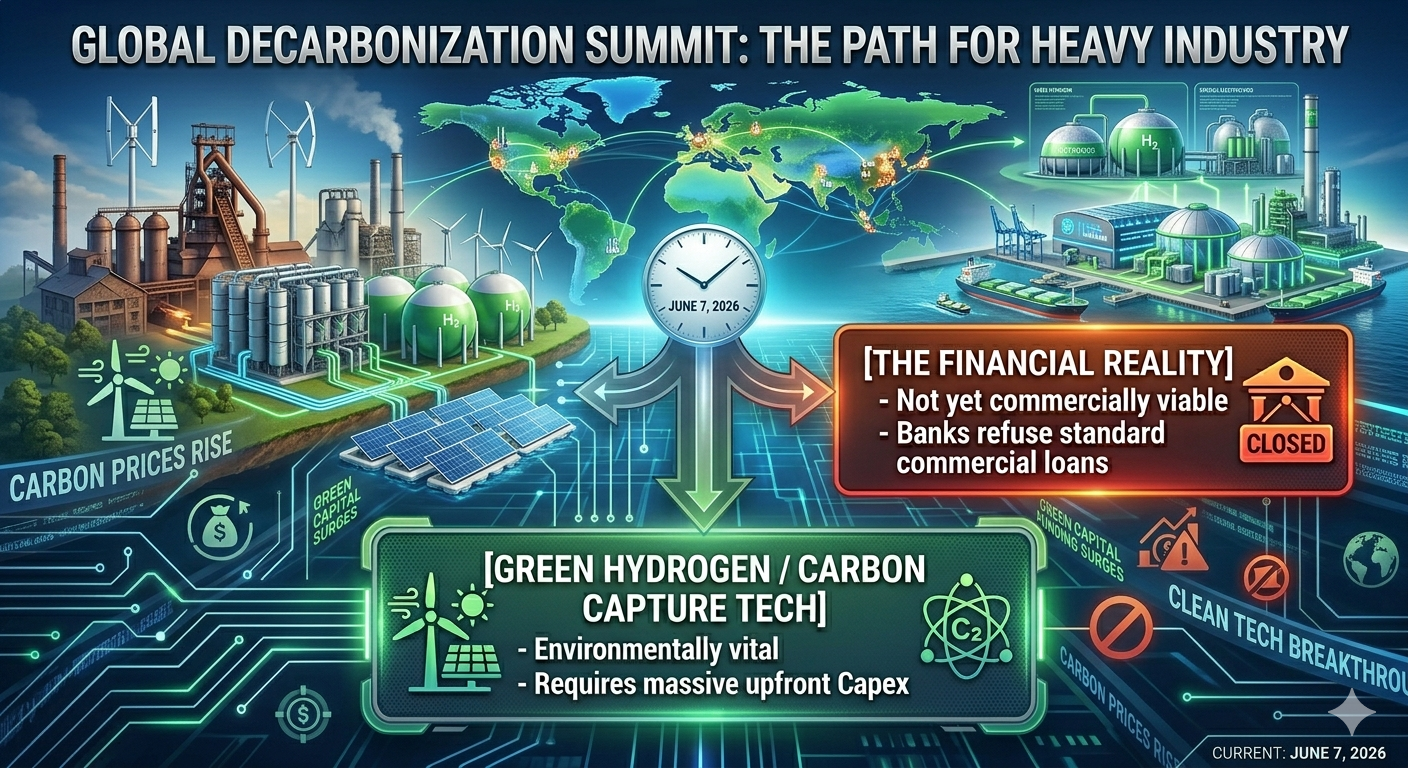
Because green hydrogen alternatives and carbon capture technologies are not yet commercially viable on a standalone basis, traditional financial institutions view them as high-risk bets. Without dedicated government-backed viability gap funding or sovereign guarantees, commercial capital will continue to steer clear of heavy industrial transitions, neutralizing a vital pillar of funding India’s climate future.
The Under-Diversified State of Our Sovereign Green Debt Market
To jumpstart the green debt market and funding India’s climate future, the Central Government has successfully issued over ₹477 billion ($5.7 billion) in Sovereign Green Bonds (SGBs). This was an excellent initial step to establish domestic market benchmarks, but the secondary market for these bonds has run into a distinct liquidity wall.
Currently, over 80% of India’s green debt stock is heavily concentrated in just two sectors: clean energy generation and public mass transportation. While these are critical sectors, this narrow concentration leaves the green bond market highly vulnerable to sector-specific shocks. To attract large-scale, diversified global pension funds, India must urgently expand its green debt issuance to encompass circular economy projects, sustainable agriculture, and climate-resilient water infrastructure. Until our green debt portfolio diversifies, institutional scale will remain restricted, directly limiting our capacity for funding India’s climate future.
UPSC Nuggets: The June 2026 Core Focus for the topic funding India’s climate future
To ensure your preparation perfectly aligns with the latest analytical trends expected in the upcoming Civil Services Examination, here is a structured breakdown of this topic.
Mains Analytical Matrix (GS Paper 3: Economy & Environment)
| Dimension | Core Institutional Framework | Critical Analytical Hurdles for Mains |
| Monetary Policy | RBI’s Priority Sector Lending (PSL) & Green Sandbox | Evaluating if current PSL caps for renewable energy are sufficient to drive deep commercial banking credit. |
| Fiscal Strategy | Ministry of Finance Sovereign Green Bonds (SGBs) | Analyzing the fiscal trade-offs of offering higher yield premiums (“greenium”) to attract foreign ESG capital. |
| Global Governance | UNFCCC Article 9 & New Collective Quantified Goal (NCQG) | Assessing the failure of developed nations in delivering the promised $100 billion annual climate finance. |
Q&A Style: Key Institutional Terminology to Memorize for the topic funding India’s climate future
Q1. What is Greenium (Green Premium)?
A: Greenium is the pricing advantage enjoyed by green bonds, where they trade at a lower yield and higher price than comparable conventional bonds due to strong investor demand for sustainable assets.
Q2. What is a Regulatory Green Sandbox?
A: Regulatory Green Sandbox: A controlled regulatory environment that allows financial institutions and fintech firms to test innovative green finance products, services, and business models under regulatory supervision with limited-scale real-world participants. It helps regulators assess risks and benefits while encouraging innovation in areas such as sustainable finance, climate-risk management, green lending, and environmental reporting solutions.
Q3. What is Climate Finance Taxonomy?
A: Climate Finance Taxonomy is a classification system that identifies and defines environmentally sustainable economic activities. It helps prevent greenwashing, improves transparency, and guides investors toward genuine sustainable investments.
Model Mains Practice Question ( for funding India’s climate future )
Mains Practice Question (GS Paper 3 – Environmental Economics)
“The absence of a legally codified National Green Taxonomy remains the single largest impediment to unlocking international ESG capital for India’s net-zero transition.”
Critically evaluate this statement in light of recent RBI guidelines on climate risk management. (250 Words, 15 Marks)
The Strategic Way Forward For funding India’s climate future
Unlocking the hundreds of billions required for funding India’s climate future demands an immediate transition from ad-hoc policy adjustments to deep, structural financial reforms. First, the Ministry of Finance must fast-track and legally enact a comprehensive National Climate Finance Taxonomy to eliminate greenwashing risks once and for all.
Second, for funding India’s climate future the RBI should consider introducing differentiated capital requirement ratios for commercial banks lowering the risk weight for verified green loans while increasing it for carbon-heavy, fossil-fuel assets. Finally, India must actively leverage its strategic bilateral partnerships, such as the India-Germany Quantum and Clean Energy Cooperation, to scale up international blended finance instruments. Until we create a transparent, predictable, and de-risked financial ecosystem, the capital required to build a climate-resilient India will remain frustratingly out of reach.