

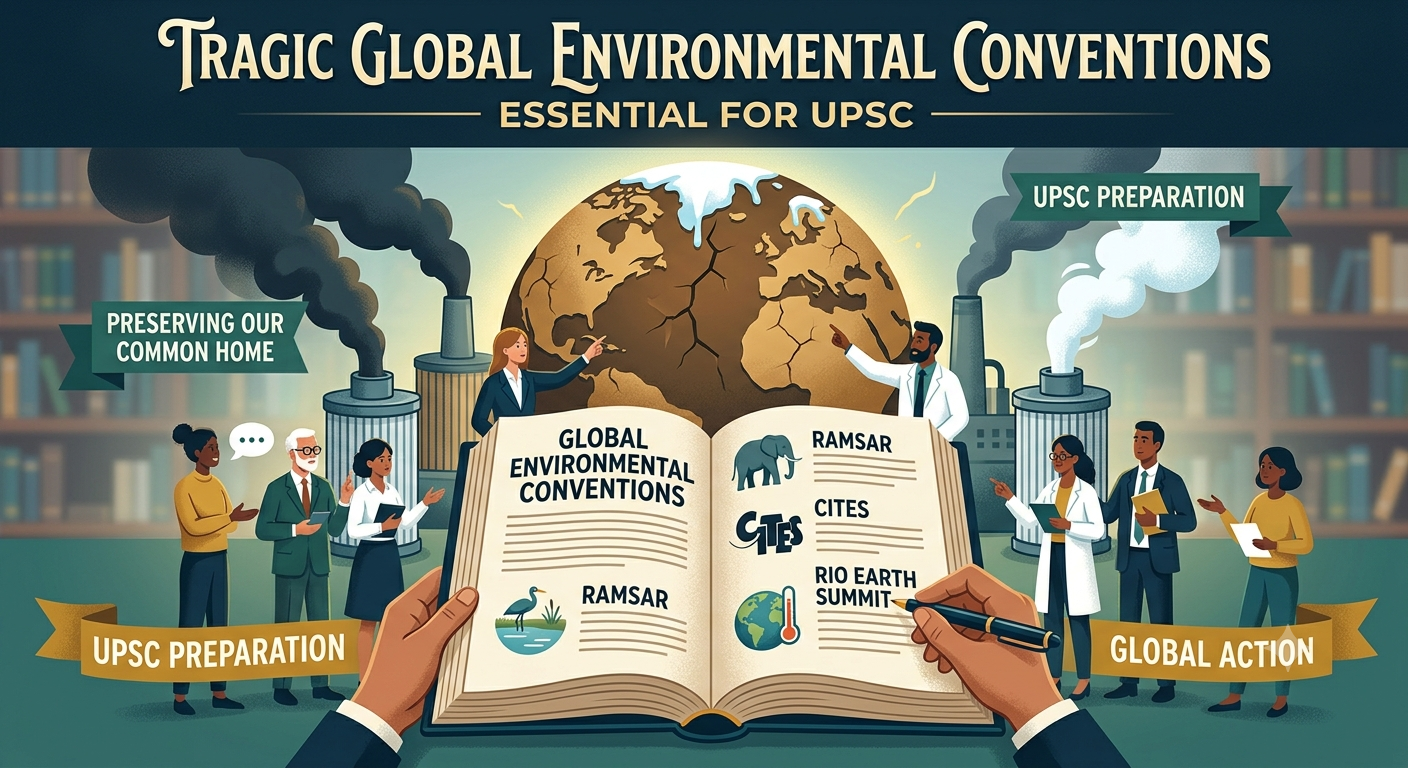
Environmental ecology is one of the highest-yielding topics in the UPSC Civil Services Examination. Year after year, candidates encounter multiple questions on multilateral agreements, protocols, and international treaties aimed at arresting ecological decay. Understanding these mechanisms is crucial because environmental degradation presents a tragic reality for humanity: melting glaciers, disappearing species, and expanding deserts. To navigate these complex international frameworks, students must thoroughly study global environmental conventions.
In this article, we break down seven critical agreements that formed in response to ecological crises. We will examine their core principles, legal frameworks, and practical importance for both Prelims and Mains.
1. Ramsar Convention on Wetlands (1971)
The tragic loss of global wetlands often dubbed the “lungs of the Earth” prompted world leaders to establish an international treaty dedicated to preserving fragile aquatic ecosystems. Signed in Ramsar, Iran, this intergovernmental framework establishes guidelines for national action and international cooperation regarding wetland conservation.
Under this agreement, member nations designate suitable wetlands as Ramsar Sites based on ecological, botanical, or hydrological significance. India currently hosts an expanding network of Ramsar sites, making it a recurring focus in civil services prep. When revising treaties for competitive exams, remembering the historical context of these global environmental conventions helps retain complex factual details.
💡 UPSC Nuggets
- Adopted: 1971 (Came into force in 1975).
- Montreux Record: A register of Ramsar sites where changes in ecological character have occurred, are occurring, or are likely to occur due to technological developments or pollution.
- Indian Sites in Montreux Record: Keoladeo National Park (Rajasthan) and Loktak Lake (Manipur). (Chilika Lake was removed after successful restoration).
2. CITES: Convention on International Trade in Endangered Species (1973)
The devastating expansion of illegal wildlife trade forced nations to curb the exploitation of vulnerable fauna and flora. Drafted as a result of a resolution adopted by members of the International Union for Conservation of Nature (IUCN), CITES ensures that international trade in wild animals and plants does not threaten their survival.
CITES protects over 38,000 species by categorizing them into three Appendices based on the level of protection needed:
- Appendix I: Species threatened with extinction; commercial trade is strictly prohibited.
- Appendix II: Species not immediately threatened with extinction, but trade must be controlled.
- Appendix III: Species protected in at least one country that has asked other parties for assistance in controlling trade.
Analyzing trade prohibitions across these appendices demonstrates how global environmental conventions utilize regulatory mechanism controls to prevent wildlife loss.
3. Bonn Convention / CMS (1979)
Migratory animals face unique tragic threats as they cross international boundaries, exposing them to habitat fragmentation, illegal poaching, and hazardous infrastructure. The Convention on the Conservation of Migratory Species of Wild Animals (CMS), commonly known as the Bonn Convention, operates under the United Nations Environment Programme (UNEP).
CMS provides a global platform for the conservation and sustainable use of migratory animals and their habitats. India hosted COP13 of the Bonn Convention at Gandhinagar in 2020, choosing the Great Indian Bustard as its mascot. Aspirants should regularly track updates regarding global environmental conventions to connect static concepts with current affairs.
4. Vienna Convention and Montreal Protocol (1985 / 1987)
The discovery of the ozone hole over Antarctica highlighted a tragic reality: human-made chemicals were eroding the atmosphere’s shield against lethal ultraviolet radiation. The Vienna Convention provided the overarching framework, while the subsequent Montreal Protocol imposed legally binding targets to phase out Ozone Depleting Substances (ODS) like Chlorofluorocarbons (CFCs).
The Montreal Protocol is widely recognized as one of the most successful environmental treaties in history. In 2016, the Kigali Amendment added Hydrofluorocarbons (HFCs) to the phase-down list, bridging atmospheric protection with climate change mitigation. Studying effective multilateral frameworks like these highlights why global environmental conventions remain essential study material for civil services candidates.
5. Rio Earth Summit Frameworks (1992)
The 1992 United Nations Conference on Environment and Development (UNCED) in Rio de Janeiro yielded three landmark treaties, often called the “Rio Sisters”:
A. UNFCCC (UN Framework Convention on Climate Change)
Created to combat dangerous human interference with the climate system. It laid the foundation for the Kyoto Protocol (1997) and the Paris Agreement (2015).
B. CBD (Convention on Biological Diversity)
Focuses on conserving biological diversity, sustainable use of its components, and fair sharing of benefits arising from genetic resources. It encompasses two major protocols:
- Cartagena Protocol: Focuses on Biosafety (handling Living Modified Organisms).
- Nagoya Protocol: Focuses on Access and Benefit Sharing (ABS).
Understanding how these interlinked systems function reveals how nations attempt to structure global environmental conventions to balance conservation with developmental rights.
6. UNCCD: UN Convention to Combat Desertification (1994)
Land degradation and desertification present severe socio-economic threats, particularly in vulnerable dryland regions. Established in 1994, UNCCD is the sole legally binding international agreement linking environment and development to sustainable land management.
The convention addresses arid, semi-arid, and dry sub-humid areas, striving to achieve Land Degradation Neutrality (LDN). In India, where significant land areas suffer from degradation, aligning national programs with global environmental conventions remains a core policy objective.
7. Minamata Convention on Mercury (2013)
Named after the tragic industrial disaster in Minamata City, Japan, where toxic mercury discharges poisoned thousands, this treaty addresses anthropogenic emissions and releases of mercury compounds. Mercury is a potent neurotoxin that bioaccumulates in food chains.
The convention controls mercury supply, trade, industrial processes, and waste management. India ratified the Minamata Convention in 2018, demonstrating its commitment to international standards. Evaluating health-focused ecological agreements underscores the human necessity behind global environmental conventions.
Examples and Practical Applications
To perform well in civil services exams, candidates must link treaties with practical environmental initiatives:
- Project Tiger & CITES: India’s tiger conservation strategy relies on CITES mechanisms to prevent international poaching networks.
- National Action Plan on Climate Change (NAPCC) & UNFCCC: India’s domestic climate goals directly support international commitments made under global environmental conventions.
- Wetland Conservation Rules (2017): Derived from India’s obligations under the Ramsar framework.
UPSC Questions Trend Analysis
An analysis of past UPSC Prelims papers shows distinct question patterns:
- Body / Treaty Mapping: Matching protocols to their governing bodies (e.g., CMS under UNEP).
- Legal Status: Questions asking whether a treaty is legally binding or voluntary.
- India’s Status: Verifying whether India is a signatory, founder, or ratifying member.
Understanding these operational nuances ensures students do not lose marks on straightforward factual questions regarding global environmental conventions.
Quick Reference Summary Table
| Convention / Treaty | Year | Governing Body / Secretariat | Primary Objective |
| Ramsar Convention | 1971 | Independent / IUCN Secretariat | Conservation of wetlands of international importance |
| CITES | 1973 | UNEP | Regulating international trade in endangered species |
| Bonn Convention (CMS) | 1979 | UNEP | Protection of migratory wild animals |
| Montreal Protocol | 1987 | UN Environment | Phasing out ozone-depleting substances |
| UNFCCC | 1992 | UN Climate Change | Stabilizing greenhouse gas concentrations |
| CBD | 1992 | UNEP | Biodiversity conservation and benefit sharing |
| UNCCD | 1994 | UN Secretariat | Combating desertification and land degradation |
Having a clean summary table makes quick revision efficient, helping students maintain clarity on global environmental conventions right before exam day.
Frequently Asked Questions (FAQs)
Q1. Are all global environmental conventions legally binding?
No. Some agreements, such as the initial frameworks of UNFCCC, set goals without imposing direct financial or operational penalties. Others, such as the Montreal Protocol and Minamata Convention, contain legally binding provisions for ratifying parties.
Q2. What is the difference between Cartagena and Nagoya Protocols?
The Cartagena Protocol deals with biosafety regarding living modified organisms (LMOs), whereas the Nagoya Protocol focuses on Access and Benefit Sharing (ABS) of genetic resources. Both fall under the Convention on Biological Diversity (CBD).
Q3. How should candidates prepare this section for UPSC Mains?
For Mains (GS Paper III), focus on the effectiveness of these treaties, challenges in implementation, climate justice issues between developed and developing nations, and India’s domestic initiatives.
Conclusion
Mastering international environmental treaties and global environmental conventions requires an organized study strategy that connects core concepts with current events. By systematically reviewing the historical backgrounds, legal frameworks, and domestic applications of these agreements, candidates can score consistently in ecological questions. Keep reviewing these frameworks, track updates from COP meetings, and continue refining your revision notes on global environmental conventions.