

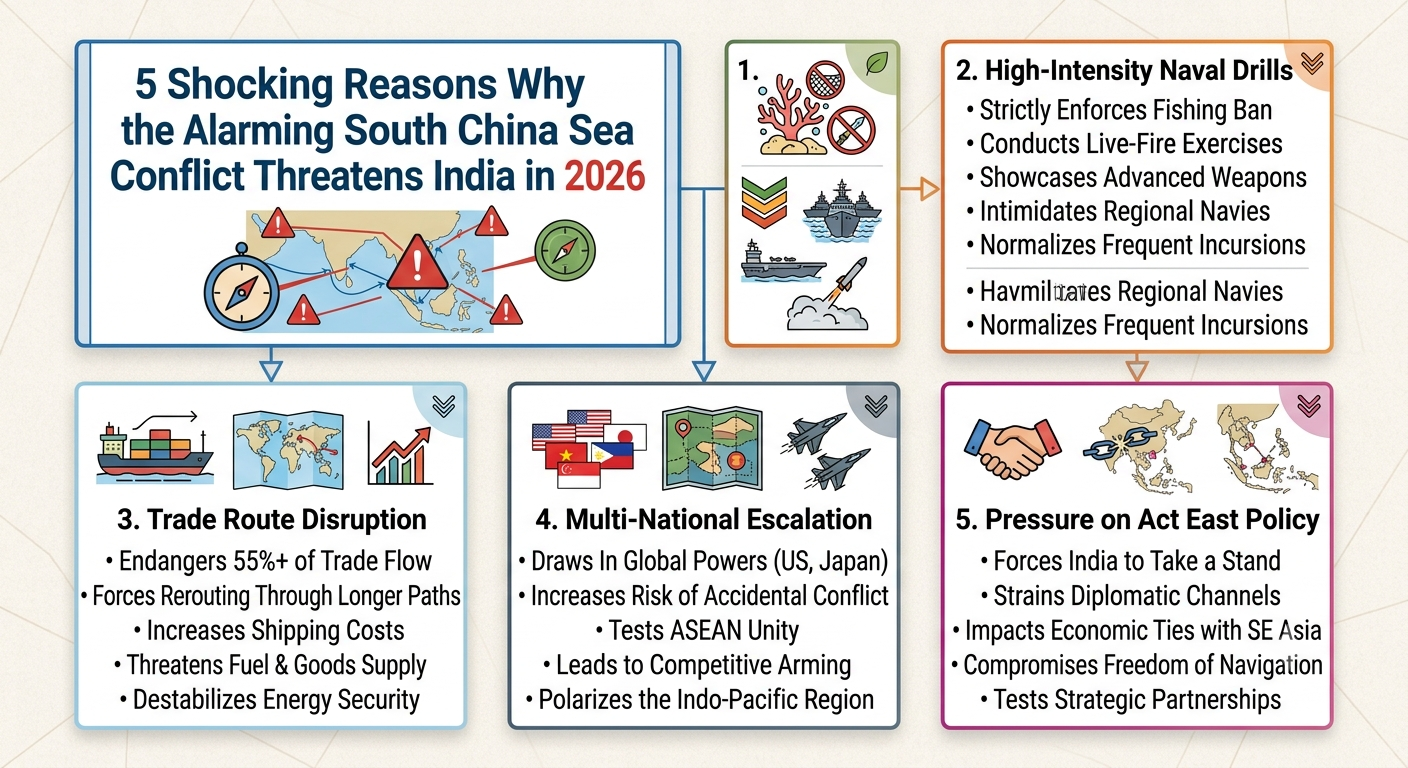
The dynamic geopolitical equilibrium of the Indo-Pacific has experienced another intense shockwave in recent days. With fresh military maneuvers and administrative declarations surrounding disputed reefs, the South China Sea Conflict has re-emerged as the most flashpoint-heavy maritime arena in Asia. For UPSC Civil Services aspirants preparing for General Studies Paper 2 (International Relations) and General Studies Paper 3 (Security Issues & Economy), tracking these developments is vital. Understanding the operational mechanisms of maritime law, territorial claims, and trade security is crucial for mastering contemporary international affairs.
1. Recent Development: China’s Escalation in Scarborough Shoal
In August 2026, China formally declared new administrative management measures for the newly established “Huangyan Dao National Nature Reserve” situated directly around Scarborough Shoal. Accompanied by aggressive routine naval patrols and live-fire military exercises, Beijing has tightened its administrative grip over waters claimed by the Philippines.

These unilateral regulatory actions marked a troubling phase in the ongoing South China Sea Conflict, effectively blocking regional fishermen from accessing traditional maritime hunting grounds. Surrounding littoral nations, backed by international freedom-of-navigation advocates, have strongly condemned these moves. The sudden militarization around Scarborough Shoal proves how rapidly the broader South China Sea Conflict can deteriorate from a localized legal dispute into a direct naval confrontation.
2. Background and Historical Roots of the Maritime Dispute
To understand why this sea is perpetually volatile, one must look at geography and historical claims. The South China Sea is a strategic marginal sea of the Western Pacific Ocean bordered by China, Taiwan, the Philippines, Vietnam, Malaysia, Brunei, Indonesia, and Singapore.

The core friction stems from China’s expansive “Nine-Dash Line” claim (now expanded to a ten-dash line), which asserts sovereign jurisdiction over roughly 90% of the entire body of water.
- The 2016 PCA Ruling: In 2016, the Permanent Court of Arbitration (PCA) at The Hague issued a landmark verdict under the United Nations Convention on the Law of the Sea (UNCLOS). The court ruled that China’s historic rights claims within the Nine-Dash Line had no legal basis under international law.
- Rejection of Verdict: Beijing rejected the ruling as “null and void,” persisting with artificial island building, land reclamation, and militarization, thereby escalating the long-term South China Sea Conflict.
The persistent disregard for international arbitration has turned the South China Sea Conflict into a litmus test for the durability of the global rules-based order.
3. Major Stakeholders and Their Geopolitical Stakes
Several primary regional and global actors drive the dynamics of this dispute:
- China: Seeks full control over sea lanes, vast underwater hydrocarbon reserves, and fisheries. China considers dominance over this sea vital for defense depth and peripheral security.
- The Philippines, Vietnam, Malaysia, Brunei, and Taiwan: Neighboring littoral states asserting their Exclusive Economic Zones (EEZs) under UNCLOS. The Philippines, in particular, has pursued legal remedies and defensive alignments to push back against territorial incursions.
- United States and Western Allies: Maintain a strong presence through Freedom of Navigation Operations (FONOPs) and security pacts like AUKUS and foreign defense treaties to deter unilateral physical changes to the status quo.
Because almost $3.37 trillion in global trade moves through these waters annually, any sharp worsening of the South China Sea Conflict sends immediate financial shocks across international supply networks.
4. Why the Escalation Directly Impacts India
While India is not a direct territorial claimant in the South China Sea, it remains profoundly vulnerable to any destabilization in these maritime routes.

Trade Security and Navigation Freedom
Over 55% of India’s overall trade passes through the Malacca Strait and into the South China Sea. If naval blockades or military exercises choke these waters during an intensified South China Sea Conflict, Indian exports and raw material imports will face crippling delays and soaring freight rates.
Offshore Hydrocarbon Investments
India’s state-owned ONGC Videsh Limited (OVL) holds active oil and gas exploration blocks off the coast of Vietnam (Block 128). China’s aggressive claims have frequently targeted these lawful commercial operations. Hence, managing risks associated with the South China Sea Conflict is essential for protecting India’s overseas commercial investments.
Strategic Regional Alignment (Act East Policy)
India’s foreign policy principles encapsulated in the SAGAR initiative (Security and Growth for All in the Region) rely heavily on an open, inclusive, and stable Indo-Pacific. A lingering South China Sea Conflict destabilizes ASEAN unity, directly challenging India’s strategic footprint under its “Act East” doctrine.
5. UPSC Nuggets: Key Facts & Exam Framework
Prelims Quick Facts
- Location: Marginal sea bounded by China, Vietnam, Malaysia, Brunei, Philippines, Taiwan, and Indonesia.
- Key Geographic Features: Paracel Islands, Spratly Islands, Scarborough Shoal, Mischief Reef.
- Chokepoints: Connects the Pacific Ocean and Indian Ocean via the Strait of Malacca, Sunda Strait, and Lombok Strait.
- UNCLOS 1982: Defines Territorial Sea (12 nautical miles), Contiguous Zone (24 nautical miles), and Exclusive Economic Zone (EEZ, 200 nautical miles).
- PCA Ruling (2016): Held that China’s Nine-Dash line claims lacked legal grounding under UNCLOS.
Mains Analytical Framework (GS Paper 2)
Practice Question for Aspirants: “The maritime territorial disputes in the South China Sea pose a direct threat to regional stability and international rule-based order. Examine how the persistent South China Sea Conflict affects India’s economic and strategic interests in the Indo-Pacific, and discuss India’s diplomatic response.” (250 Words, 15 Marks)
Model Answer Structure:
- Introduction: Highlight the strategic and economic significance of the South China Sea as a vital global Sea Line of Communication (SLOC).
- Core Impact on India:
- Freedom of navigation concerns impacting over half of India’s sea trade.
- Energy security risks regarding ONGC Videsh exploration blocks in Vietnam’s EEZ.
- Regional power imbalance caused by Chinese militarization.
- India’s Diplomatic & Security Response:
- Firm backing of UNCLOS and peaceful resolution of disputes without threat or use of force.
- Strategic defense partnerships with ASEAN members (e.g., BrahMos missile export to the Philippines).
- Active participation in QUAD and regional maritime security architectures.
- Conclusion: Emphasize that India’s vision of a free, open, and rules-based Indo-Pacific relies on international compliance with maritime law.
Understanding these analytical layers during a South China Sea Conflict crisis equips students to write structured, top-tier Mains responses.
6. Conclusion and Strategic Way Forward
The recent unilateral moves around Scarborough Shoal show that territorial frictions in West Asia and East Asia are interconnected threats to global stability. As regional nations fortify their coastlines, adherence to international frameworks like UNCLOS must remain non-negotiable. For India, defending freedom of navigation while deepening defense ties with ASEAN partner nations offers the most effective shield against any expansion of the South China Sea Conflict.
Frequently Asked Questions (FAQs)
Q1. What is the Nine-Dash Line in the South China Sea?
The Nine-Dash Line is a boundary line used historically by China to claim rights over approximately 90% of the South China Sea. The Permanent Court of Arbitration declared this claim legally invalid under UNCLOS in 2016.
Q2. How does the South China Sea Conflict affect Indian trade?
More than 55% of India’s commercial trade navigates through the South China Sea and adjacent chokepoints like the Malacca Strait. Conflict-led disruptions directly increase shipping costs and interrupt domestic supply chains.
Q3. What is India’s stance on Scarborough Shoal and South China Sea disputes?
India advocates for a free, open, and inclusive Indo-Pacific, emphasizing adherence to UNCLOS 1982, peaceful dispute resolution, respect for sovereignty, and freedom of navigation.