

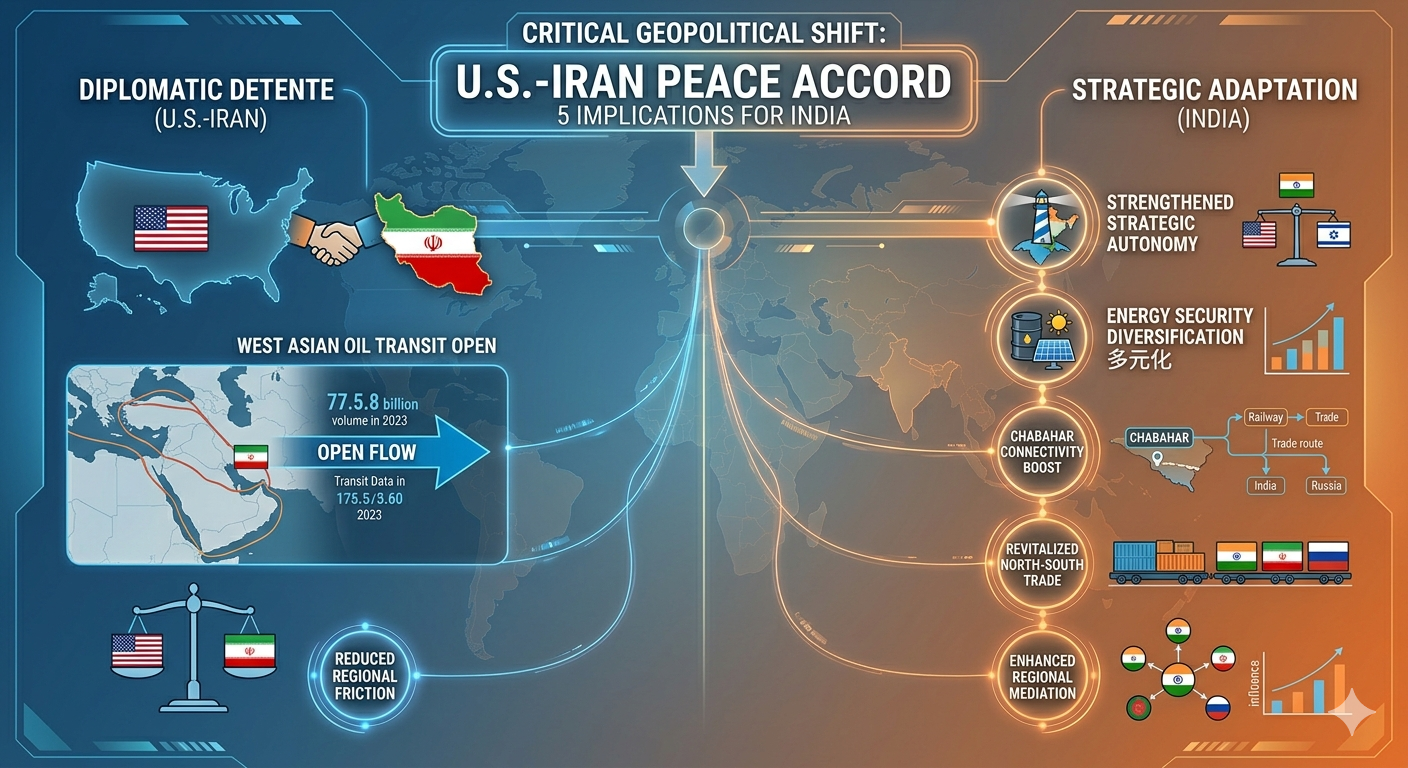
Today let us unpack how this sudden detente alters international relations and why analyzing this geopolitical shift is essential for the civil services examination. The geopolitical landscape witnessed an unexpected shift on June 16, 2026, as the United States and Iran announced a breakthrough preliminary peace agreement. This emergency memorandum of understanding aims to halt a hot war and lift the devastating naval blockade on the strategic Strait of Hormuz. For civil services aspirants, evaluating this shift through a diplomatic and economic lens is vital. Let us unpack how this sudden detente alters international relations and why analyzing this geopolitical shift is essential for the civil services examination.
What Happened? The 60-Day Emergency De-escalation
The military conflict involving the U.S., Israel, and Iran had brought maritime traffic in the Persian Gulf to a standstill. However, the U.S. Iran Preliminary Peace Accord of 2026 introduces a temporary 60-day mechanism to prevent a global energy collapse.
[Active Conflict & Blockade] ➔ [Preliminary Peace Accord] ➔ [60-Day Mine Removal & Open Transit]
Under this pact, the U.S. will terminate its naval blockade in the Gulf of Oman, while Iran will allow toll-free commercial shipping through the Strait of Hormuz. Tracking this sudden geopolitical shift helps students grasp how rapidly modern international conflict resolution operates under intense economic pressure.
Background: From the JCPOA Collapse to the 2026 Flare-Up
The roots of this crisis trace back to the collapse of the 2015 Joint Comprehensive Plan of Action (JCPOA). The subsequent expansion of regional proxy networks eventually led to direct military confrontations in early 2026.
Iran’s chokehold on the Strait of Hormuz the transit route for one-fifth of the world’s petroleum and liquefied natural gas (LNG) triggered severe supply disruptions. This initial disruption highlights why monitoring a geopolitical shift remains central to the International Relations syllabus.
Importance for India: Energy Security and Regional Stability
India relies heavily on West Asian crude oil and LNG imports, making the unblocking of the Strait of Hormuz a significant relief for its domestic economy.
| Dimension | Impact of Disruption | Impact of the 2026 Peace Accord |
| Crude Oil Prices | Spiked sharply, widening India’s CAD. | Expected stabilization of domestic fuel prices. |
| Trade Logistics | Exorbitant war-risk insurance premiums. | Restoration of normal maritime freight rates. |
| Strategic Projects | Disrupted progress on the Chabahar Port. | Renewed operational viability for regional connectivity. |
Understanding these economic variables demonstrates why evaluating a major geopolitical shift provides critical context for General Studies papers.
UPSC Relevance: Mastering General Studies Paper II & III
For civil services preparation, this peace accord links directly to the “Effect of policies and politics of developed and developing countries on India’s interests” section of the syllabus.
UPSC NUGGETS
- Strait of Hormuz: Links the Persian Gulf with the Gulf of Oman and the Arabian Sea. It serves as a primary global choke point.
- Chabahar Port: Located in southeastern Iran, providing India an alternate route to Afghanistan and Central Asia, bypassing Pakistan.
- Operation Sankalp: The Indian Navy’s maritime security initiative launched to safeguard Indian flagged vessels transiting through the Gulf region.
Aspirants must evaluate whether this 60-day window will lead to a permanent treaty or if it represents a temporary pause before further friction, showcasing how an unexpected geopolitical shift reshapes global alignment.
Key Takeaways: Material Constraints Overriding Ideology
The primary takeaway from this accord is that global economic integration forces nations to prioritize resource security over prolonged military conflict. The severe shortage of fuel and industrial components compelled both superpowers to seek immediate compromises. This balance between economic survival and military strategy shows why studying a geopolitical shift is essential for writing balanced analytical essays.
Prelims and Mains Analytical Angles

Prelims Angle: Questions may focus on West Asian geography, specific maritime choke points, or the mandates of international maritime bodies like the IMO and UNCLOS.
Mains Angle (GS Paper II): Questions may require an evaluation of India’s strategic autonomy during West Asian conflicts, analyzing how India balances its ties with Iran, Israel, and the United States amid a sudden geopolitical shift.
FAQs on the 2026 West Asian Crisis
Q1: What is the primary objective of the U.S.-Iran Preliminary Peace Accord?
A1: It serves as an emergency 60-day de-escalation mechanism to halt military operations, lift naval blockades, and restore international shipping through the Strait of Hormuz to prevent global economic destabilization.
Q2: How does this development impact India’s trade architecture?
A2: It reduces maritime freight costs, removes high war-risk insurance premiums, and stabilizes oil imports, while securing vital infrastructure projects like the Chabahar Port.
Q3: Why is the Strait of Hormuz considered a global strategic choke point?
A3: It carries approximately 20% of global petroleum liquids and LNG supplies. Any closure triggers direct inflation and supply chain shocks across major global manufacturing hubs.
Conclusion
The preliminary peace accord highlights that modern international conflicts are tightly constrained by global supply chains. While the 60-day window provides vital relief, India must continue diversifying its energy portfolio and expanding its strategic maritime capabilities to protect its interests against any future geopolitical shift.
Articles to refer and get deep into the affair :
Link to dynamic notes on: India’s Energy Security and Alternative Strategic Petroleum Reserves (SPRs).
Link to conceptual explainer on: The Geography of West Asian Choke Points: Mandeb, Hormuz, and Malacca.
Link to analysis article on: Evolution of India-Iran Relations from the Cold War to the Chabahar Pact.