

The geopolitical landscape of 2026 is shifting rapidly. As traditional international institutions struggle to maintain order, emerging alliances are stepping up to redefine how nations handle modern threats. On June 22–23, 2026, India took center stage by hosting the critical BRICS National Security Advisers’ (NSA) Meeting in New Delhi. Chaired by Indian NSA Ajit Doval, this high-level gathering focused intensely on the non-traditional security challenges confronting our world today. For civil services aspirants, this event provides vital material for both Prelims and Mains, exposing structural vulnerabilities within the current global security architecture.
What Happened at the BRICS NSA Meeting 2026?
Under India’s 2026 BRICS Chairship, the top security officials from the expanded 11-member bloc gathered in New Delhi. The primary agenda items revolved around cross-border terrorism, cybersecurity vulnerabilities, and the weaponization of emerging technologies like Artificial Intelligence (AI). The discussions aimed to forge a collective response to threats that bypass traditional military defense lines.
The meeting highlights how the bloc is shifting its focus from a purely economic cooperative framework to a robust political and security alliance. This transition underscores the urgent need to address deep-seated operational gaps within the failing global security architecture.
Background: The Evolution of BRICS and Security Cooperation
Originally formed as BRIC in 2006 and expanded to BRICS with South Africa’s entry in 2010, the group was initially viewed as an economic grouping of fast-growing markets. However, the expansion to 11 members including Egypt, Ethiopia, Iran, Saudi Arabia, and the UAE has fundamentally transformed its geopolitical weight.
India is hosting the BRICS Chairship for the fourth time in 2026, guiding conversations under the theme: “Building for Resilience, Innovation, Cooperation and Sustainability”. As Western-led bodies encounter gridlocks over ongoing conflicts, the global south is using platforms like BRICS to demand a complete overhaul of the global security architecture.
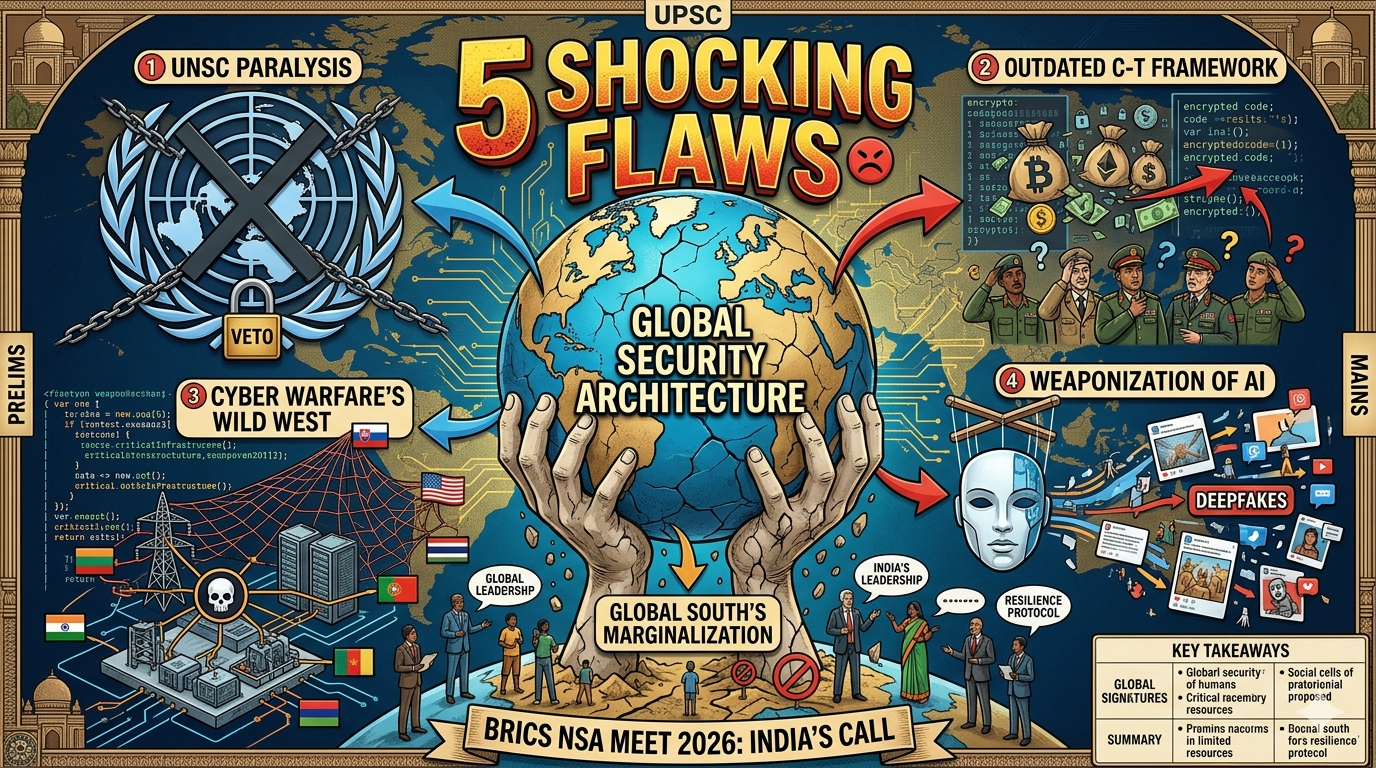
The 5 Shocking Flaws in the Global Security Architecture
The New Delhi discussions highlighted five severe weaknesses within our current global governance frameworks and global security architecture.:
I. Institutional Paralysis in the UNSC
The United Nations Security Council (UNSC) remains frozen by veto deadlocks among its permanent members. This inability to act effectively during major humanitarian and geopolitical crises leaves a dangerous power vacuum.
II. Outdated Counter-Terrorism Frameworks
Traditional mechanisms fail to address modern decentralized terror financing networks. Cryptocurrencies and encrypted communication channels allow bad actors to exploit regulatory loopholes left open by the current global security architecture.
III. The Wild West of Cyber Warfare
There are no binding global treaties governing state-sponsored cyberattacks or data espionage. Critical infrastructure across developing nations remains heavily exposed to digital disruption without an international legal framework for protection.
IV. Weaponization of AI and Deepfakes
Generative AI tools are actively being deployed to manipulate elections, spread disinformation, and disrupt social cohesion. Existing global security bodies lack the technical speed and agility required to regulate these fast-evolving digital threats.
V. Marginalization of the Global South
Decisions regarding global security policies are routinely dominated by Western powers, ignoring the immediate resource shortages, food insecurity, and climate vulnerabilities faced by developing countries within the global security architecture.
UPSC NUGGETS: BRICS AT A GLANCE
2026 Chairship: India (4th time hosting: 2012, 2016, 2021, 2026)
2026 Theme: Building for Resilience, Innovation, Cooperation and Sustainability.
11 Members: Brazil, Russia, India, China, South Africa, Egypt,Ethiopia, Iran, Saudi Arabia, UAE, Indonesia.
Core Pillars: 1) Political & Security, 2) Economy & Finance, 3) Cultural & People-to-People exchanges.
Strategic Importance for India
For New Delhi, chairing this meeting is a strategic balancing act. India must address its direct national security concerns while maintaining leadership within the Global South.
- Countering Cross-Border Terror: India used the platform to review the outcomes of the BRICS Joint Working Group on Counter-Terrorism, pushing for stricter enforcement against state-sponsored terror.
- Managing the China-Russia Dynamics: Despite bilateral border issues with China, engagement within BRICS ensures India retains a vital seat at the table, preventing the bloc from turning into an explicitly anti-Western front.
- Securing Digital Frontiers: By leading conversations on information security and ICT usage, India aims to set regional standards for a safer, more resilient global security architecture.
Key Takeaways from New Delhi 2026
The consensus built during the 2026 meet outlines a practical roadmap for handling non-traditional threats. The member nations agreed to enhance real-time intelligence sharing, standardize digital forensics, and establish joint protocols to counter cyber extortion.
Furthermore, the expansion of BRICS brings major energy players into a single forum, linking energy supply chains directly to regional stability. This economic interdependence serves as a stabilizing counterweight to the structural fragilities found in the wider global security architecture.
UPSC Exam Angle: Prelims & Mains Focus
Prelims Points to Remember
- BRICS Expansion: Remember the exact list of the 11 member nations. Watch out for elimination-style questions regarding recent additions like Ethiopia, Iran, and the UAE.
- Three Pillars: Understand that BRICS operates across three distinct structural pillars: Political, Economic, and Cultural.
- NSA Mechanism: The NSA forum reports directly to the Summit leaders, focusing specifically on intelligence cooperation and counter-terrorism initiatives.
Mains Analytical Framework (GS Paper II)
Mains Question: “The rise of plurilateral groupings like BRICS reflects a growing lack of trust in traditional multilateral institutions.” Critically analyze this statement in the context of emerging non-traditional security threats and the evolving global security architecture.
When writing this answer, structure your response by highlighting:
- The institutional paralysis of the UN and WTO.
- The rise of hybrid warfare, cyber threats, and algorithmic manipulation.
- How India balances its presence in both Western-aligned groups (like the QUAD) and non-Western groupings (like BRICS and the SCO) to safeguard its strategic autonomy.
Conclusion
The 2026 BRICS NSA Meeting in New Delhi emphasizes that security can no longer be defined solely by military hardware and border deployments. As asymmetric threats rewrite the rules of international relations, plurilateral forums are essential to fill the gaps left by traditional organizations. For India, leveraging its chairship allows it to protect its sovereign interests while helping shape a fairer, more democratic global security architecture.
Frequently Asked Questions (FAQs – global security architecture, BRICS 2026.)
Q1: Who chaired the 2026 BRICS NSA meeting?
The meeting was hosted and chaired by India’s National Security Adviser, Ajit Doval, in New Delhi.
Q2: What are non-traditional security challenges?
These are non-military threats such as cyberattacks, climate change, pandemics, cross-border terrorism, and the misuse of artificial intelligence.
Q3: How many member countries are currently in BRICS?
As of 2026, BRICS consists of 11 member nations: Brazil, Russia, India, China, South Africa, Egypt, Ethiopia, Iran, Saudi Arabia, UAE, and Indonesia.
Q4: Why is the BRICS NSA meeting important for India’s foreign policy?
It allows India to lead global south discussions on counter-terrorism and cybersecurity while maintaining strategic autonomy amid rising geopolitical competition.
To get into depth :
Learn more about the history of BRICS expansions in our comprehensive guide on “Evolution of Plurilateral Alliances.”