

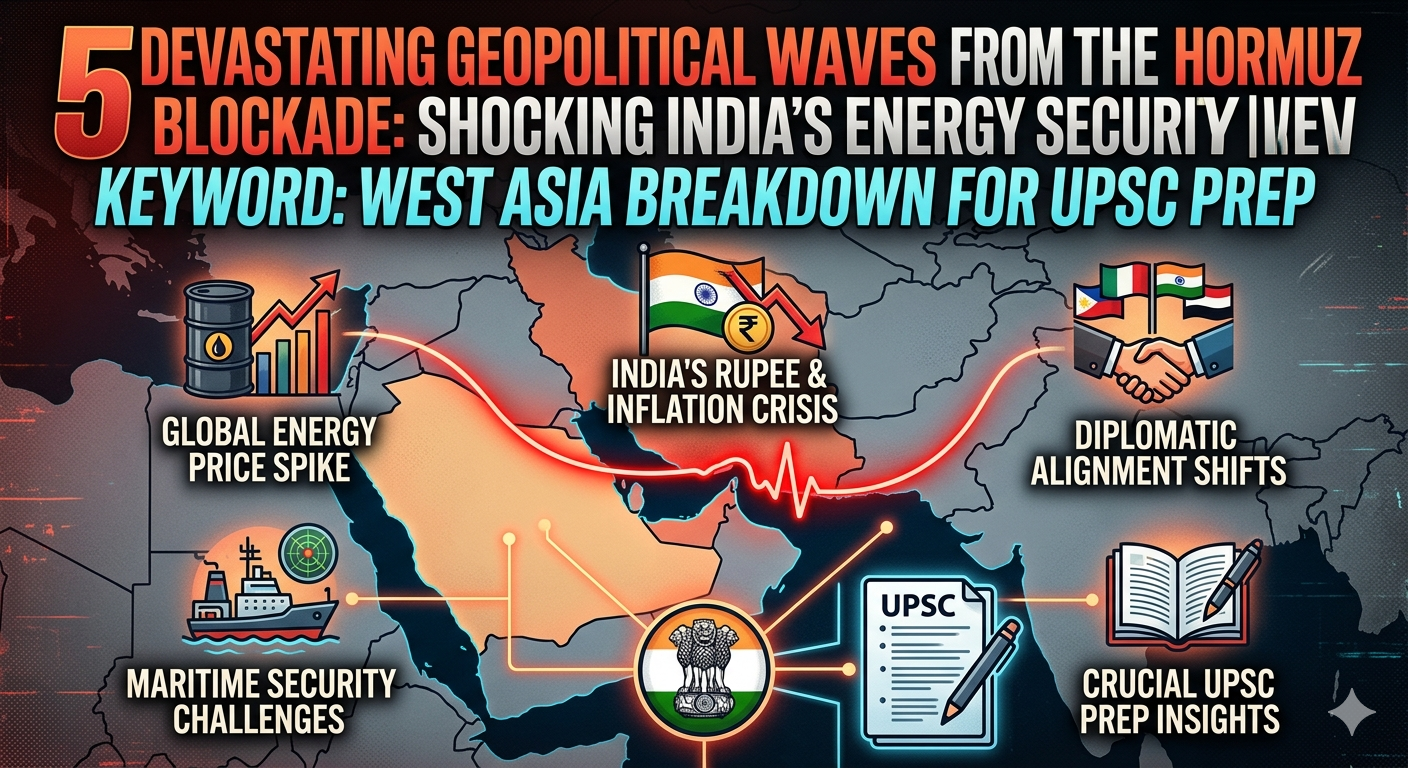
The global energy map is on fire and this is what you have to know for your UPSC prep. A dramatic series of escalating military strikes in West Asia has led to a declaration that has sent shockwaves through global markets: the complete closure of the Strait of Hormuz. For any serious aspirant navigating the daily current affairs cycle, this isn’t just another headline. It is a massive, multi-layered crisis that directly intersects with your GS Paper 2 (International Relations) and GS Paper 3 (Economy and Security) syllabus. Let’s strip away the mainstream media noise and deliver a sharp, exam-centric breakdown of this unfolding crisis for your West Asia breakdown for UPSC prep.
The Chokepoint Catalyst: Why Hormuz Changes Everything
The Strait of Hormuz is the most critical maritime oil chokepoint on the planet. Flanked by Oman and Iran, this narrow strip of water connects the Persian Gulf with the Gulf of Oman and the Arabian Sea. At its narrowest, the shipping lane is only two miles wide in either direction, making it highly vulnerable to military interdiction.
[Persian Gulf] —> (Strait of Hormuz: 2-mile shipping lanes) —> [Gulf of Oman] —> [Arabian Sea]
When escalating regional tensions culminate in a total blockade, global supply chains don’t just slow down they fracture. For India, which relies heavily on sea lines of communication through this zone, the strategic calculations shift overnight. Understanding the physical and political geography of this chokepoint is an absolute prerequisite for a solid West Asia breakdown for UPSC prep.
The Direct Hits: Indian Seafarers Caught in the Crossfire
This crisis is hit home with extreme proximity. Merchant vessels carrying Indian crews have faced direct kinetic strikes in the waters off Oman. The Guinea-Bissau-flagged bitumen carrier Jalveer, carrying 20 Indian seafarers, was hit by missile strikes in its engine room. While the crew was fortunately reported safe, the incident highlights a massive vulnerability.
India provides a massive share of the global merchant shipping workforce. When commercial lanes turn into active war zones, it creates an immediate consular, humanitarian, and security challenge for New Delhi. Tracking how India ensures the safety of its diaspora and seafaring assets is a high-yield focus area within any comprehensive West Asia breakdown for UPSC prep.
UPSC Nuggets: The High-Yield Fact Sheet
Geographic Coordinates: The Strait of Hormuz separates Iran to the north from the Musandam peninsula of Oman to the south.
Trade Volume: Approximately 20-30% of the world’s total consumption of liquid petroleum passes through this chokepoint daily, making it the ultimate global economic windpipe.
The Indian Navy’s Shield: In response to maritime security threats in this region, the Indian Navy historically deploys Operation Sankalp a dedicated maritime security operation to escort and protect Indian-flagged commercial vessels.
Syllabus Tagging: GS Paper 2 (Effect of policies and politics of developed and developing countries on India’s interests) & GS Paper 3 (Energy Security, Infrastructure).
Macroeconomic Shockwaves: The Rupee and Inflation Under Siege
The immediate economic fallout of a Hormuz blockade is felt at the domestic petrol pumps and in national reserves. Following the closure announcement, the Indian Rupee experienced a sharp depreciation, plunging 60 paise to look toward unprecedented lows against the US Dollar.
Hormuz Blockade —> Crude Oil Supply Disruption —> Global Oil Price Spike —> India’s Import Bill Inflates —> Rupee Plunges & Domestic Inflation Surges
Because India imports over 80% of its crude oil requirements, any disruption in West Asia instantly inflates our current account deficit (CAD). A spiking import bill means the Reserve Bank of India (RBI) must carefully recalibrate its monetary policy to fight imported inflation, directly impacting economic growth metrics. Mastering these interlinked economic indicators is essential for a high-scoring West Asia breakdown for UPSC prep response in Mains.
The Diplomatic Tightrope: Balancing Strategic Autonomy
Geopolitically, a blockade forces India to activate its delicate diplomatic balancing act. New Delhi maintains robust strategic partnerships with Washington, deep historical and energy ties with Iran, and crucial economic relations with the GCC (Gulf Cooperation Council) countries, particularly the UAE and Saudi Arabia.
When regional powers engage in direct military exchanges, India’s doctrine of strategic autonomy faces its ultimate test. India cannot afford to take sides blindly; it must safeguard its energy corridors while advocating for international law, freedom of navigation, and diplomatic de-escalation. Analyzing these multi-aligned diplomatic maneuvers forms the core of an advanced West Asia breakdown for UPSC prep.
The Strategic Imperative: Securing India’s Future Energy Map
If this blockade teaches us anything, it is that complete reliance on a single transit corridor is a profound security risk. This crisis underscores the absolute urgency of diversifying India’s energy map and transit infrastructure.
- Strategic Petroleum Reserves (SPR): India’s emergency oil storage facilities located at Visakhapatnam, Mangaluru, and Padur are designed to act as a cushion during sudden supply disruptions.
- Alternative Transit Corridors: Initiatives like the International North-South Transport Corridor (INSTC) and the India-Middle East-Europe Economic Corridor (IMEC) gain renewed strategic importance as alternate routes that bypass traditional chokepoints.
- The Green Transition: Accelerating the shift toward renewable energy, green hydrogen, and biofuels is no longer just an environmental goal it is a core national security imperative to reduce vulnerability to overseas maritime blockades.
Integrating these forward-looking policy solutions into your answers will distinguish your analysis in the civil services exam. Keep reviewing these dynamic geopolitical changes, keep your static foundations strong, and ensure your daily notes reflect a precise West Asia breakdown for UPSC prep.
Prelims-Style Practice Question
Q. Consider the following statements regarding the Strait of Hormuz:
- It connects the Persian Gulf directly with the Red Sea.
2. It is flanked by Iran to the north and Oman to the south.
3. The Indian Navy’s ‘Operation Sankalp’ was launched to ensure the safe passage of Indian vessels through the Gulf region.
Which of the statements given above are correct?
A) 1 and 2 only
B) 2 and 3 only
C) 1 and 3 only
D) 1, 2, and 3
Correct Answer: B) 2 and 3 only
Explanation: Statement 1 is incorrect because the Strait of Hormuz connects the Persian Gulf with the Gulf of Oman (which leads to the Arabian Sea), not the Red Sea. Statements 2 and 3 are factively correct and represent vital touchpoints for your ongoing West Asia breakdown for UPSC prep.