

For any civil services aspirant scanning the economic landscape, a quiet but seismic shift is occurring in India’s balance of payments. For months, debates have raged in corridors from the North Block to Dalal Street about the nature of capital flowing into the country. The publication of recent economic indicators highlighting a significant downturn in long-term foreign investment requires deep, structural analysis. To understand how India plans to sustain its ambitious infrastructure-led nation-building, one must examine the economics of falling net FDI in India and decipher what this trend implies for the nation’s macroeconomic stability.
Foreign Direct Investment (FDI) has long been considered the bedrock of non-debt-creating capital inflows for developing markets. Unlike volatile hot money, traditional FDI brings not just capital but technology, managerial best practices, and integration into global value chains. However, recent data highlights a stark divergence: while India’s domestic markets are booming and digital public infrastructure is expanding at an unprecedented rate, net FDI inflows have hit a multi-year low. This contraction forces us to re-evaluate the core structural drivers of our investment ecosystem.
Deconstructing the Downturn: Structural vs Cyclical Factors
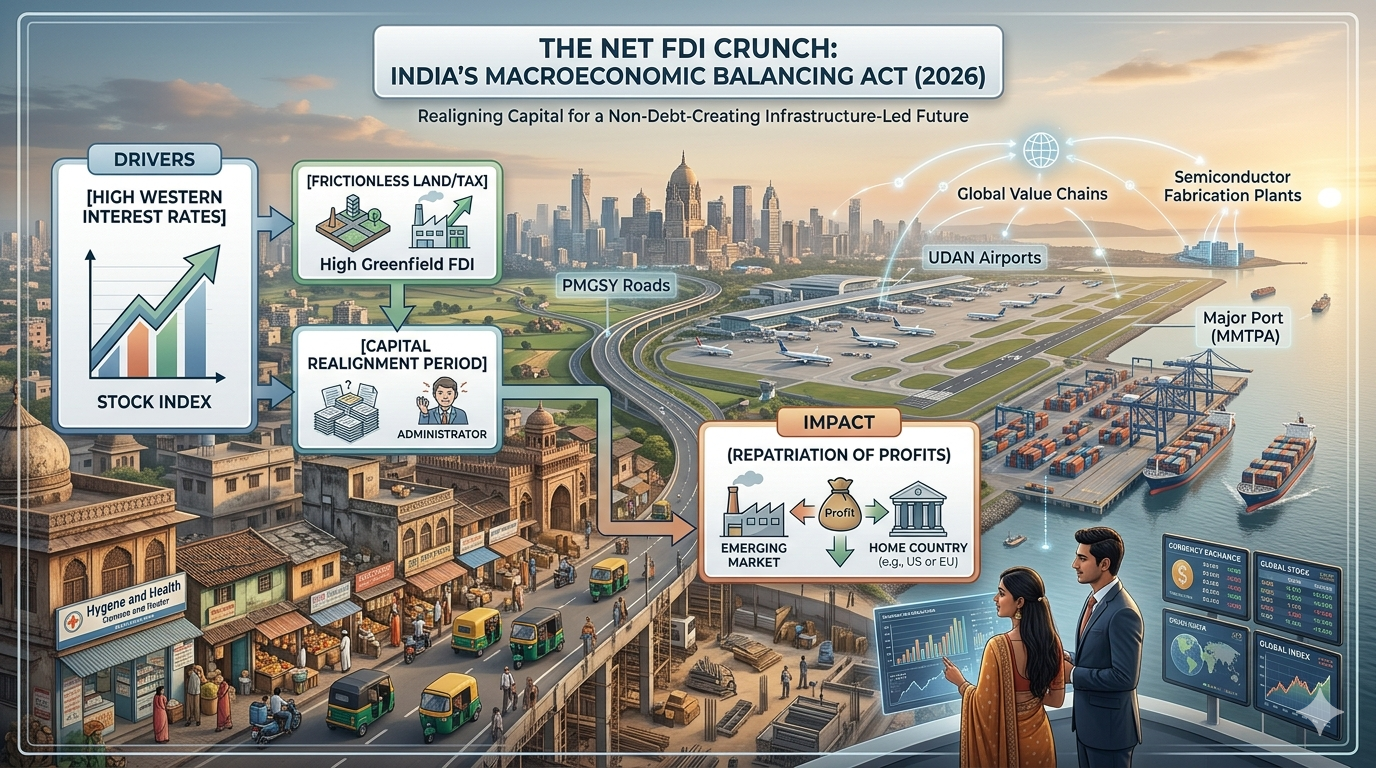
To write a high-scoring Mains answer for GS Paper 3 and learning more about the economics of falling net FDI in India, you cannot simply state that investments are declining. You must compartmentalize the phenomenon into structural and cyclical components. The current shift in capital dynamics is heavily influenced by external macroeconomic realities. Aggressive monetary tightening by major western central banks has fundamentally re-altered the global cost of capital. With higher interest rates in developed economies, the risk-adjusted return profile of emerging markets faces stiff competition.

Yet, external rate environments tell only half the story. A closer look at internal dynamics reveals that corporate restructuring and profit externalization by multinational corporations (MNCs) operating within our borders are accelerating. We are witnessing a phase where mature foreign enterprises are choosing to repatriate profits rather than reinvesting them domestically. This structural shift highlights that the economics of falling net FDI in India is heavily driven by capital realignment, where investors harvest gains from India’s initial digital boom to cushion balance sheets back home.
The Composition of Inflows: FPI Volatility vs FDI Stability
The most critical analytical mistake an aspirant can make in an economics essay is treating all foreign capital as a single monolithic block. We must draw a sharp line between short-term portfolio investments and fixed greenfield capital. While Foreign Portfolio Investment (FPI) into Indian equities has seen periodic surges due to our inclusion in global bond indices, this capital remains inherently flighty. It reacts instantly to minor geopolitical shocks, such as recent energy infrastructure tensions in West Asia.
Conversely, greenfield FDI directly leads to factory construction, employment generation, and capacity building. When net FDI drops, the structural quality of our capital account worsens, leaving the rupee more vulnerable to external shocks. Relying on short-term portfolio flows to finance structural deficits creates an unstable foundation. It is precisely why the economics of falling net FDI in India demands urgent intervention, as speculative market capital cannot substitute for long-term industrial commitment.
📌 UPSC Nuggets: GS Paper 3 (Economy & Infrastructure)
focus topic : The economics of falling net FDI in India
Syllabus Link: Mobilization of Resources, Growth, Development, and Employment; Investment Models.
Key Distinction for Prelims:
- FDI (Foreign Direct Investment): Investment exceeding 10% or more of the post-issue paid-up equity capital of a listed company, or any investment in an unlisted company. Represents long-term strategic control.
- FPI (Foreign Portfolio Investment): Investment less than 10% of the paid-up equity capital of a listed company. Represents financial investment without operational control.
Mains Analytical Angle: Examine how declining net FDI complicates India’s capital account management despite robust foreign exchange reserves. Factor in the rising import bill driven by recent global energy shocks.
The Infrastructure Paradox: Public Capital vs Foreign Gaps
This capital contraction and the economics of falling net FDI in India comes at a fascinating historical juncture. India is currently executing one of the largest infrastructure-led rollouts in modern history. From the massive budgetary expansions under the Pradhan Mantri Gram Sadak Yojana (PMGSY) to the doubling of operational airports under the UDAN scheme, public capital expenditure has been doing the heavy lifting. The state has successfully stepped in to build the foundational architecture of highways, ports, and rural tap water connectivity.
| Macroeconomic Metric (June 2026) | Status / Target | Strategic Vulnerability |
| Rural Road Connectivity (PMGSY) | 99.6% Habitations Linked | Requires High Domestic Maintenance Funding |
| Operational Airports (UDAN) | Doubled to 165 Airports | High Dependence on Imported Aviation Fuel |
| Major Port Capacity | Nearly Doubled (1,726 MMTPA) | Vulnerable to Global Maritime Supply Shocks |
| Net FDI Inflow Trend | Structural Multi-Year Decline | Risk of Technology Transfer Stagnation |
However, the fiscal math dictates that public spending cannot permanently replace private foreign equity. Government-led infrastructure creation is intended to crowd-in private investment. If international capital remains hesitant despite world-class physical logistics, it points to deeper micro-level friction points. Analyzing the economics of falling net FDI in India reveals that while our physical infrastructure is reaching world-class standards, regulatory complexities, contract enforcement timelines, and cross-border tariff structures continue to create caution among global boardrooms.
Regulatory Red Tape and Global Supply Chain Realignment
To unlock high marks in GS Paper 2 and 3 integration, your analysis of the economics of falling net FDI in India must look at the administrative realities that foreign firms encounter. Over the past few years, India has made massive strides in the Ease of Doing Business index, simplifying company registration and tax filings. Yet, land acquisition remains incredibly complex, leading states to experiment with voluntary alternatives like land pooling. When global electronics and automotive giants look to diversify away from traditional East Asian manufacturing hubs, they prioritize frictionless execution.

If local bureaucratic approvals take quarters instead of weeks, capital naturally diverts to nimbler alternative destinations in Southeast Asia. This tells us that the economics of falling net FDI in India is not merely a reflection of global monetary policy, but a warning that domestic policy execution speeds must match global standards. Our regulatory frameworks must evolve from being rule-bound gatekeepers to outcome-oriented facilitators if we want to reverse this trend.
The Strategic Path Forward: Rebuilding Investor Confidence
Reversing a structural decline in net foreign equity requires a comprehensive multi-pronged strategy. First, India must aggressively expand its manufacturing Production Linked Incentive (PLI) schemes beyond electronics into deep-tech and capital-intensive sectors like synthetic biology and semiconductor fabrication plants and bring change in the the economics of falling net FDI in India. These industries have long gestation periods but anchor trillions in permanent global capital once established.
Furthermore, we must deepen our economic diplomacy within plurilateral frameworks like the Quad and the Indo-Pacific Economic Framework (IPEF). By aligning our domestic data localization and tech governance policies with trusted international partners, we can build high-security supply corridors. Addressing the economics of falling net FDI in India is ultimately about building a predictable, legally stable, and transparent operating environment that assures long-term investors that their capital is both secure and poised for sustainable growth.
Conclusion: The Ultimate Test for India’s Economic Ambitions
For future civil servants, analyzing this foreign investment dip of the economics of falling net FDI in India provides a vital lesson in macroeconomic balance. A country cannot achieve its long-term development targets solely on the back of domestic retail trading or volatile portfolio capital. True economic sovereignty requires deep industrial partnerships funded by stable, long-term foreign equity.
As you prepare your notes for the upcoming Civil Services Examination, remember to link this topic across papers. Connect the decline in net FDI (GS3) with administrative governance reforms (GS2) and global supply chain geopolitics (GS2 – International Relations). Mastering the economics of falling net FDI in India requires looking beyond headline growth numbers to understand the complex, structural currents shaping the nation’s financial future.