

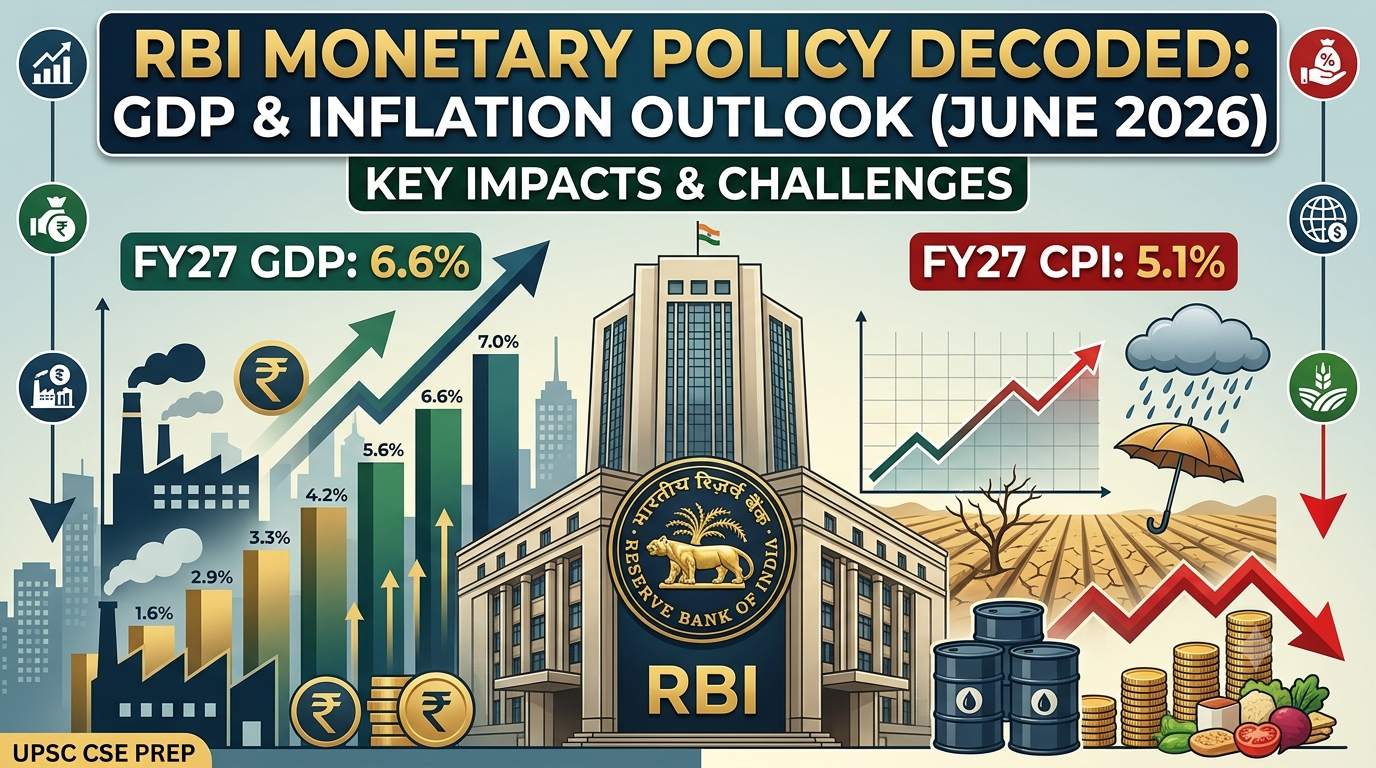
The Reserve Bank of India (RBI) recently concluded its highly anticipated Monetary Policy Committee (MPC) meeting for June 2026, sending significant ripples across the domestic and global financial markets. Under the leadership of the newly appointed RBI Governor, Sanjay Malhotra, the central bank decided to hold the benchmark repo rate steady at 5.25% while maintaining a strategic “neutral” policy stance. This decision highlights a delicate balancing act as policymakers attempt to insulate the domestic economy from intense supply-side shocks and shifting external vulnerabilities without dampening domestic credit expansion. Understanding the nuances of the latest RBI monetary policy announcement is essential for civil services aspirants.
Event Summary: The Status Quo Amidst Volatility
The June 2026 MPC meeting concluded with a unanimous vote to keep the RBI monetary policy repo rate unchanged at 5.25%. This marks the eighth consecutive time the central bank has opted for a status quo on key lending rates. Concurrently, the Standing Deposit Facility (SDF) rate stays locked at 5.00%, while the Marginal Standing Facility (MSF) rate and the Bank Rate remain at 5.50%. However, the real talking point of this review lies in the macroeconomic projections.
The RBI revised India’s real GDP growth forecast for FY27 downward to 6.6% from its earlier estimate of 6.9%. Conversely, the headline Consumer Price Index (CPI) inflation projection was raised sharply by 50 basis points to 5.1%. To counter external pressures, the bank introduced sweeping structural changes to boost foreign capital inflows. Aspirants analyzing the evolving nature of the RBI monetary policy must look beyond the unchanged repo rate to dissect these underlying structural adjustments.
Economic Significance of the June 2026 Updates
The downward revision of growth projections alongside rising inflation signals the return of supply-driven macroeconomic pressures. A major factor behind this recalibration is the global energy landscape, as the RBI raised its crude oil baseline assumption to $95 per barrel from $85 per barrel. This change comes in response to international crude prices averaging $110 per barrel due to the ongoing West Asia conflict. Furthermore, an alarming 42% deficit in monsoon rainfall recorded in early June 2026 threatens agricultural yields and threatens to trigger severe food inflation.
By shifting its policy focus to managing external vulnerabilities and stabilizing the Balance of Payments (BoP) rather than tightening domestic demand, the latest RBI monetary policy demonstrates an adaptive framework designed to safeguard India’s macroeconomic resilience against global cross-currents.
Key Benefits: Boosting Capital Inflows and Market Access
To offset the pressure of persistent foreign portfolio outflows, the central bank unveiled several bold regulatory updates to attract global capital. ( RBI monetary policy )
Scrapping Capital Gains Tax: The RBI completely eliminated the income and long-term capital gains taxes for Foreign Portfolio Investors (FPIs) investing in government securities.
Expanding the Fully Accessible Route (FAR): All new issuances of 15-year, 30-year, and 40-year government bonds are now open to foreign institutional buyers without any investment caps.
Liberalizing NRI and OCI Investments: Investment thresholds for Non-Resident Indians (NRIs) and Overseas Citizens of India (OCIs) in listed equities have been relaxed, bypassing mandatory SEBI registration.
These capital-enhancing mechanisms highlight how the current RBI monetary policy actively uses external liberalization tools to defend the Indian Rupee and maintain healthy foreign exchange reserves.
Policy Indicator – Rate / Projection
Repo Rate – 5.25% (Unchanged)
Standing Deposit Facility (SDF) – 5.00% (Unchanged)
Marginal Standing Facility (MSF) – 5.50% (Unchanged)
Revised Real GDP Growth (FY27) – 6.6% (Down from 6.9%)
Revised CPI Inflation Forecast (FY27 – 5.1% (Up from 4.6%)
Alarming Concerns: Stagflationary Headwinds in RBI monetary policy?
While the domestic economy remains fundamentally resilient, the sharp convergence of a slowing growth rate and rising price pressures creates complex policy challenges. Slower growth in new orders and international sales has caused India’s Services PMI to ease to 57.3 in June 2026, pointing to a cooling phase in the private sector. If high global energy costs and domestic monsoon deficits persist, input cost inflation could severely dent corporate profit margins.
Additionally, the central bank’s decision to restore the export proceeds realization period back to nine months from 15 months compresses the operational flexibility of domestic exporters. This protective stance reveals that the RBI monetary policy is currently operating with minimal room to maneuver, caught between accelerating supply-side inflation and slowing real economic momentum.
Government Response and Fiscal Coordination
The Union Government is working closely with the central bank to mitigate these external spillovers through proactive fiscal policy interventions. To shield consumers and industrial units from rising global energy prices, the government is ready to deploy an expansionary fiscal strategy driven by targeted subsidies. High collections of the Goods and Services Tax (GST), consistently exceeding ₹2.00 lakh crore, provide the government with the necessary financial cushion to absorb these subsidy bills without derailing the national fiscal consolidation path. This strong fiscal position allows the administration to focus heavily on capital expenditure and supply-chain infrastructure. This policy balance ensures that the structural goals of the executive align with the monetary stability targets set by the RBI monetary policy.
The UPSC Angle for RBI monetary policy : Connecting the Dots
For the UPSC Civil Services Examination, the decisions of the Monetary Policy Committee are highly relevant across both Prelims and Mains stages. In the Preliminary exam, direct conceptual questions regularly appear regarding the composition of the MPC, the legal mandates under the RBI Act of 1934, and the operational differences between the quantitative tools like SDF, MSF, and repo rates.
For the Mains (GS Paper III: Indian Economy), the focus shifts to analytical issues, such as the efficacy of monetary tools during supply-side shocks, the impact of global geopolitical tensions on domestic inflation, and mechanisms for management of the Balance of Payments. Evaluating how the RBI monetary policy interacts with external capital flows and exchange rate dynamics forms the core of advanced macroeconomics preparation.
UPSC Nuggets: Quick Facts for Aspirants into RBI monetary policy
The MPC Mandate: The Monetary Policy Committee is a statutory 6-member body mandated to maintain headline CPI inflation at 4% with a tolerance band of +/- 2%.
Accountability Mechanism: If headline inflation breaches the prescribed tolerance band (2% to 6%) for three consecutive quarters, the MPC is legally required to submit a formal report to the Central Government explaining the failure and detailing remedial measures.
SDF vs. Reverse Repo: The Standing Deposit Facility (SDF) has effectively replaced the fixed reverse repo rate as the primary floor tool for liquidity absorption. Unlike the reverse repo, the SDF does not require the RBI to provide government securities as collateral to commercial banks, making it a highly flexible asset management instrument.
Frequently Asked Questions from RBI monetary policy (FAQs)
Q1. Why did the RBI keep the repo rate unchanged despite rising inflation forecasts?
The MPC noted that the current inflation pressures are primarily driven by global supply-side disruptions (such as high oil prices) and weather conditions, rather than excessive domestic demand. Raising lending rates would not fix these supply-chain constraints but would impose unnecessary borrowing costs on domestic industries, harming economic growth.
Q2. What is the significance of the RBI maintaining a “neutral” policy stance?
A neutral stance indicates that the central bank is not committed to a specific directional path. It allows the MPC to remain nimble, keeping options open to either raise or cut interest rates in future cycles depending on how global geopolitics and the domestic monsoon unfold.
Q3. How does removing capital gains tax for FPIs benefit the domestic economy?
Scrapping this tax lowers transaction costs for foreign institutional investors buying Indian government bonds. This policy encourages strong foreign capital inflows, which helps finance the current account deficit, builds a stronger foreign exchange buffer, and stabilizes the volatile rupee.
Conclusion
The June 2026 monetary review underlines that while India remains one of the fastest-growing major global economies, it is not completely immune to external shocks. By balancing an unchanged repo rate with aggressive capital-account liberalization, the central bank aims to preserve domestic growth momentum while building a strong buffer against global volatility. For civil services candidates, maintaining a close watch on the evolution of the RBI monetary policy provides deep insights into the interconnected nature of fiscal and monetary management in a globalized world.