

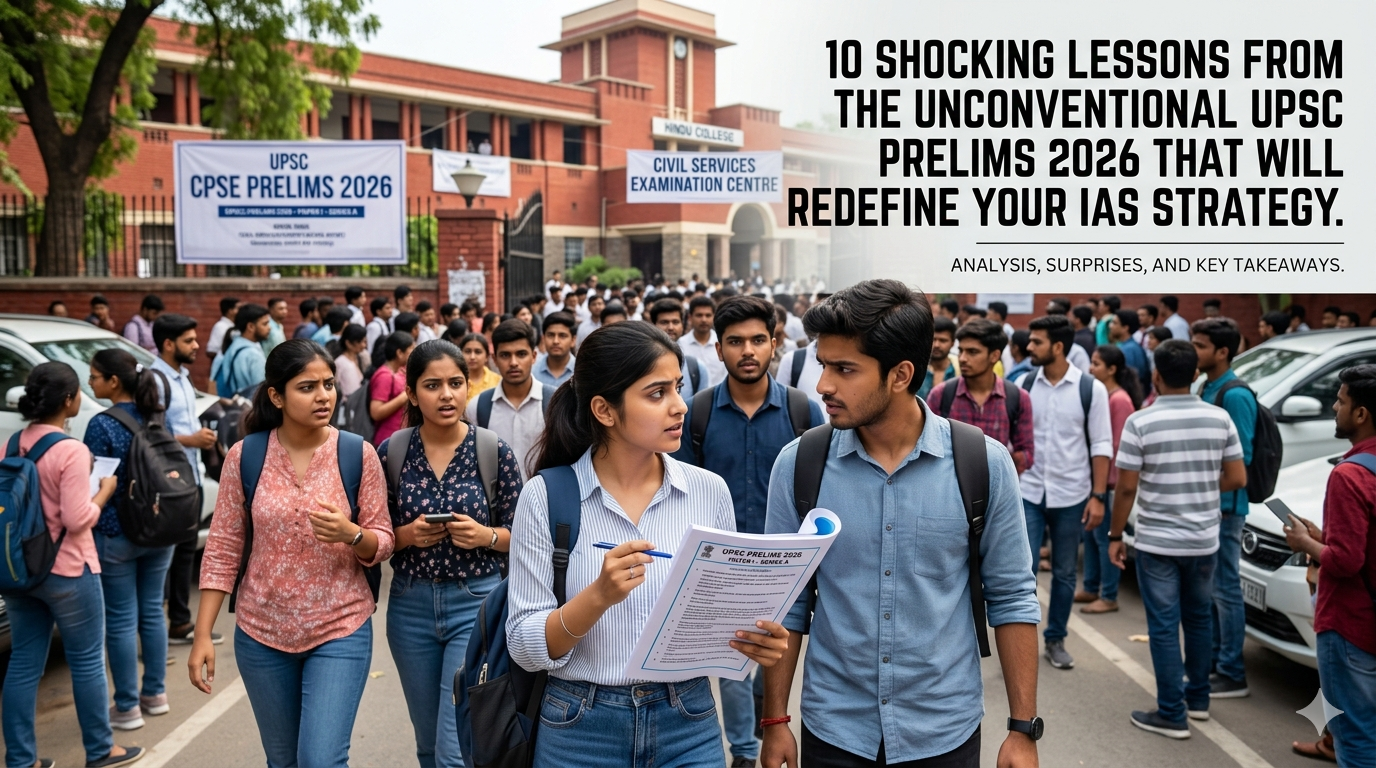
The dust has finally settled on the UPSC Prelims 2026 exam held yesterday, and if the collective collective gasp from exam centers across Rajinder Nagar and Mukherjee Nagar is any indication, the Union Public Service Commission has once again proven why it holds the crown for being delightfully unpredictable. For candidates who spent months memorizing static textbooks or relying on shallow summaries, the reality check was swift and brutal.
But out of the chaos comes clarity. The UPSC Prelims 2026 paper did not just test knowledge; it tested psychological resilience, decision-making, and administrative mindset right at the threshold level.
If you are a serious civil services aspirant planning your path forward, understanding the DNA of this specific paper is non-negotiable. Let’s dissect the spiciest shifts, the structural surprises, and the core strategic lessons from this year’s paper to ensure your preparation matches what the commission actually demands. Make sure you don’t miss any of them.
The Unexpected Intrusion of Ethics in GS Paper I
The biggest shockwave through the UPSC Prelims 2026 general studies booklet was the structural introduction of situation-based, analytical decision-making questions. Traditionally, evaluating an aspirant’s integrity, emotional intelligence, and bureaucratic judgment is strictly reserved for the GS Paper IV (Ethics) in the Mains examination.
This year, however, the commission broke the firewall. Candidates were confronted with complex administrative scenarios where they had to choose the most accountable, transparent, and legally sound course of action under acute pressure.
This paradigm shift means that constitutional law is no longer just about memorizing historical articles or parliamentary procedures. It is about visualizing yourself in the DM’s chair and applying those values in real-time.
Why the Standard Polity Strategy Completely Crashed
For years, the universal rule of thumb for civil services aspirants has been simple: master a single standard reference textbook for Indian Polity, memorize the amendments, and bank on those straightforward marks.
The UPSC Prelims 2026 effectively dismantled that safety net. Straightforward, factual questions on institutional frameworks were remarkably scarce. Instead, the focus pivoted heavily toward applied governance, judicial philosophies, and the deeper conceptual essence of rights.
Old Polity Focus: Article numbers, structural eligibility, and direct text.
2026 Polity Focus: Systemic accountability, ethical governance, and situational judgment
Aspirants who spent their year solely focusing on literal interpretations found themselves struggling with highly nuanced options that required structural deduction rather than rote recall.
The Deceptive Calm of CSAT Reading Comprehension
While the General Studies paper kept everyone on edge, the Civil Services Aptitude Test (CSAT) offered a mixed bag of psychological tricks. The reading comprehension segment turned out to be a temporary act of mercy by the commission.
Passages in the UPSC Prelims 2026 CSAT paper were relatively structured, coherent, and accessible, avoiding the overly convoluted jargon that has historically driven students to despair.
However, this accessibility was balanced by an intensely challenging Quantitative and Logical Reasoning section, which relied heavily on complex data interpretation and puzzle-solving matrices designed to drain a candidate’s clock.
History’s Unforgiving Turn Toward Deep Roots
If you built your history preparation around skimming modern freedom struggle timelines, the UPSC Prelims 2026 historical section felt like a calculated ambush. Modern Indian history took a back seat to an incredibly rigorous focus on Ancient India, Art and Culture, and Early Medieval socio-economic systems.
Questions covered intricate aspects of temple architecture, Harappan trade vectors, Rigvedic social terminology, and the historical geography of the ancient Tamilakam region.
The commission expects you to engage with history like an academic researcher, looking at the structural evolution of Indian society rather than treating it as a superficial sequence of dates and events.
Economy Reads Like a Fast-Paced Fintech Pitch
Economic concepts in the UPSC Prelims 2026 moved decisively away from generic textbook macroeconomics and landed squarely in the territory of modern digital finance and global macro-shocks.
The questions were highly contemporary, dealing with digital payment architectures, tokenization mechanisms, global bond yield dynamics, and Central Bank digital assets.
Understanding monetary policy now requires an active grasp of how financial technologies interface with institutional regulations, rendering old-school static notes thoroughly obsolete.
The Death of Separated “Current Affairs” Booklets
One of the most vital takeaways from the UPSC Prelims 2026 is that current affairs can no longer be treated as an independent subject that you can cram from a monthly compilation booklet in the final weeks before the exam.
The commission seamlessly blended current developments into the core static syllabus. A question on an environmental treaty or a science concept was deeply embedded in its foundational physics or biological principles.
If you do not understand the underlying science of a genome project or the structural geography of a region in the news, simply knowing the headline will not help you eliminate options.
To Stay prepared with such type of Current Affair Questions stay updated with dailyupscprep.in
Science and Technology is Fully Forward-Looking
The Science and Tech domain in the UPSC Prelims 2026 read like an advanced futuristic briefing. It focused aggressively on bleeding-edge innovations that have dominated global tech spaces over the last two years.
Aspirants faced deep conceptual questions on Large Language Models (LLMs), quantum computing frameworks, green hydrogen production efficiencies, and swarm drone defense architectures.
The clear message here is that surface-level awareness of terminologies is a recipe for failure; the paper demanded an analytical understanding of how these technologies function and their broader socioeconomic implications.
Environmental Sciences Expand to an Absolute Priority
Climate change, biodiversity loss, and resource geopolitics are no longer minor subsets of geography. In the UPSC Prelims 2026, environmental ecology asserted itself as a core pillar of the examination.
The paper tested candidates on highly specific ecological interactions, conservation statuses of obscure endemic species, and complex international supply chain regulations surrounding critical minerals and recycling incentives.
This structural expansion reflects the growing global and administrative emphasis on sustainable resource management, demanding that future bureaucrats be deeply ecologically literate.
The Elimination Technique Makes a Strategic Return
After being heavily suppressed by the “only one pair/only two pairs” formatting choices of recent years, a more nuanced variation of elimination strategies found a purpose in the UPSC Prelims 2026.
Because many questions used a situational or case-study style format, candidates could systematically eliminate options by applying core constitutional parameters, logical consistency, and administrative principles.
Success inside the examination hall was determined not just by absolute data retention, but by your presence of mind to spot contradictions and deduce answers rationally under immense stress.
A Revolutionary Wave of Systemic Transparency
Beyond the questions themselves, the broader ecosystem surrounding the UPSC Prelims 2026 marks a historic turning point for civil services reforms. For the first time in its history, the Commission has committed to releasing provisional answer keys shortly after the preliminary examination.
This structural shift allows candidates to access authoritative answers via the online Question Paper Representation Portal (QPRep) and submit material objections backed by verified sources within a specific window.
This break from old traditions significantly boosts candidate confidence, providing immediate structural clarity and removing the agonizing months of evaluation guesswork that previously characterized the post-prelims phase.
UPSC NUGGETS: Core Knowledge Frameworks for Your Notes
To help you bridge yesterday’s UPSC Prelims 2026 exam trends with your ongoing preparation, here is a highly structured conceptual reference mapping the exact operational areas highlighted by the commission.
Core Institutional & Policy Matrix
| UPSC Syllabus Segment | Core Theme Highlighted in 2026 | Key Analytical Focus |
| GS Paper II: Governance | Administrative Discretion & Ethics | Balances statutory rules with situational public interest and integrity. |
| GS Paper III: Economy | Macro-Fiscal & Digital Assets | Explores global bond yield transmissions and sovereign digital token architectures. |
| GS Paper III: Environment | Critical Mineral Geopolitics | Examines international supply chain resilience, circular economy regulations, and domestic recycling subsidies. |
| GS Paper III: Sci-Tech | Foundational AI & Quantum Systems | Analyzes structural operation frameworks of LLMs, quantum coherence, and green energy applications. |