

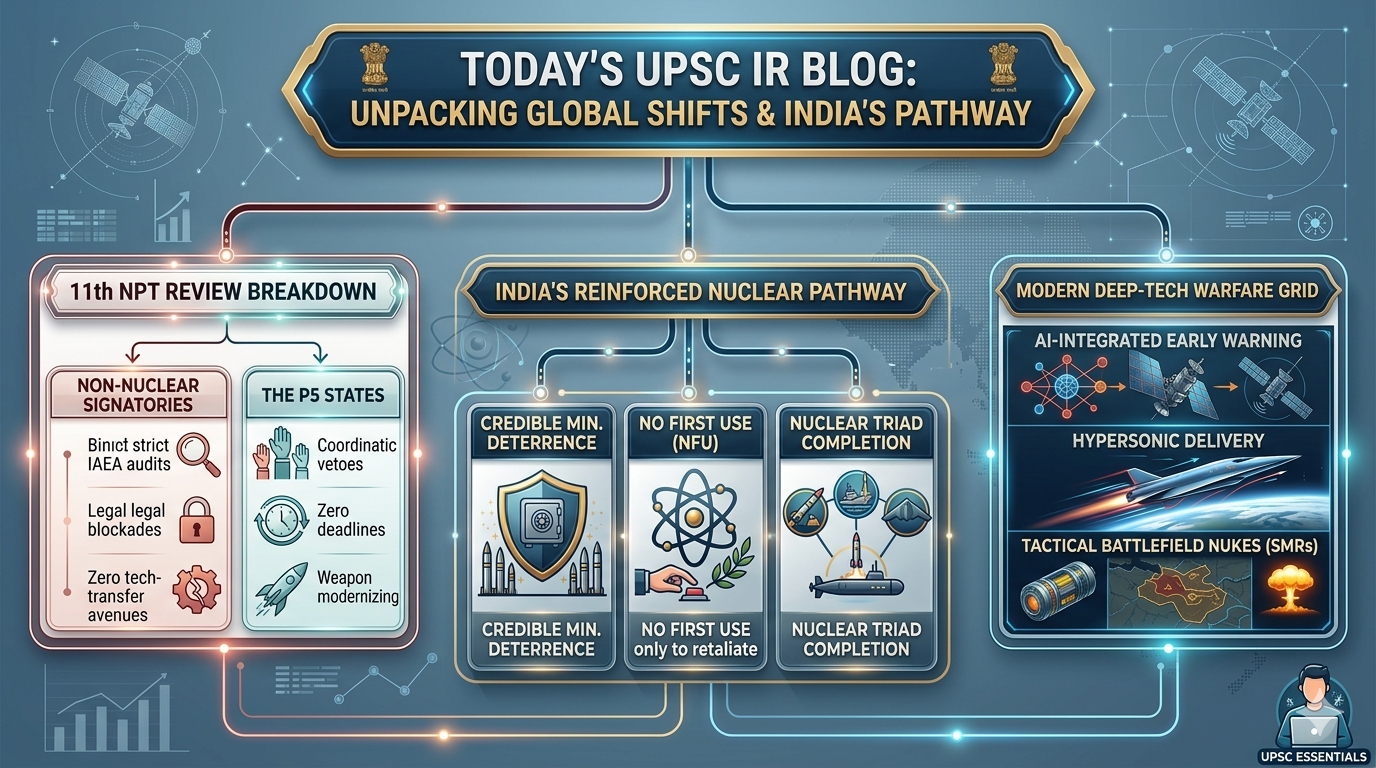
The 11th Review Conference of the Nuclear Non-Proliferation Treaty (NPT) has completely collapsed : Every serious UPSC aspirant knows that International Relations (IR) cannot be studied from static textbooks alone. The dynamic nature of geopolitical shifts demands that we constantly analyze institutional cracks. If you opened your newspapers this week, you probably noticed a seismic development
11th Review Conference of NPT is not just any ordinary news for a candidate preparing for GS Paper 2 (International Relations) and GS Paper 3 (Internal Security), it is a critical juncture. The debacle of this conference lays bare the deep systemic fault lines of our present global governance structures and directly redefines India’s strategic calculus.
Let’s break this big breakdown and relate it to your civil services syllabus and extract the high-yield analytical points that you need to outscore your competition in the coming Mains examination.
The Myth of “Vertical Disarmament” and the Asymmetric Enforcement Gap
The NPT’s central promise was a grand bargain: non-nuclear states pledged not to obtain atomic weapons, and the recognized five nuclear-weapon states (the P5: US, Russia, China, UK and France) pledged to pursue nuclear disarmament in good faith. This bargain has been exposed as a one-sided arrangement by the 2026 Review Conference.

The main reason for the failure of the 11th Conference of NPT was the collective refusal of the P5 to accept a specific timeline for the complete elimination of their active stock. The IAEA imposes strict intransigent monitoring systems on the non-nuclear states and is absolutely helpless against qualitative modernization programs of the big powers.
In the last negotiations, the P5 effectively used concerted diplomatic pressure to eliminate specific disarmament timeframes from later draft declarations. The naked double standard has wrecked what little consensus there was and ignited a firestorm of protest from the Global South. This collapse is a textbook case of institutional inertia in global governance bodies for an aspirant.
📌 UPSC NUGGET: GS Paper 2 Core Concepts
The Nuclear Non-Proliferation Treaty (NPT)
Origin: Opened for signature in 1968, entered into force in 1970. It was renewed indefinitely in 1995.
The Three Pillars: Disarmament, Non-proliferation and the Peaceful use of Nuclear Energy.
The Enforcement Gap: Article VI requires states to disarm but with no deadlines, verification mechanisms, or penalties for the P5.
India’s Position: India has been opposed to signing the NPT on the grounds that it is fundamentally flawed and discriminatory creating a status of “nuclear haves” and “nuclear have-nots.”
The Non-Signatory Paradox and India’s Realized Strategic Autonomy
A second structural bottleneck pushing the NPT toward irrelevance is what strategic experts call the Non-Signatory Paradox. The treaty is designed to police global security but completely ignores the nuclear-armed realities of India, Pakistan, Israel and North Korea (which withdrew in 2003).
The Western blocs had for decades been critical of New Delhi’s failure to sign the treaty. But the messy collapse of global nuclear bilateralism in the last few years has completely vindicated India’s position on strategic autonomy.

India was able to build a credible, independent nuclear deterrent while avoiding violation of its long-standing non-proliferation commitment by keeping itself away from a discriminatory legal text.
It is this track record that earned us a unique historic waiver from the Nuclear Suppliers Group (NSG) in 2008. Today, NPT members watch the global treaty system crumble around them. India stands tall as a responsible nuclear power with a steady, defensive posture.
How the Rise of Deep-Tech Warfare Accelerates Proliferation Risks
The collapse of this conference isn’t happening in an isolated political bubble; it coincides with an aggressive, multi-polar technology race. The rapid convergence of Artificial Intelligence (AI), quantum computing, and hypersonic delivery platforms has completely rewritten the classic laws of deterrence.

The ongoing tech race between global superpowers has shrunk response windows for early-warning systems down to mere minutes. Automated command systems mean that micro-seconds of computer lag could accidentally trigger an escalation.
Furthermore, the growing trend toward tactical, low-yield nuclear weapons has drastically lowered the threshold for actual battlefield usage. Because the outdated NPT architecture focuses entirely on conventional, large-scale systems, it is completely unequipped to monitor or regulate these complex, AI-driven risks.
How to Structurally Anchor This Topic in Your Mains Answers
When writing a high-scoring Mains answer on global security and nuclear policy, your arguments must be crisp, analytical, and tightly mapped to the official syllabus. Use this structured breakdown to build a balanced, compelling answer:
| Syllabus Paper | Core Analytical Dimension | High-Yield Technical Terms to Use |
| GS Paper 2 (IR) | Institutional breakdown of global bodies; structural bias of the P5 grouping. | Asymmetric Enforcement, Strategic Autonomy, Non-Signatory Paradox, Multipolar Deterrence. |
| GS Paper 3 (Security) | Border vulnerabilities, technological updates to regional security threats. | Credible Minimum Deterrence, Deep-Tech Convergence, Tactical Delivery Systems. |
Way Forward: Reimagining Global Nuclear Governance
If the international community wants to prevent total institutional collapse, global nuclear architecture must undergo a fundamental upgrade. This starts with moving away from the discriminatory P5-centric models and establishing a universal, non-discriminatory disarmament framework that brings all nuclear-armed nations to the table.
Furthermore, global verification systems must expand to regulate dual-use emerging technologies like AI-driven command loops and automated early-warning systems.
For India, our path forward is clear: we must maintain our focus on deep-tech self-reliance, strengthen our strategic partnerships across the Global South, and continue advocating for a fair, global commitment to complete, verifiable nuclear elimination.