

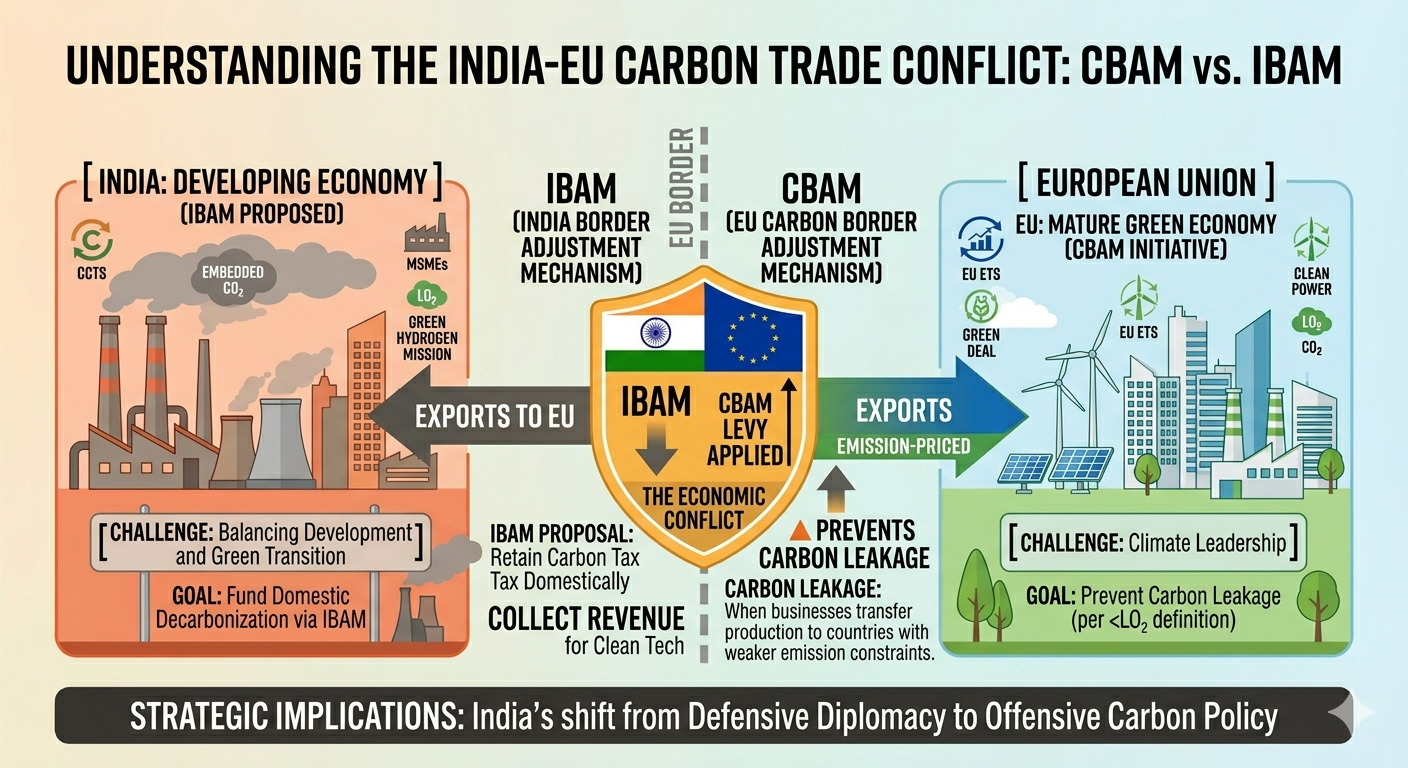
IBAM vs CBAM, The global trade architecture is witnessing its most significant shake-up since the establishment of the World Trade Organization (WTO). As European borders begin enforcement of the Carbon Border Adjustment Mechanism (CBAM), New Delhi has moved from defensive diplomacy to offensive policy-making. To ensure Indian industries are not crippled by external climate penalties, the government is actively preparing to launch its counter-strategy: the India Border Adjustment Mechanism (IBAM).
For a civil services aspirant, this development sits directly at the intersection of international trade, environmental economics, and climate justice. It is a brilliant, high-yield topic for GS Paper II (International Relations) and GS Paper III (Economy and Environment). Here is your deep-dive guide to understanding the geopolitical and economic wrestling match over carbon pricing.
The Genesis: Why the EU Created CBAM
The European Union’s CBAM is essentially a carbon border tax imposed on carbon-intensive imports entering the EU market. The primary objective is to prevent “carbon leakage.” This phenomenon occurs when EU-based companies, bound by strict domestic emission limits, move their production bases to countries with laxer environmental regulations to save costs.

By placing a financial tariff on imports based on their embedded emissions, the EU aims to create a level playing field. It officially targets six foundational, high-emission sectors: steel, aluminium, cement, fertilisers, electricity, and hydrogen. However, developing nations like India view this as a form of green protectionism that disproportionately penalizes developing manufacturing hubs.
Enter IBAM: India’s Strategy to Keep Carbon Money at Home
India has adopted a strong, legally sound position: if our exporters are required to pay a monetary penalty for their carbon footprint, the tax money should stay in India to finance our own green transformation rather than bolstering the coffers of Europe. The proposed India Border Adjustment Mechanism (IBAM) is structurally based on this.
India intends to impose its own carbon-related fee on exiting products headed for areas imposing CBAM-like regulations through the adoption of the India Border Adjustment Mechanism (IBAM). India’s recently implemented Carbon Credit Trading Scheme (CCTS) provides authority for this domestic collection. New Delhi can lawfully claim under WTO regulations that the embedded carbon has already been taxed by pricing emissions domestically before ships depart Indian ports. This would compel the EU to waive or drastically lower its border levy.
Structural Comparison: IBAM vs CBAM
To write a high-scoring Mains answer, you must clearly distinguish between the operational philosophies of these two competing trade and climate mechanisms.
| Feature | Carbon Border Adjustment Mechanism (CBAM) | India Border Adjustment Mechanism (IBAM) |
| Originating Power | European Union (EU) | Government of India |
| Primary Philosophy | Border tax to equalize carbon pricing and prevent leakage. | Revenue retention to fund domestic green transitions. |
| Target Sectors | Heavy industries (Steel, Aluminium, Cement, Fertilisers). | Aligned initially with CBAM-affected Indian exports. |
| Legal Backbone | EU Emissions Trading System (ETS). | Energy Conservation Act & Carbon Credit Trading Scheme (CCTS). |
| Revenue Destination | EU Budget / Climate Funds. | Indian Green Technology and Decarbonisation Funds. |
Geopolitical Implications and the Principle of CBDR
Common but Differentiated Responsibilities (CBDR), the cornerstone of international climate discussions, is once again in the forefront of the conflict between CBAM and the India Border Adjustment Mechanism (IBAM). CBDR, which was established under the 1992 UNFCCC, acknowledges that while all countries must combat climate change, industrialized nations have a greater financial ability and historical responsibility for world emissions.
CBAM essentially circumvents CBDR by levying a uniform carbon tariff on imports regardless of the economic standing of the nation of origin. It makes developing nations like India, whose millions of people are still trying to escape poverty, pay the same expenses for environmental compliance as highly industrialized Western Europe. In order to ensure that climate compliance does not come at the expense of industry stagnation or national economic growth, New Delhi has reasserted its strategic autonomy through the implementation of the India Border Adjustment Mechanism (IBAM).
UPSC Nuggets: Core Facts for Prelims & Mains
📌 Prelims Pointers: High-Yield Revision
- CBDR-RC: Standing for Common but Differentiated Responsibilities and Respective Capabilities, this remains India’s strongest legal anchor in international environmental disputes.
- Article XX of GATT: The WTO allows environmental exceptions under Article XX of the General Agreement on Tariffs and Trade. The legal battle over the India Border Adjustment Mechanism (IBAM) will hinge on whether carbon taxes qualify as valid environmental conservation measures.
- CCTS Authority: The Carbon Credit Trading Scheme in India is governed jointly by the Bureau of Energy Efficiency (BEE) and the Ministry of Power. Know this institutional mechanism cold!
📝 GS Papers II and III: Mains Analytical Framework
Climate financing Trap: Developed countries have mainly failed to meet their annual climate financing commitments of $100 billion. By taking money away from developing countries, mechanisms like CBAM exacerbate this imbalance.
Trade Competitiveness: The CBAM is expected to increase tariffs by 20–35% for the Indian steel and aluminum industries. Describe the economic protection provided by the India Border Adjustment Mechanism (IBAM).
The Economic Strain on Indian MSMEs and Heavy Industry
While large-scale conglomerates like Tata Steel or Hindalco possess the capital to overhaul their manufacturing lines and adopt green hydrogen, the story is starkly different for India’s micro, small, and medium enterprises (MSMEs). These smaller units form the deep tier-2 and tier-3 supply chains for larger exporters.
For these units, auditing, calculating, and certifying embedded carbon emissions is an administrative and financial nightmare. If European buyers reject Indian goods due to uncertified supply chains, millions of manufacturing jobs could hang in the balance. The implementation of the India Border Adjustment Mechanism (IBAM) aims to buffer this shock. By redirecting the collected carbon tax revenues into a dedicated domestic fund, the Indian government can specifically subsidize energy efficiency audits and green tech upgrades for struggling MSMEs.
The Way Forward: Navigating the New Green Trade Era
The introduction of the India Border Adjustment Mechanism (IBAM) is a necessary tactical maneuver, but it is not a permanent solution to global industrial decarbonization. India’s long-term economic security relies heavily on accelerating its transition toward cleaner production methods.
[ Counter-Tax (IBAM) ] ──► [ Domestic Revenue Retention ] ──► [ Green Subsidies for MSMEs ] ──► [ Clean Industrial Output ]
To secure our future trade pipelines, India must rapidly scale up its domestic green infrastructure. This includes executing the National Green Hydrogen Mission, fully operationalizing the broad-gauge railway electrification target, and expanding our production capacity for clean energy. By using the revenues generated by the India Border Adjustment Mechanism (IBAM) to directly fund heavy industry transition, India can transform an aggressive external trade barrier into an internal catalyst for sustainable, clean economic growth.
Syllabus Mapping & Answer Writing Practice
To seamlessly integrate this topic into your daily study routine, map these developments to these precise sections of the UPSC CSE syllabus:
- GS Paper II (International Relations): Bilateral, regional, and global groupings and agreements involving India and/or affecting India’s interests; Effect of policies and politics of developed countries.
- GS Paper III (Economy & Environment): Effects of liberalization on the economy, changes in industrial policy; Conservation, environmental pollution, and degradation.
💡 Mains Practice Question: “The European Union’s Carbon Border Adjustment Mechanism (CBAM) shifts the financial burden of climate action onto developing nations, violating the spirit of climate justice. Evaluate how the proposed India Border Adjustment Mechanism (IBAM) serves as an effective policy counter-response.” (250 Words, 15 Marks)
As the global trade paradigm shifts from price competitiveness to carbon compliance, mechanisms like IBAM will define India’s era of “offensive climate diplomacy.” For a UPSC aspirant, mastering these nuances is the key to transitioning from a generic answer to a high-scoring, bureaucratic analysis in GS Papers II and III. Stay ahead of the curve, keep mapping these macro-dynamic shifts to your syllabus, and remember that every policy challenge we study today is a blueprint for the governance you will handle tomorrow. Happy learning!