

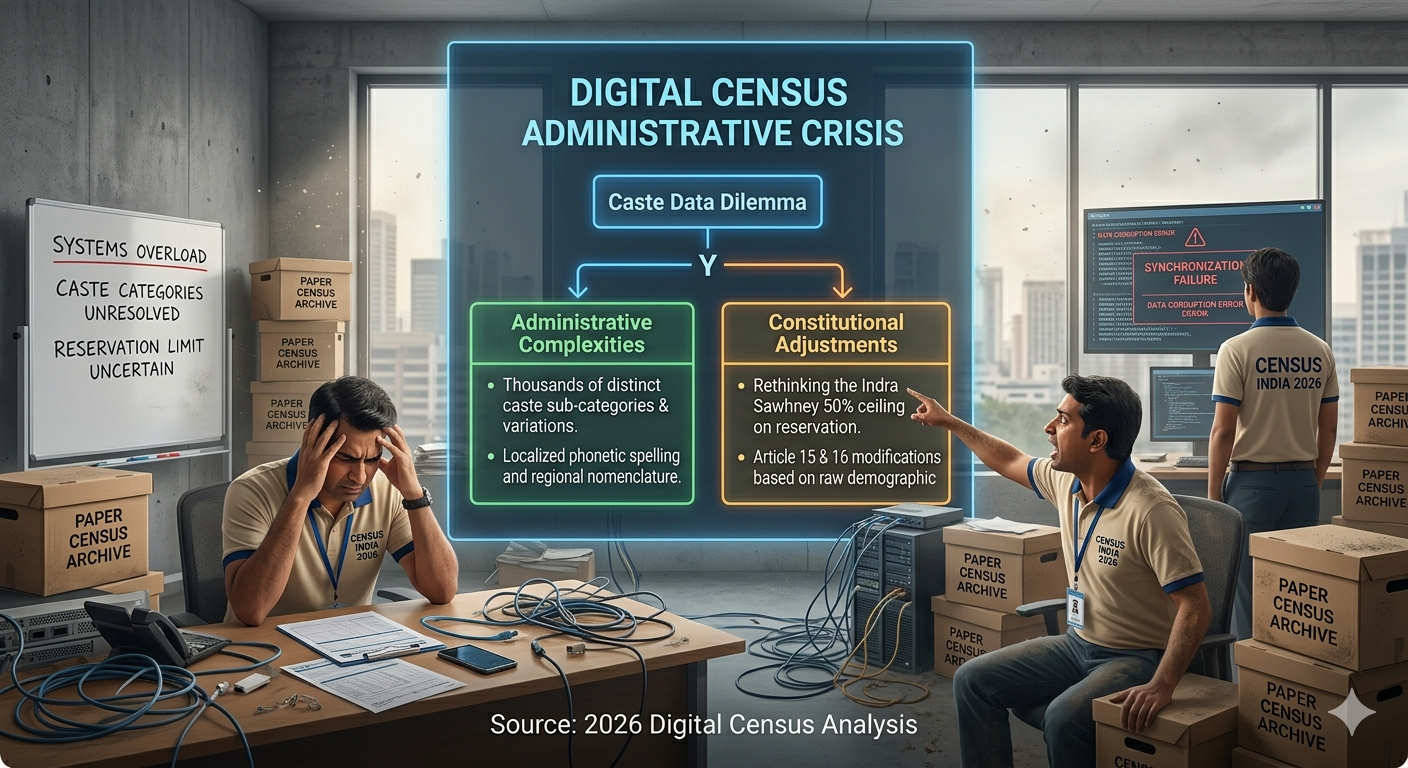
India is about to get a massive digital census administrative crisis shake as the national counting exercise finally gets underway. But this is not an ordinary head-count now. The upcoming exercise brings in structural changes that have set political corridors and academic circles on fire: a full-fledged caste enumeration for the first time since 1931 and a complete shift to a smartphone-based digital data collection infrastructure. For civil services aspirants trying to decode this development, this is a golden intersection of governance, technology, and social stratification. Understanding this digital census administrative crisis requires you to view this not as a mere logistical event, but as a tectonic shift in Indian federalism.
The Politically Charged Caste Enumeration Dilemma
The first major fault line in digital census administrative crisis is the sheer volatility of gathering comprehensive caste data across a highly diverse, multi-layered society. A caste census will give affirmative action and targeted delivery of welfare scientific accuracy, but the ground-level execution is a bureaucratic nightmare, activists say. The local surveys in states like Bihar and Karnataka did not merely yield perfect numbers; they led to significant socio-political tensions and immediate legal disputes regarding classifications. The basic problem is that caste identity in India is not a simple dropdown menu. There are thousands of sub-castes, synonyms and localized phonetic variants.
Analyzing this digital census administrative crisis highlights that any error in capturing this data directly compromises the implementation of constitutional protections. If a sub-caste name is misspelled or misclassified by an overworked field worker, an entire community could find themselves locked out of vital affirmative benefits. Furthermore, releasing this raw demographic data will inevitably lead to immediate structural demands to remove the 50% legal ceiling on reservations established by the landmark Indra Sawhney judgment. This shifts the debate from simple data collection to a fundamental restructuring of state-led welfare, altering the reservation landscape.

The Great Divide: Digital Literacy and Enumerator Preparedness
The second structural flaw in digital census administrative crisis is the sudden switch from a paper-based census to a fully digital one using smartphones, custom applications and self-enumeration portals. Digital tracking should enable real-time processing, and fewer mistakes in the transmission of data on paper. This transition in practice presumes a level of technological capacity that is not uniformly available across India’s administrative machinery. The bulk of the field enumeration is done by school teachers, local Anganwadi workers and junior municipal staff. For these people, doing complex data entry work on low-end mobile devices, combined with unreliable field connectivity, is a big operational challenge.
Unpacking this digital census administrative crisis means looking closely at the downstream effects of these systemic bottlenecks. During early technical trials, field workers reported frequent application crashes, data synchronization failures, and rapid battery depletion in remote areas. When an enumerator struggles with an unoptimized digital tool, their priority shifts from ensuring meticulous data accuracy to simply completing the digital form before the app times out. This operational friction directly risks under-counting vulnerable populations, including migratory workers, homeless individuals, and remote tribal communities who are already historically difficult to document accurately.
The Delimitation Domino Effect and Political Representation
The third digital census administrative crisis, and perhaps the most serious, structural problem relates to the integration of this digital data set with the forthcoming delimitation of parliamentary constituencies. Under the de facto enumeration methodology, citizens are enumerated at their place of residence during the tracking period. This residential counting mechanism results in a stark disconnect between real census numbers and local voter registration databases. These specific numbers will be hugely consequential for the number of Lok Sabha seats in the future. So any localized error in the data can directly change political representation for the next few decades. This only increases the political divide between states.
Evaluating this digital census administrative crisis requires analyzing these political realities. Southern states have successfully implemented population stabilization policies over the last few decades, while Northern states have seen significant demographic growth. If seat allocation is adjusted strictly based on the new population metrics, Southern states stand to lose relative representation in Parliament despite fulfilling national development goals. This creates a fundamental strain on cooperative federalism, turning a statistical exercise into an existential political battleground over the balance of democratic power within the Indian Union.
Cyber Risks and Data Security Vulnerabilities
The last fault line in digital census administrative crisis is the enormous security risks that come with centralizing sensitive citizen data like never before. Malicious actors would be very interested in obtaining the caste identities, economic indicators, biometric data and personal details of over 1.4 billion citizens. In a time of sophisticated cyber warfare and complex digital profiling of every citizen, one security breach could endanger the sovereign security of the entire population. Before rolling out collection tools, the state needs to build an ironclad wall against these modern threats.
Approaching this digital census administrative crisis requires strict adherence to privacy parameters. India’s current data protection framework is still evolving, and local government bodies often lack the cybersecurity infrastructure required to defend against state-sponsored hacking or corporate data mining. If unauthorized entities gain access to this centralized repository, it opens the door to predatory commercial targeting, political manipulation, and deep social engineering. Without localized data encryption and clear access protocols at every tier of government, the entire digital infrastructure remains a high-risk security liability.
| Dimension | The De Facto Counting Reality | The Administrative Impact |
| Demographic Skew | Urban clusters swell artificially due to seasonal labor migration. | Distorts the true seat-to-population ratio across state lines. |
| Political Friction | Southern states face a relative loss of seats due to successful population stabilization. | Challenges core concepts of cooperative federalism. |
| Security Risks | Massive centralized cloud hosting of sensitive citizen data. | High risk of state surveillance or unauthorized corporate profiling. |
UPSC Nuggets: High-Yield Exam Pointers
To help you seamlessly integrate these current developments of digital census administrative crisis with your core civil services syllabus, here is a consolidated breakdown of the essential touchpoints for General Studies Paper I, II, and III.
GS Paper I (Indian Society)
- Mandal Commission (1980): Recommended 27% reservation for Other Backward Classes (OBCs), which relied heavily on 1931 census estimates. The upcoming exercise will provide the first objective, updated baseline to verify or adjust these parameters.
- Caste as a Stratification Metric: Understand how the institutionalization of caste data impacts social mobility and modern caste styling.
GS Paper II (Governance & Polity)
The Delimitation Puzzle: Article 82 mandates the readjustment of parliamentary seats after each census. Pay close attention to how the 84th Constitutional Amendment Act of 2001 froze this process until after the first census post-2026.
Constitutional Backing: Understand the interaction between Article 340 (appointment of a Commission to investigate the conditions of backward classes) and the legislative mandate of the Census Act, 1948.
GS Paper III (Internal Security & Economy)
- Data Privacy Benchmarks: Connect these digital data collection risks with the supreme court’s landmark K.S. Puttaswamy judgment, which established privacy as a fundamental right under Article 21.
- Fiscal Federalism: Analyze how the Finance Commission utilizes population percentages as a core metric for horizontal tax devolution among states, and how a digital shift alters these critical formulas.
Conclusion: Balancing Social Equity with Administrative Security
The 2026 digital census is far more than a technical transition; it is a profound exercise in redefining state capacity and the relationship between the citizen and government data. To master this digital census administrative crisis, you must learn to look past regular news headlines and critically assess the structural balance between social equity and administrative safety. While the inclusion of comprehensive caste in digital census administrative crisis tracking can provide the empirical clarity needed to fine-tune welfare systems, doing so through a fragile digital pipeline risks introducing widespread operational errors. If the state hopes to transform this massive exercise into a reliable foundation for future governance, it must immediately address field-level technical gaps, protect individual data privacy, and ensure that the ultimate political outcome strengthens, rather than fragments, India’s cooperative federal framework. This digital census administrative crisis can be the most important part of your syllabus, so stay prepared and remember the cores.