

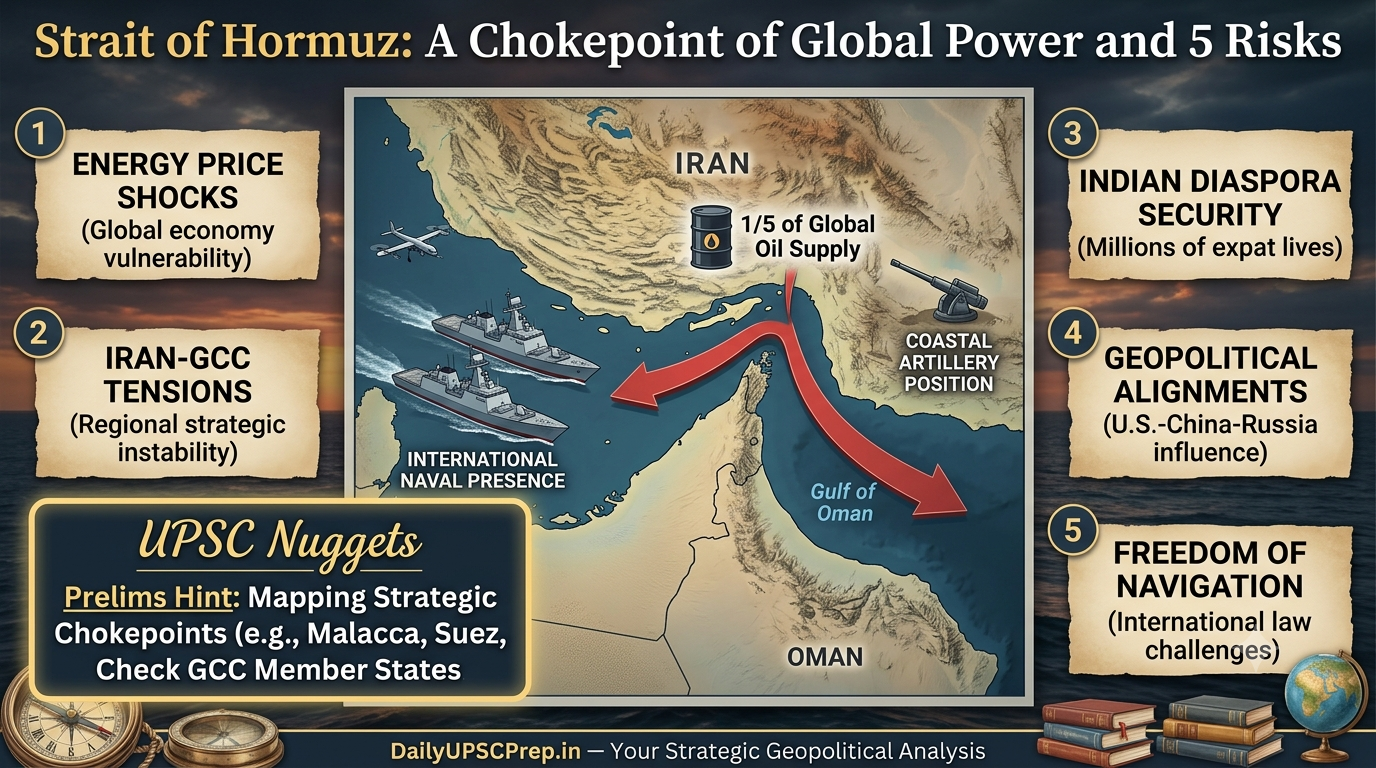
The global energy architecture is facing unprecedented tremors as crucial maritime chokepoints increasingly transform into volatile theatres of war. In mid-2026, maritime traffic through the Persian Gulf has ground to a near-total standstill following a sudden escalation of regional military conflict. This disruption has triggered an acute energy supply shock, sending global crude prices surging and fracturing vulnerable international value chains. For India, a country deeply dependent on foreign hydrocarbon imports, the ongoing Strait of Hormuz crisis presents a multifaceted challenge that spans across foreign policy, maritime security, and domestic macroeconomic stability.
What Happened? The 2026 Flashpoint
The current situation represents a profound shock to global commerce, given that nearly one-fifth of the world’s petroleum and liquefied natural gas supplies pass through this narrow waterway daily. Although a fragile, temporary ceasefire has recently been mediated by international actors, market anxieties remain deeply entrenched. Analysts point out that the highly volatile security environment threatens to permanently alter traditional shipping routes and drastically inflate insurance premiums for commercial cargo vessels. As the international community scrambles to find alternative supply corridors, the Strait of Hormuz crisis continues to loom large over Asian economies, forcing nations to re-evaluate their strategic petroleum reserves.
+-------------------------------------------------------------+
|             THE GEOGRAPHIC CHOKEPOINT AT A GLANCE           |
|                                                             |
|   [ Persian Gulf ] ---> ( Strait of Hormuz ) ---> [ Gulf of |
|                                                     Oman ]  |
|          |                     |                      |     |
|    North: Iran            Width: ~21 miles       South: Oman|
+-------------------------------------------------------------+
Historical Background of the Chokepoint
To understand the absolute gravity of the current situation, civil services aspirants must examine the historical context of this strategic chokepoint. The strait, bounded by Iran to the north and Oman to the south, connects the oil-rich Persian Gulf with the Gulf of Oman and the Arabian Sea. It has historically been a geopolitical flashpoint, heavily weaponized during the historic “Tanker Wars” of the 1980s. The current 2026 flare-up stems from long-simmering diplomatic standoffs and sudden, sophisticated strikes on port installations. The persistence of the Strait of Hormuz crisis highlights the vulnerability of global trade to localized conflicts, serving as a stark reminder of how geography shapes modern international relations.
The weaponization of maritime chokepoints is not a entirely new phenomenon, but the introduction of advanced drone warfare and anti-ship ballistic missiles has amplified the danger exponentially. In 2026, the deployment of autonomous systems has paralyzed traditional naval escort missions, creating an unpredictable risk environment. The international trade community is realizing that conventional maritime deterrence frameworks are struggling against these asymmetric, low-cost threats. This systemic vulnerability has drastically exacerbated the Strait of Hormuz crisis, causing international shipping lines to completely reroute vessels around the Cape of Good Hope, adding massive delays and compounding global inflationary pressures.
Key Stakeholders in the Conflict
Multiple stakeholders are deeply entangled in this complex geopolitical matrix, each driven by competing strategic imperatives. Primarily, regional powers like Iran hold immense asymmetric leverage due to their direct geographic command over the northern coast of the waterway. On the other hand, global powers like the United States are attempting to enforce maritime freedom of navigation while navigating domestic political transitions and shifting alliance priorities. The clash of these security architectures means that any localized skirmish can instantly snowball into a prolonged Strait of Hormuz crisis, disrupting regular diplomatic channels and pushing regional stability to the absolute brink.
Beyond the primary military combatants, major Asian consumers like China, Japan, and India are the most severely impacted collateral stakeholders. These emerging and developed industrial giants depend heavily on the uninterrupted flow of West Asian crude to sustain their domestic economic growth engines. The disruption has triggered intense diplomatic maneuvering, with Asian capitals seeking direct assurances from regional players to safeguard their state-owned energy shipments. Consequently, the resolution of the Strait of Hormuz crisis is no longer just a Middle Eastern territorial concern but a critical priority for global economic governance and multi-lateral energy diplomacy.
Critical Impacts on India
1. Energy Security and Fiscal Strain
For New Delhi, the stakes could not be higher. India imports over 80 percent of its crude oil requirements, a significant portion of which originates from the Persian Gulf region. A prolonged blockage of this maritime artery threatens to upend India’s fiscal math by widening the current account deficit and stoking domestic inflation. The cascading effects on fuel prices directly impact transportation costs, food security, and manufacturing competitiveness, making the Strait of Hormuz crisis an immediate threat to India’s national development objectives and macroeconomic stability.
2. Diaspora and Remittance Vulnerabilities
Furthermore, India’s strategic interests in the region extend beyond crude oil to include the safety of millions of Indian expatriates living and working in the Gulf Cooperation Council (GCC) nations. The economic shockwaves generated by the conflict could potentially impact employment stability and trigger a mass repatriation emergency. Additionally, any decline in inward remittances would put severe pressure on India’s balance of payments. Therefore, managing the fallout of the Strait of Hormuz crisis requires a delicate balancing act of proactive diplomacy, maritime evacuation readiness, and robust macroeconomic contingency planning.
UPSC Relevance: Connecting the Dots (Strait of Hormuz crisis)
General Studies Paper II (International Relations)
From a civil services examination perspective, this topic is highly relevant across multiple papers of the UPSC syllabus. In GS Paper II, it perfectly exemplifies the concept of ‘geopolitics of energy’ and the impact of regional conflicts on India’s strategic interests. Aspirants must analyze New Delhi’s “Link West” policy and how the current turmoil tests India’s strategic autonomy. Unpacking the complex dynamics of the Strait of Hormuz crisis helps students develop a nuanced understanding of bilateral relationships in a rapidly evolving multipolar world order.
General Studies Paper III (Economy & Security)
Similarly, in GS Paper III, this issue intersects directly with economic development, infrastructure resilience, and internal maritime security. The vulnerability of maritime supply lines highlights the urgent need for diversifying energy sources, accelerating the transition to renewable energy, and expanding the Strategic Petroleum Reserves (SPR) program. Evaluating the economic vulnerabilities exposed by the Strait of Hormuz crisis allows future administrators to conceptualize resilient policy frameworks that can shield the domestic market from external geopolitical shocks.
📌 UPSC Nuggets: Prelims Pointer
- Geographical Dimensions: The Strait of Hormuz connects the Persian Gulf (west) with the Gulf of Oman and the Arabian Sea (east).
- Choke Point Width: It is remarkably narrow, with its narrowest point being around 21 miles (33 km) wide. The actual shipping lanes are just 2 miles wide in either direction, separated by a 2-mile buffer zone.
- Strategic Islands: Pay close attention to mapping questions regarding islands like Abu Musa, and the Greater and Lesser Tunbs, which have historically been subjects of territorial disputes.
- Operational Context: The unfolding Strait of Hormuz crisis underscores why tracking these specific geographical features and surrounding littoral states is vital for scoring well in the civil services exam.
Conclusion
In conclusion, the ongoing turmoil in the Persian Gulf serves as a critical wake-up call for global energy governance and maritime diplomacy. While temporary truces offer brief windows of relief, a permanent solution requires addressing the core geopolitical animosities dividing the region. For India, the path forward lies in strengthening maritime security cooperation, deepening strategic ties with alternative energy producers, and rapidly scaling up domestic clean energy infrastructure. Ultimately, navigating the turbulent realities of the Strait of Hormuz crisis will test the true resilience of India’s strategic autonomy and diplomatic finesse.
Frequently Asked Questions (FAQs)
Q1: Why is the Strait of Hormuz called a strategic chokepoint?
A1: It is called a chokepoint because it is a narrow navigable channel through which a massive volume of global trade passes. Approximately 20% of the world’s petroleum liquids flow through it, making its closure catastrophic for global energy markets.
Q2: How does a crisis in the Middle East directly affect a common citizen in India?
A2: A disruption like the Strait of Hormuz crisis spikes global crude oil prices. Since India imports most of its oil, higher global prices lead to expensive domestic petrol and diesel, which increases transport costs and inflates the prices of everyday essential commodities.
Q3: What alternatives does India have to counter such maritime disruptions?
A3: India is actively working on diversifying its energy imports (sourcing from Russia, Africa, and the Americas), expanding its Strategic Petroleum Reserves (SPR) to store buffer crude, and accelerating its transition to renewable energy to reduce import dependency.
[…] the broader geopolitical landscape. If you are new to this topic, start with our analysis of the 5 Devastating Repercussions of the Strait of Hormuz Crisis: A Critical Geopolitical Analysis to understand its global […]