

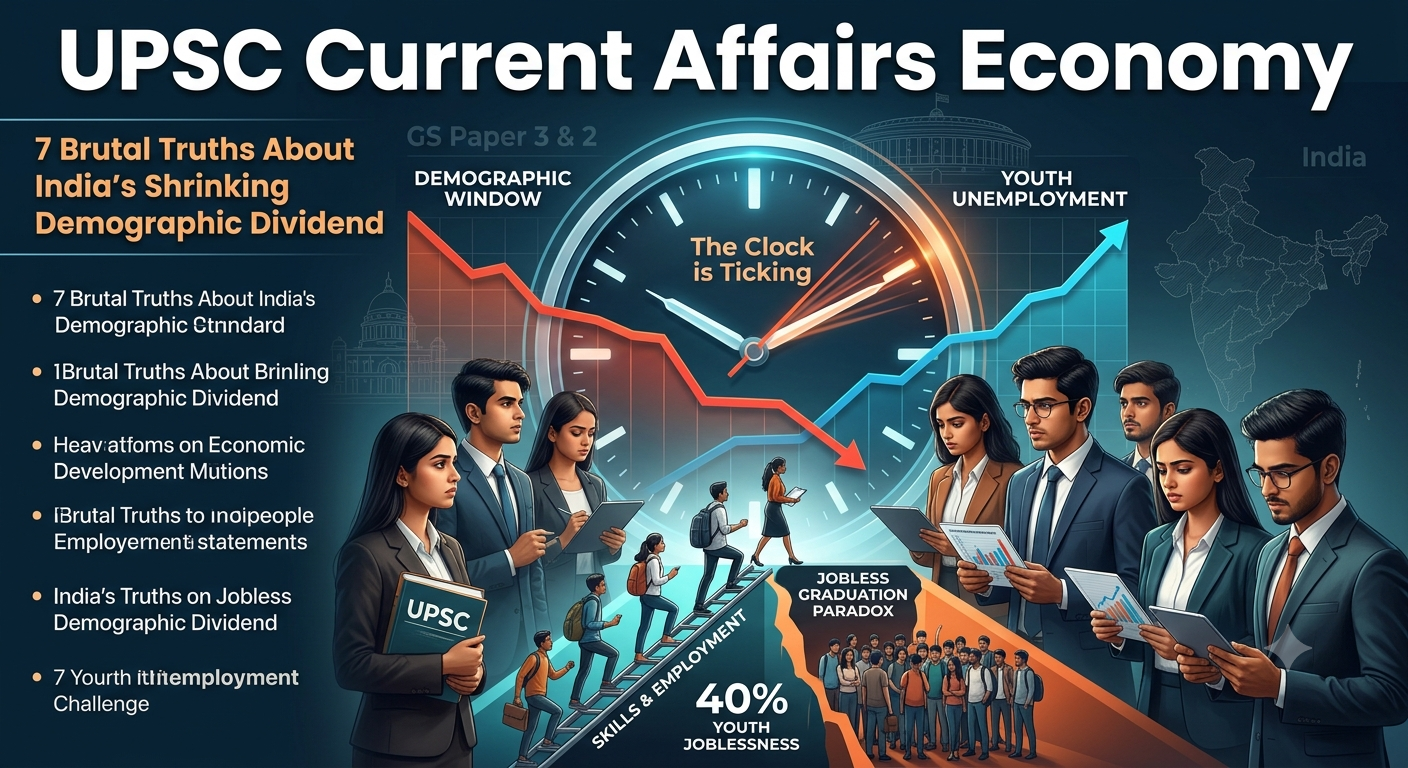
For years, the loudest boast in India’s economic narrative has been its young population. With roughly 65% of its citizens falling squarely into the working-age bracket of 15 to 64 years, India possesses an enviable demographic window that most Western and East Asian nations can only dream of. However, recent data from July 2026 points to a disturbing structural anomaly: delayed public sector recruitments, a stark 3% formal vocational training baseline, and a hidden youth unemployment rate touching nearly 18%. To understand how these moving economic parts alter your dynamic UPSC Current Affairs Economy preparation framework, we must dismantle the core structural bottlenecks.
1. The Paradox of Hidden Unemployment
While the headline Periodic Labour Force Survey (PLFS) numbers paint a relatively stable picture of a 2% youth unemployment rate, a deeper dive into the numbers reveals a structural crisis. When you factor in the 2.4 crore “discouraged youth”—those who have completely stopped looking for work due to structural lack of opportunities—the real youth joblessness among educated individuals skyrockets to 18%. Furthermore, urban female exclusion remains staggering, with youth unemployment among urban women hovering at 20.1%. Analyzing how these labor market dynamics cause deep socio-economic inequalities is a fundamental pillar of tracking UPSC Current Affairs Economy.
2. Structural Bottlenecks Eroding the Window
Why is the window closing? The first culprit is the severe training deficit. Only 3% of the total Indian workforce has received formal vocational instruction, creating a severe skill mismatch where graduates are heavily under-skilled for corporate needs. Second, delayed public recruitments and structural litigations have locked up thousands of entry-level state and union jobs, forcing millions of youth into perpetual preparation cycles. Finally, over 30 crore workers are registered on the informal e-Shram portal, signaling that our growth remains stubbornly unorganized. Evaluating these structural constraints is an indispensable exercise for scoring in UPSC Current Affairs Economy.
3. The Governance Failure: Delayed Recruitments
The public sector, historically a massive stabilizer for formal employment, is currently mired in procedural inertia. Delayed administrative pipelines, question paper leaks, and back-to-back judicial stays on recruitment notifications have frozen employment cycles across multiple states. This structural delay leaves millions of over-qualified youth stranded in their most productive years. When analyzing administrative delays for GS Paper 2 (Governance), you should evaluate the cascading socio-economic damage of these frozen vacancies. Tracking how state-level administrative machinery impacts national productivity indices will naturally give depth to your dynamic UPSC Current Affairs Economy notes.
4. The Path Forward: Decentralization and Skill Reconstruction
To reverse this rapid erosion before the demographic window closes by the early 2040s, structural adjustments are required. India must look at successful decentralization models like Kerala’s People’s Plan Campaign, where 35–40% of plan funds were devolved directly to local bodies, allowing local governance structures to identify, scrutinize, and expedite delayed public employment and local infrastructure projects. Simultaneously, the manufacturing sector must absorb the rural labor migration through targeted micro-skilling frameworks. Understanding how fiscal federalism acts as a tool for economic stabilization is vital for writing answers in UPSC Current Affairs Economy.
5. The Geopolitical Stakes of Domestic Stability
An unstable domestic labor market directly constrains India’s ambitions to project power globally. If the country fails to convert its raw human capital into a highly skilled, high-output workforce, domestic fiscal strain will limit defense spending and capital expenditure on critical projects like regional connectivity and maritime infrastructure. A nation handling internal demographic friction cannot effectively execute robust neighborhood diplomacy or maintain deep strategic leverage across the Indo-Pacific. Synthesizing this deep intersection between domestic macroeconomics and external geopolitical posture is an advanced requirement for mastering your extensive UPSC Current Affairs Economy syllabus.
6. The Danger of the Middle-Income Trap
If the demographic window closes by the early 2040s without hitting high-income thresholds, India risks falling into the classic “Middle-Income Trap.” This happens when a nation’s growth stagnates after reaching middle-income levels, as it can no longer compete with low-wage economies in cheap manufacturing, nor can it compete with advanced economies in high-value innovation due to an under-skilled workforce. Examining how systemic educational deficiencies lead directly to long-term macroeconomic stagnation is a core requirement for answer writing. Incorporating these macroeconomic vulnerabilities into your arguments will significantly elevate your core UPSC Current Affairs Economy mindset.
7. Urban Clustered Realities and Economic Migrations
The spatial distribution of joblessness also poses a threat to urban planning. As agricultural labor forces contract to 43%, a massive wave of migration is steering rural youth toward tier-1 cities. However, with nearly 65% of India’s 7,933 urban settlements lacking formal master plans, these cities cannot assimilate migrating labor productively. The resulting informal urban settlements increase social friction and suppress wage growth. Unpacking how rapid, unplanned urbanization impacts economic growth and creates parallel informal labor sub-economies is an essential component of analyzing daily trends in UPSC Current Affairs Economy.
8. Conclusion: Moving Past the Rhetoric
India’s demographic dividend is not an automated resource; it is a time-bound, highly volatile asset. If policy intervention continues to favor short-term headline management over deep structural labor, vocational, and recruitment reforms, the country faces a future characterized by an aging, under-employed, and low-income population. For a future civil servant, looking past political slogans to critique structural economic parameters with cold, hard data is exactly what examiners look for. Maintaining this data-driven, analytical perspective across all GS papers is the ultimate way to fulfill your daily UPSC Current Affairs Economy routine.
UPSC Nuggets: High-Yield Pointers for Prelims & Mains for UPSC Current Affairs Economy
GS Paper 3 (Indian Economy) & GS Paper 2 (Governance)
- Key Statistic to Quote: Only 3% of India’s workforce has received formal vocational training (Compare this with South Korea’s 96% or Germany’s 75% to highlight the skill deficit in Mains answers).
- The Disincentivized Worker Phenomenon: When writing answers on unemployment, always distinguish between Headline Unemployment (PLFS ~2%) and Real Youth Joblessness (~18%) by defining the role of “discouraged youth” who have exited the labor pool entirely.
- Case Study for Mains (Best Practice): Quote Kerala’s People’s Plan Campaign. It represents a textbook model of democratic decentralization where devolving 35–40% of plan funds to local bodies enabled grass-root level accountability, project tracking, and immediate employment generation.
- The 2040 Horizon: India’s dependency ratio is projected to peak and reverse by the early 2040s. Use this timeline to argue why immediate, front-loaded structural policy interventions in primary education and vocational skilling are needed now.
Frequently Asked Questions (FAQs)
Q1. What is the difference between headline unemployment and hidden unemployment?
Headline unemployment refers to the official figure released in reports like the Periodic Labour Force Survey (PLFS), which estimates youth joblessness at around 2-3%. However, hidden unemployment accounts for the “discouraged youth”—millions of educated young individuals who have completely stopped looking for work due to structural lack of opportunities. When these individuals are factored in, real youth joblessness touches nearly 18%, a critical distinction required for mastering UPSC Current Affairs Economy.
Q2. Why is India’s demographic dividend described as a “time-bound window”?
A demographic dividend occurs when the working-age population (15-64 years) is significantly larger than the dependent population (children and the elderly). This is a one-time historical window because as the youth bulge ages and fertility rates fall below the replacement level (currently under 2.1 in India), the dependency ratio will reverse. India’s window is projected to start closing rapidly by the early 2040s, making it a hot topic for UPSC Current Affairs Economy.
Q3. How do delayed public sector recruitments impact the macroeconomic environment?
Delayed administrative timelines, exam cancellations, and prolonged legal disputes freeze thousands of entry-level vacancies for 3 to 4 years. This traps millions of over-qualified youth in perpetual preparation cycles instead of active employment, leading to a massive loss of potential labor productivity, lower household savings, and increased structural dependency. Evaluating these governance bottlenecks is a foundational exercise for scoring high marks in UPSC Current Affairs Economy.
Q4. What is the “Middle-Income Trap” and how does it relate to India?
The Middle-Income Trap occurs when a developing nation stagnates at a middle-income level and fails to transition into a high-income developed economy. This happens because the country loses its competitive edge in low-wage manufacturing but lacks the highly skilled workforce needed to innovate in high-value industries. Preventing this stagnation requires deep investments in human capital, a key theme emphasized in contemporary UPSC Current Affairs Economy editorials.
b. The 2026 SWI Report and the “Jobless Graduation” Paradox
The depth of this crisis is laid bare by the State of Working India 2026 report, which highlights a staggering, counter-intuitive reality of UPSC Current Affairs Economy: the higher an Indian youth’s education level, the higher their likelihood of being unemployed. Graduate unemployment for the 15–25 age bracket has reached a staggering 40%, creating a massive structural mismatch. This has triggered severe “Qualification Inflation” across the country, where engineering graduates and PhD holders are routinely seen applying for entry-level, low-skilled municipal vacancies just to secure basic economic stability.

This structural bottleneck occurs because our economic architecture skipped the traditional, labor-intensive manufacturing stage, shifting directly from agriculture to capital-intensive, high-end tech and service sectors. For aspirants mapping out their UPSC Current Affairs Economy notes, analyzing how this educational expansion operates without a corresponding formal job market is critical for tackling structural questions on growth and human development in GS Paper 3.