

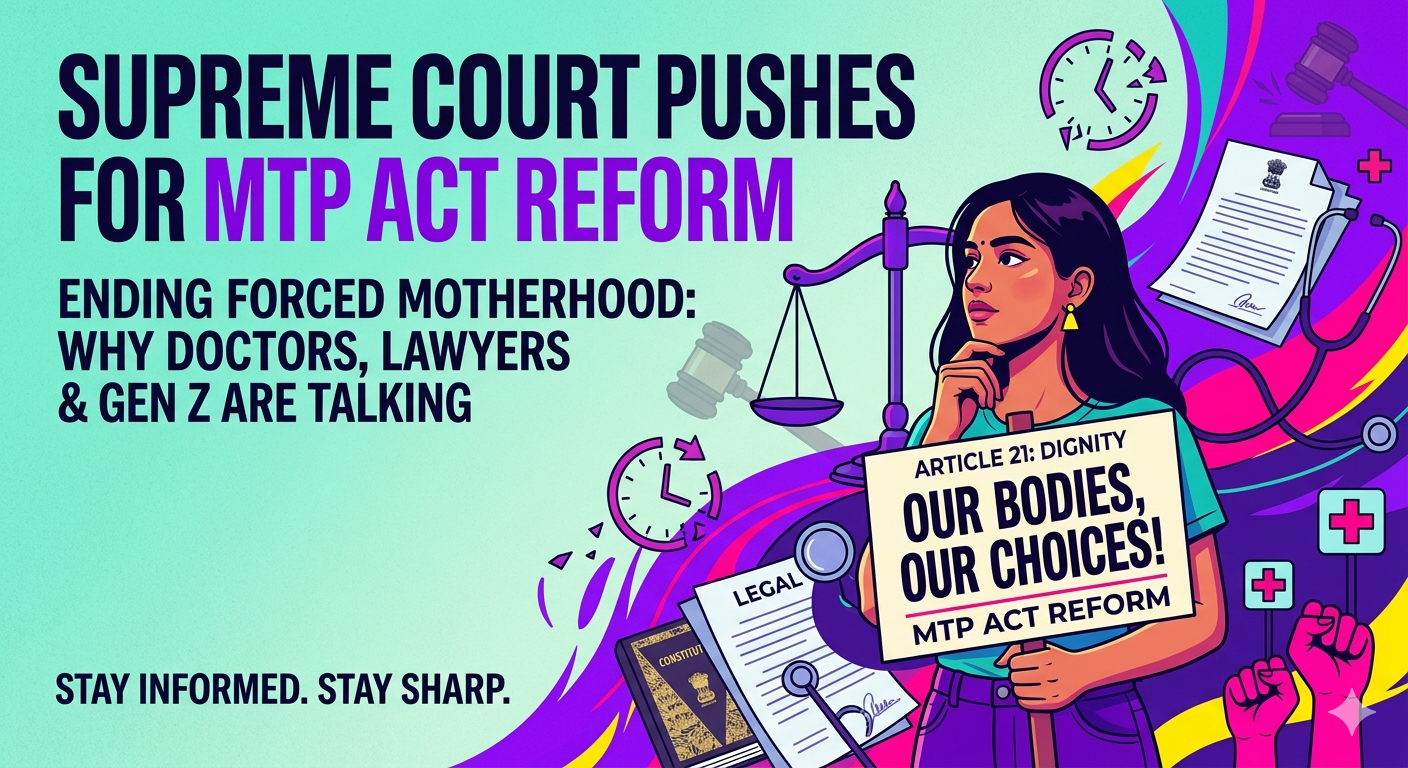
No More Forced “Motherhood”: The Supreme Court’s 2026 MTP ACT reform explained
In May 2026 a massive move was taken by the Supreme Court of India; it asked the government to fix the “Medical Termination of Pregnancy Act.” (MTP) Why? Because the ones who actually get stuck in this situation are minor rape survivors when they actually are in need of abortion after the 24-week limit but are not permitted to do so.
Let us first understand the problem and fix :
Currently, the MTP Act allows abortion up to 24 weeks for specific categories (like rape survivors). But what if the pregnancy is discovered later?
Survivors, who are already in an emotional turmoil at this time, have to run to high courts and supreme courts for permissions, wasting their precious time of life. It becomes like they are getting the punishment for no reason. The fix that the Supreme Court suggests is to remove the hard “time limits” for minor survivors to ensure they don’t face the trauma of forced motherhood.
THE UPSC “KNOWLEDGE NUGGETS”
- Article 21: The right to life and personal liberty. The Supreme Court linked reproductive choice directly to dignity.
- Reproductive autonomy: the legal idea the state (government) cannot force a woman to carry a pregnancy against her own will.
- Bodily integrity: A fundamental right that says you have control over your own body.
This Supreme Court MTP Act reform isn’t just “lawyer talk” but a change in the views of young people, right? It prioritizes mental health over rigid rules. It acknowledges that the minor needs to be under the most care and protection, not paperwork.
However, on this MTP ACT REFORM , doctors often hesitate because late-term abortions carry significant medical risks for the patient and legal risks for the practitioner under strict laws like POCSO. However, the Supreme Court’s push is vital because it moves the focus from “legal fear” to “patient dignity,” ensuring that medical professionals are legally protected when they prioritize a survivor’s mental and physical well-being over rigid deadlines.
The Socio-Psychological Necessity of MTP Act Reform
The conversation surrounding MTP Act reform is often dominated by legal jargon, but at its heart, this is a mental health crisis intervention. For a minor survivor, every day spent waiting for a court order is a day of compounding trauma. The 2026 push for MTP Act reform recognizes that “forced motherhood” is a violation of the soul as much as the body.
Psychologists argue that forcing a child to carry a pregnancy resulting from assault can lead to lifelong PTSD and dissociation. By advocating for a system that bypasses judicial delays, the MTP Act reform prioritizes “psychological literacy”—the understanding that emotional recovery cannot begin until a survivor has regained control over their own physical autonomy.
Breaking the “Silence Barrier” in Rural India
While urban centers have better access to legal aid, the MTP Act reform is a lifeline for survivors in rural or marginalized communities. In many parts of India, the 24-week limit is often breached simply because of a lack of local diagnostic facilities or the heavy social stigma that keeps survivors in silence.
This MTP Act reform moves toward a “survivor-centric” model. It suggests that the law must meet the victim where they are, rather than demanding that a traumatized minor navigate a complex urban legal system. By decentralizing the permission process and giving more power to specialized medical boards, the reform ensures that justice isn’t a privilege reserved only for those who can afford a Supreme Court lawyer.
The Global Ripple Effect of India’s Legal Shift
India’s move toward comprehensive MTP Act reform in 2026 sets a powerful international precedent. At a time when many developed nations are debating the restriction of reproductive rights, India is expanding them through the lens of human dignity.
This MTP Act reform signals to the world that India views reproductive rights not as a static policy, but as an evolving commitment to Article 21. It shifts the narrative from “regulation” to “empowerment.” For the youth of today, this reform represents a promise: that the state’s role is to protect the vulnerable from further harm, ensuring that a survivor’s future is defined by their potential, not by their past trauma.
For daily UPSC current affairs , stay updated on dailyupscprep.in