

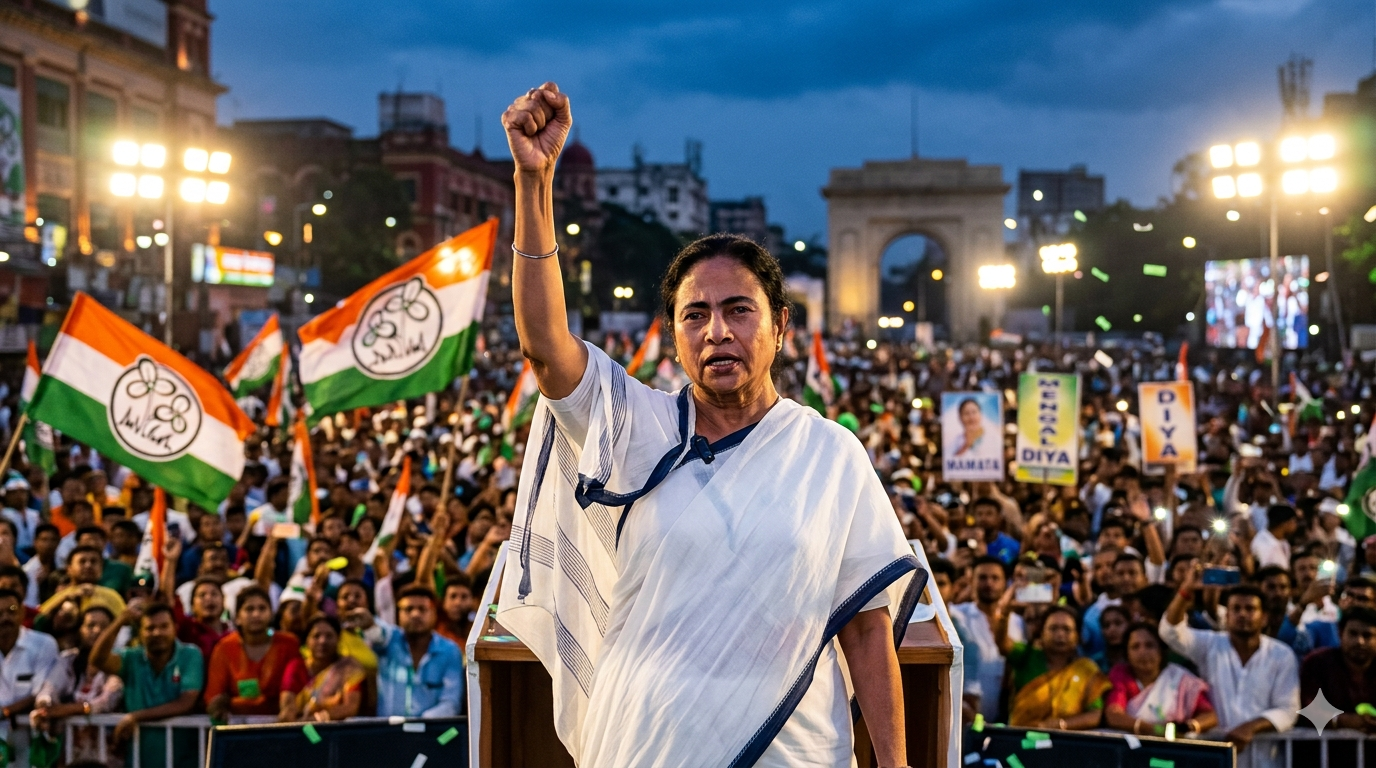
Today, All the eyes in the nation are on West Bengal. After 15 years of absolute dominance, Mamata Banerjee’s Trinamool Congress (TMC) is facing its toughest challenge yet. As the counting for 293 seats progresses, the trends are sending shockwaves through the political landscape.
The Numbers (as of now):
The Lead: The BJP has surged past the 170 -190 mark, well above the magic number of 148 needed for a majority. Which clearly shows a win !
The Slip: The TMC is currently hovering around 100 seats, a massive drop from their 215-seat landslide in 2021.
The Key Battle: In Bhowanipore , Mamata Banerjee is in a neck-and-neck fight with her former aide-turned-rival, Suvendu Adhikari. It’s more than just a seat; it’s a battle of prestige.
Why is it so “Crazy” today?
The “SIR” Factor: This election was the first to use the Special Intensive Revision (SIR) of electoral rolls. Mamata Banerjee has alleged that millions of legitimate voters were “technologically deleted” by the Election Commission using AI, calling it a “digital coup.”
CCTV & Transparency: Just hours ago, the TMC alleged a “CCTV blackout” at several counting centers. The Election Commission had to issue a rare midday clarification to reassure the public.
The “Tiger Cubs” Speech: Facing a potential loss,Mamata Banerjee addressed the media, telling her supporters to remain vigilant and “fight like tiger cubs” until the last vote is counted, hinting that she might challenge the entire election in court.
Why this matters to YOU:
Federalism under Fire: If the Center’s ruling party wins Bengal, the power dynamic between the State and the Center changes completely. It could mean faster implementation of central schemes but less “regional say.”
The Economy of Bengal: Markets are already reacting. A change in government usually leads to a shift in industrial policy affecting jobs, tech investments in Kolkata, and local startups.
The “Voter ID” Precedent: If the allegations about the “SIR” (voter deletions) are true, it sets a scary precedent for how future elections in your state might be handled.
The UPSC/Exam Angle:
Article 324: Understand the absolute power of the Election Commission of India during the counting process.
Model Code of Conduct (MCC): Does “administrative rigging” fall under a violation of the MCC or is it a matter for an Election Petition (Article 329)?
Federalism: How a “Double Engine Government” (same party at center and state) impacts the basic structure of the Constitution.
Bengal is at a crossroads. Whether this is a “historic win” for the BJP or a “miracle comeback” for the TMC, the 2026 results will be studied in textbooks for decades.
For such daily current affairs , stay updated on dailyupscprep.in
This is a gripping update. You’ve captured the high-stakes drama of this political shift with great intensity. To help you reach your word count while maintaining that “on-the-ground” energy, here is the reframed content with Mamata Banerjee as the central focus.
The End of an Epoch? The “Didi” Dynasty at the Brink
The 2026 West Bengal results represent more than just a change in government; they signal a potential eclipse of the political identity forged by Mamata Banerjee. For over a decade, her “Ma, Mati, Manush” slogan was the heartbeat of Bengal, but today, that pulse is weakening. As the BJP crosses the 190-seat threshold, the narrative in Kolkata has shifted from “invincibility” to “introspection.” The loss of her own bastion in Bhowanipore—a seat that once symbolized her personal connection with the masses—suggests that even the most formidable regional walls can crumble under the weight of anti-incumbency and administrative fatigue.
The “Digital Coup” and the Battle for the Ballot
The most explosive element of this election remains the SIR (Special Intensive Revision) controversy. Mamata Banerjee has not taken the lead loss lightly, framing the deletion of millions of voters as a targeted “technological strike” against her core base. By labeling it a “digital coup,” she is positioning this defeat not as a rejection by the people, but as a manipulation of the process. Her call for supporters to “fight like tiger cubs” is a clear signal that Mamata Banerjee intends to take this battle from the counting centers to the courtrooms, potentially challenging the constitutional validity of AI-driven electoral revisions.
A Legacy at the Crossroads
Win or lose, the political landscape of India has been permanently altered. If Mamata Banerjee transitions to the opposition, her role as a federal firebrand will be put to its ultimate test. Will she remain the singular voice of regional resistance, or will this “Double Engine” surge diminish the decentralization she fought for? For the youth of Bengal, the era of Mamata Banerjee has been the only political reality they’ve known. As the counting nears its end, the nation watches to see if the “Tigress of Bengal” can mount one final, miraculous counter-attack or if 2026 marks the closing chapter of an era.