

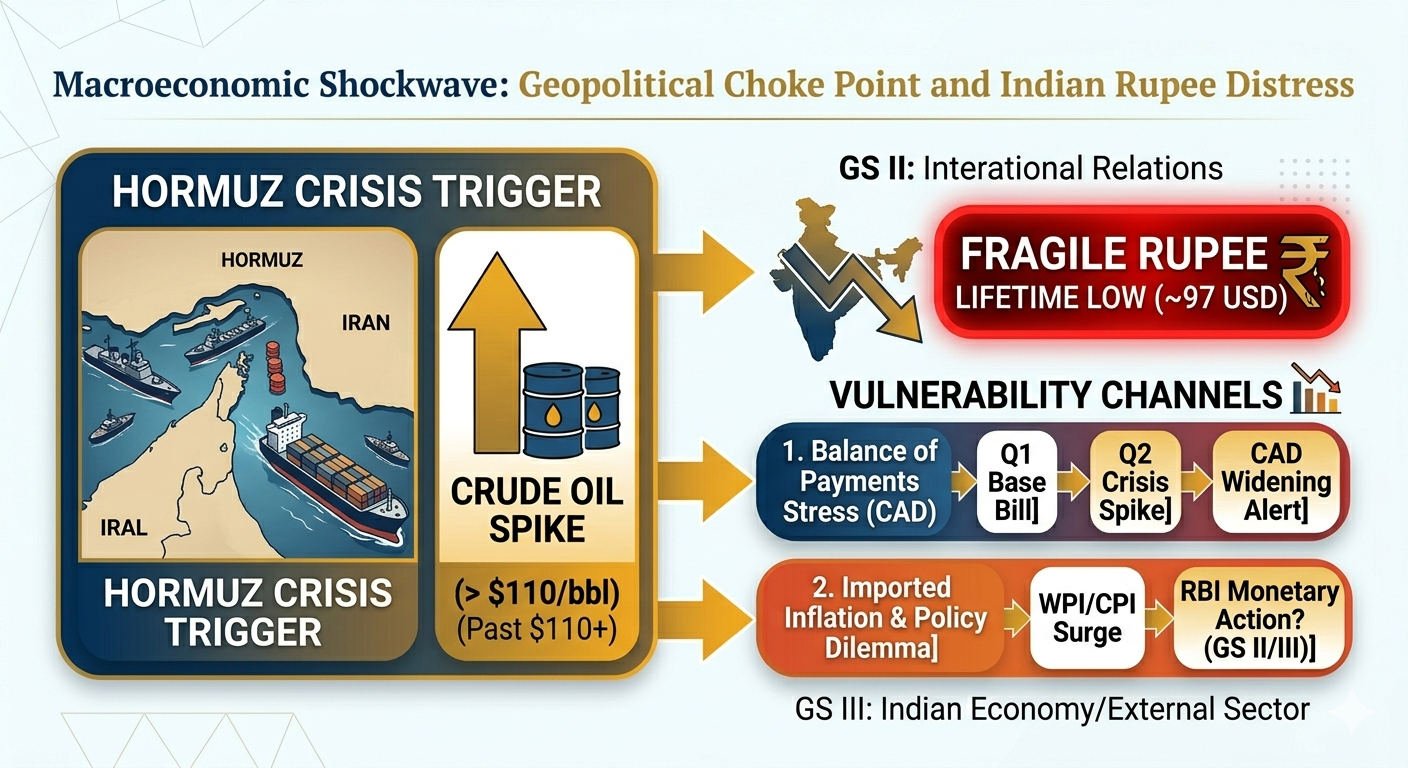
The external sector of the UPSC Syllabus Economy 2026 is facing a severe stress test. As geopolitical friction escalates in West Asia, the Indian rupee has plummeted to an unprecedented lifetime low of 96.86 against the US dollar. This structural depreciation is not an isolated currency fluctuation; it is a direct consequence of structural blockades in global choke points, specifically the Strait of Hormuz. For aspirants tracking the UPSC Syllabus Economy, understanding the twin transmission channels of imported inflation and balance of payments (BoP) stress is vital for tackling analytical mains questions this year.
The Geopolitical Trigger: Why the Strait of Hormuz Matters
The current vulnerability of the domestic currency stems directly from a prolonged blockade over the Strait of Hormuz. This narrow, 33-kilometer waterway connecting the Persian Gulf with the Gulf of Oman handles more than 20% of the world’s daily petroleum shipments.
When a maritime choke point of this magnitude faces disruptions, global energy supply chains collapse instantly, driving Brent crude prices comfortably past $110 per barrel. Because India imports over 85% of its crude oil requirements, any shock waves passing through this waterway translate immediately into local fiscal distress. Mastery of these maritime choke points and their domestic financial implications forms a core component of the UPSC Syllabus Economy.
The Balance of Payments (BoP) Transmission Channel
The most direct impact of the surging oil prices is felt on India’s merchandise trade deficit. As the oil import bill swells, the demand for US dollars outstrips the supply of rupees, causing a natural depreciation of the domestic currency. And this direct UPSC Syllabus Economy

When the trade deficit widens, it exerts structural pressure on the Current Account Deficit (CAD). If foreign portfolio investors (FPIs) engage in persistent selling due to global risk aversion, the capital account fails to comfortably finance the CAD. This structural mismatch forces the Reserve Bank of India (RBI) to draw down its foreign exchange reserves to defend the currency, reducing the country’s import cover. Evaluated through the lens of the UPSC Syllabus Economy, this exposes the country’s baseline vulnerability to external sector vulnerabilities.
Imported Inflation and the RBI’s Monetary Dilemma
A depreciating rupee makes critical imports, such as crude oil, electronic components, and fertilizers, significantly more expensive. This phenomenon, known as imported inflation, rapidly filters into the domestic Wholesale Price Index (WPI) and Consumer Price Index (CPI).
Higher energy prices raise logistics, manufacturing, and agricultural input costs across the country. For the RBI’s Monetary Policy Committee (MPC), this creates a difficult policy trade-off: tightening interest rates to curb inflation could dampen domestic growth, while keeping rates steady risks letting inflation expectations unanchor. Navigating these central bank mechanisms is a recurring theme within the UPSC Syllabus Economy.
Structural Impacts on Corporate External Commercial Borrowings (ECBs)
Many Indian conglomerates rely heavily on External Commercial Borrowings (ECBs) to raise cheap capital from overseas markets. However, when the rupee depreciates sharply, the cost of servicing this foreign currency-denominated debt skyrockets in domestic currency terms.
If corporate houses have not adequately hedged their currency exposure, their balance sheets experience severe stress, which can lead to a slowdown in domestic private capital expenditure. Analyzing these corporate financial flows and systemic banking risks remains crucial for anyone comprehensively cover the UPSC Syllabus Economy.
The Way Forward: Policy Options for India
To insulate the domestic macroeconomic framework from external shocks, India must adopt a multi-pronged strategy:
- Strategic Reserve Management: Utilizing RBI’s forex reserves carefully to smoothen excessive volatility without artificially fixing the rupee’s value.
- Diversification of Trade Infrastructure: Accelerating alternative trade pathways and settling international trade invoices in local currencies (e.g., INR-Dirham mechanisms) to bypass dollar hegemony.
- Strategic Energy Reserves (SPR): Expanding subterranean fuel storage facilities to provide a buffer against prolonged maritime blockades.
- Accelerated Energy Transition: Reducing long-term structural dependence on fossil fuels by scaling up green hydrogen and renewable energy infrastructure.
Implementing these structural policy adjustments ensures long-term macroeconomic stability, a key point of analysis in the UPSC Syllabus Economy.
UPSC Nuggets: Revision Points
📌 Core Concepts for Prelims & Mains ( UPSC Syllabus Economy )
- Strait of Hormuz: Connects the Persian Gulf and the Gulf of Oman. It is bounded by Iran to the north and Oman (Musandam enclave) and the UAE to the south.
- Imported Inflation: A scenario where domestic price levels rise due to the increasing cost of imported raw materials and commodities.
- Current Account Deficit (CAD): Occurs when the total value of goods, services, and transfers imported exceeds the total value of those exported.
- Currency Hedging: A financial strategy used by corporations to eliminate or reduce the risk of foreign exchange fluctuations.
| Economic Indicator | Direction during Choke Point Crisis | Macroeconomic Implication |
| India VIX (Volatility Index) | 📈 Escalates | Reflects heightened market fear and risk aversion. |
| Forex Reserves | 📉 Declines | Depletes as RBI sells dollars to stabilize the rupee. |
| Bond Yields | 📈 Rises | Increases borrowing costs for the government and corporate entities. |
Sample UPSC Mains Practice Question
Q. Discuss how geopolitical disruptions in maritime choke points influence India’s macroeconomic stability. Suggest policy measures to insulate the domestic economy from imported inflationary shocks. (15 Marks, 250 Words)
Concise Answer Structural Framework:
- Introduction: Define the current context (e.g., Strait of Hormuz disruption driving Brent crude beyond $110/bbl and pushing the rupee to historic lows).
- Body Paragraph 1 (The Vulnerabilities): Analyze the impact on the Current Account Deficit (CAD), capital flight by FPIs, and the reduction of foreign exchange reserves.
- Body Paragraph 2 (The Inflationary Cycle): Explain the transmission mechanism of imported inflation via input costs, logistics, and its impact on the RBI’s monetary policy stance.
- Body Paragraph 3 (The Corporate & Fiscal Strain): Detail the rising debt-servicing costs of unhedged External Commercial Borrowings (ECBs).
- Conclusion: Emphasize long-term structural solutions like the Internationalization of the Rupee, deepening Strategic Petroleum Reserves (SPRs), and accelerating renewable energy targets to fulfill the macroeconomic objectives outlined in the UPSC Syllabus Economy.