

The global order is currently witnessing massive geopolitical turbulence. As a major conflict unfolds in West Asia, the U.S.-Iran conflict analysis has become the most critical talking point for international observers and administrative aspirants alike. With an uneasy ceasefire tentative memorandum of understanding being debated, the geopolitical ripples of this theater are felt directly in New Delhi. For civil services aspirants, understanding the deep fractures of this crisis is indispensable for clearing the Mains GS Paper II and analytical Prelims questions.
Let us dive deep into the multi-layered aspects of this U.S.-Iran conflict analysis, focusing strictly on what matters for your preparation.
What Happened? The Trigger Point
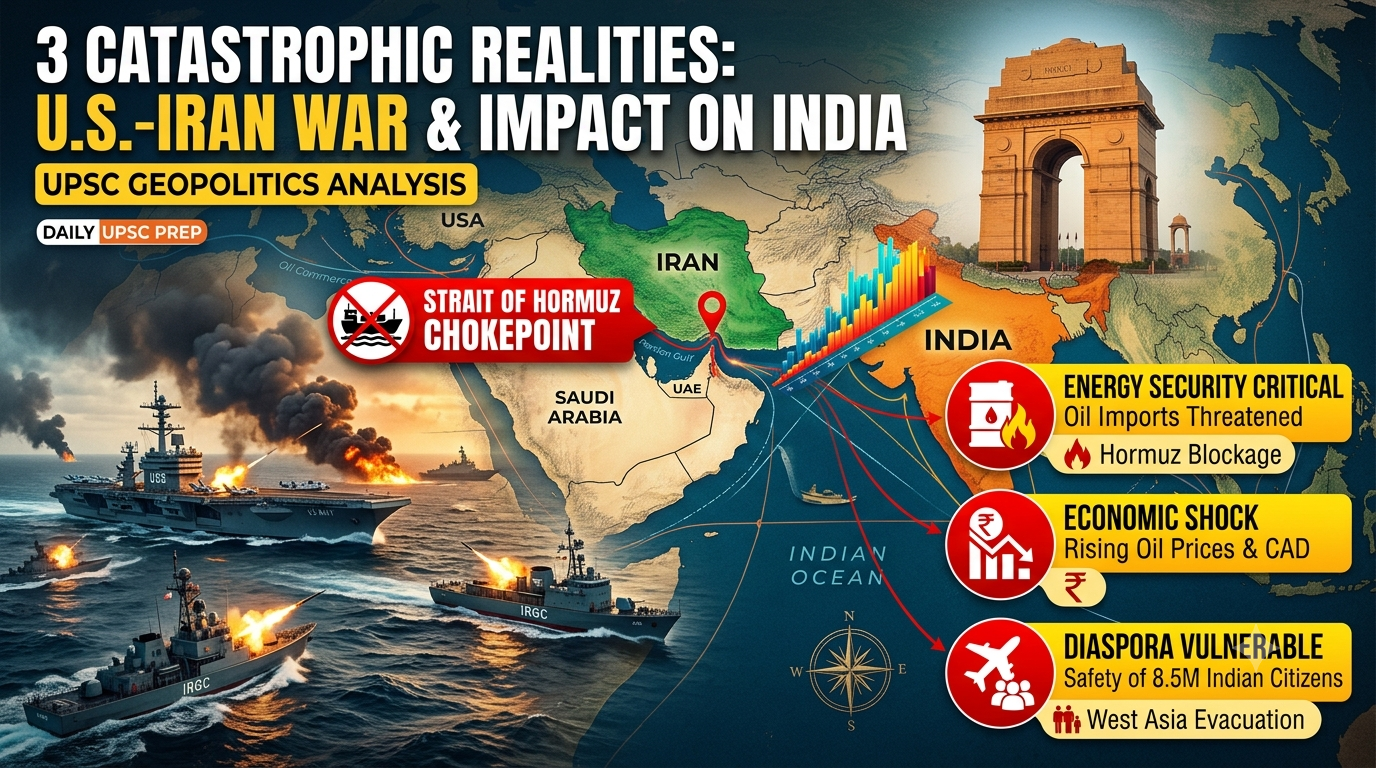
The military escalation between the United States and Iran has reached an unprecedented scale, disrupting the fragile maritime balance of the Middle East. At the center of this flashpoint is the choking of the Strait of Hormuz, a critical maritime artery where roughly 20% of the world’s petroleum liquids pass daily.
Although a fragile 60-day negotiation period has officially commenced following a recent Memorandum of Understanding (MoU), deep-seated structural issues such as Iran’s advancing nuclear program and localized proxy warfare remain fundamentally unresolved. The strategic U.S.-Iran conflict analysis shows that while a full-scale regional collapse has been momentarily averted by diplomacy, the economic and operational damage inflicted upon global shipping lines continues to trigger massive global inflation.
Historical Background: The Long Road to Friction
The animosity between Washington and Tehran is not a recent phenomenon; it is rooted in decades of systemic trust deficits. The core friction points can be mapped across a specific historical timeline:
- 1953 Coup: The overthrow of Iran’s democratically elected Prime Minister Mohammad Mossadegh.
- 1979 Islamic Revolution: The pivotal structural transformation that turned Iran into an anti-Western domestic state.
- The JCPOA Saga: The signing of the Joint Comprehensive Plan of Action (JCPOA) in 2015, followed by the unilateral exit of the United States under the “Maximum Pressure” policy strategy.
This breakdown created a highly volatile strategic environment. Any detailed U.S.-Iran conflict analysis reveals that the current confrontation is a direct result of this historic escalation, where minor maritime provocations quickly snowballed into intensive naval engagements across the Persian Gulf.
The 3 Catastrophic Realities for India which comes with U.S.-Iran conflict analysis
The ongoing West Asian crisis poses deep strategic challenges for India across political, economic, and security dimensions.

1. The Chokepoint Vulnerability (Energy Security)
India relies heavily on the West Asian region, importing over 80% of its crude oil requirements. The absolute blockades or high risk-premiums in the Strait of Hormuz mean India must look for alternative, far more expensive supply lines, threatening national energy security.
2. Macroeconomic Stress
As crude oil prices spike due to regional disruptions, India’s Current Account Deficit (CAD) widens drastically. The sticky inflation driven by global supply-side shocks forces the Reserve Bank of India (RBI) to keep interest rates high, directly dampening domestic industrial growth.
3. Safety of the Indian Diaspora
West Asia houses over 8.5 million non-resident Indians. Any prolonged military theater subjects our massive workforce to physical danger, necessitating complex state-sponsored evacuation strategies and severely reducing crucial remittance inflows. Comprehensive U.S.-Iran conflict analysis must always consider these humanitarian and fiscal ties.
UPSC Nuggets: High-Yield Insights
UPSC Edge: Strategic Chokepoints To Remember (U.S.-Iran conflict analysis)
Make sure to open your atlas and locate the following maritime choke points immediately:
- Strait of Hormuz: Connects the Persian Gulf with the Gulf of Oman and the Arabian Sea.
- Bab-el-Mandeb: Connects the Red Sea to the Gulf of Aden.
- Strait of Malacca: Connects the Indian Ocean to the South China Sea.
- Mains Tip: In GS Paper II, always draw a neat sketch map of the Persian Gulf to secure an extra 1 or 1.5 marks in your International Relations answers.
Relevance for UPSC Examination
This U.S.-Iran conflict analysis topic directly intersects with multiple areas of the Union Public Service Commission (UPSC) Syllabus.
Prelims Angle
In the Preliminary examination, questions are regularly framed around map-based locations (e.g., bordering countries of the Persian Gulf, such as Iran, Iraq, Saudi Arabia, UAE, Qatar, Kuwait, Bahrain, and Oman). It also tests conceptual clarity on the economic impacts of supply-side inflation on India’s fiscal parameters.
Mains Angle (GS Paper II & III)
For the Civil Services Mains, this case study of U.S.-Iran conflict analysis serves as excellent fodder for questions on:
- “Bilateral, regional and global groupings and agreements involving India and/or affecting India’s interests.”
- The operational stability of India’s strategic connectivity projects, particularly the International North-South Transport Corridor (INSTC) and the development of the Chabahar Port in Iran.
A structured U.S.-Iran conflict analysis allows aspirants to argue how India balanced its strategic autonomy while navigating relations with both Washington and Tehran.
Key Takeaways for Aspirants
- Strategic Autonomy: India does not take definitive military sides but continuously champions freedom of navigation and the UN Charter.
- De-escalation Need: Diplomatic resolution is the only sustainable pathway to safeguard maritime commercial corridors.
- Diversification: India must continuously accelerate its transition toward renewable alternatives and domestic strategic petroleum reserves to mitigate sudden West Asian energy shocks.
Frequently Asked Questions (FAQs)
Q1: Why is the Strait of Hormuz called a global chokepoint?
A1: It is geographically narrow (approximately 33 km at its narrowest point) but handles nearly one-fifth of global oil consumption shipments, making its transit routes highly vulnerable to maritime blockades.
Q2: How does the conflict affect India’s Chabahar Port project?
A2: Geopolitical tensions and active sanctions complicate investments and operational logistics at Chabahar, which serves as India’s key transit gateway to landlocked Central Asia bypassing Pakistan.
Q3: What is India’s official stance on the U.S.-Iran conflict?
A3: India consistently advocates for constructive diplomacy, immediate de-escalation, adherence to international maritime laws, and the restoration of regional peace through multilateral dialogue.
Conclusion
The volatile situation in West Asia serves as a crucial reminder of how deeply interconnected modern global economics and national security frameworks are. For a UPSC civil services aspirant, conducting a thorough U.S.-Iran conflict analysis is not just about memorizing military events; it is about evaluating the long-term strategic, fiscal, and diplomatic implications for India’s foreign policy footprint. Keep tracking the official updates from the Ministry of External Affairs (MEA) to enrich your answers with real-time developments.