

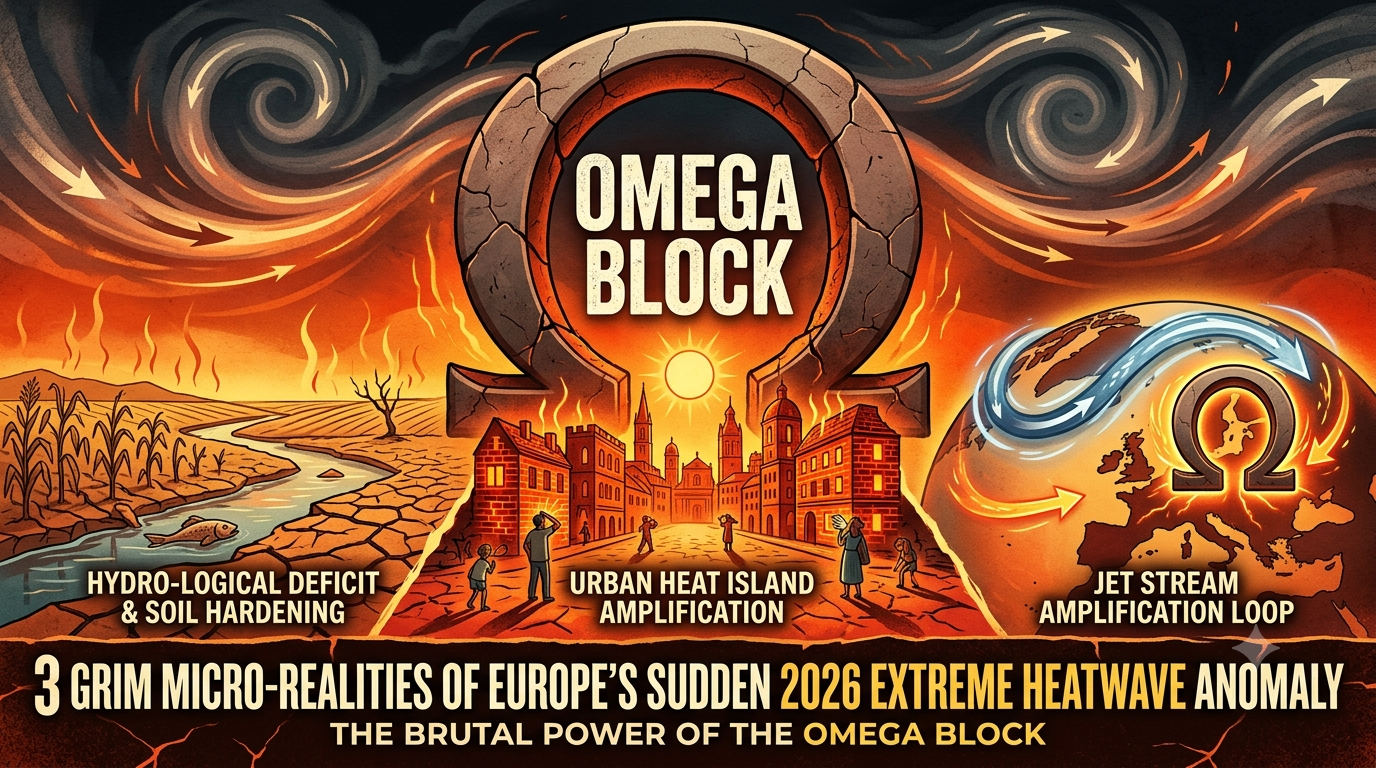
The global climate architecture has been shattered as unprecedented extreme heatwave anomaly events hit the Northern Hemisphere in mid-2026. In an alarming atmospheric development that has stunned meteorologists and policy planners worldwide, Western Europe is experiencing a catastrophic, record-shattering climate emergency. This is not just a standard summer spike; a massive, persistent meteorological barrier has locked sub-continental temperatures to near-historic highs. For civil services aspirants analyzing physical geography and environmental degradation, this crisis provides a definitive case study on jet stream dynamics and climate abnormalities. The sheer scale of this atmospheric disruption forces us to evaluate the devastating impacts of an extreme heatwave anomaly.
What Happened? The June 2026 European Climate Emergency
In June 2026, countries including France, Italy, the United Kingdom, and the Netherlands reported unprecedented atmospheric stress. France recorded its highest temperature since systematic record-keeping began, with localized regions breaching the dangerous 44 degree C threshold. The extreme weather has disrupted regional supply chains, strained national power grids due to cooling demands, and led to tragic, heat-related fatalities across the continent.
Emergency public shelters have been set up in municipal museums and cinemas to protect vulnerable urban populations. The underlying trigger behind this synchronized thermal lockdown is a highly stable atmospheric configuration that prevents cooler oceanic air masses from clearing out the trapped heat. This extreme weather event highlights the dangers of a prolonged extreme heatwave anomaly.
Jet Stream Disruption – THE OMEGA BLOCK (Ω)
Low Pressure West – Atlantic Storms
High Pressure Center – Trapped Warm Air, Intense Compression, Clear Skies / No Rain
Low Pressure East – Eastern Storms
Background: The Science Behind the Omega Block
To understand why this system is so resilient, one must look at high-altitude planetary wind configurations. Under normal atmospheric conditions, the polar jet stream blows continuously from west to east, moving alternating high and low-pressure weather systems across Europe. However, when the jet stream weakens and develops deep, meandering bends, it can form a pattern resembling the Greek letter Omega.
This configuration places a dominant, high-pressure ridge over central Europe, flanked by two low-pressure troughs over the Atlantic Ocean and Eastern Europe. The central high-pressure system acts as a giant atmospheric lid, creating a robust “Heat Dome.” Warm air rising from the parched ground cannot escape into the upper atmosphere; instead, it is forced downward, warming further through compressional heating. This persistent weather setup creates a severe extreme heatwave anomaly
The 3 Grim Realities of the 2026 Thermal Crisis
The ongoing European crisis reveals three critical structural challenges that extend far beyond simple temperature tracking:
A. Accelerated Hydro-Logical Deficits and Soil Hardening
The lack of cloud formation and rainfall beneath the high-pressure ridge accelerates soil moisture evaporation. This process hardens agricultural topsoil and causes water levels in critical transport rivers like the Rhine and Danube to drop, disrupting industrial shipping and reducing hydro-electric power output.
B. Urban Heat Island Amplification
In densely built European cities, concrete and asphalt absorb solar radiation throughout the day and radiate it back at night. This lack of nighttime cooling puts immense stress on local populations, turning standard municipal areas into dangerous thermal traps during a severe extreme heatwave anomaly.
C. The Jet Stream Amplification Loop
Human-induced global warming is narrowing the temperature gradient between the equator and the Arctic. This reduced contrast slows down the jet stream, making stagnant atmospheric blocks like the Omega Block more frequent, expansive, and difficult to break.
UPSC Nuggets: High-Yield Pointers
- Omega Block vs. Rex Block: An Omega Block features a high-pressure system flanked by two low-pressure systems, mimicking the shape of the Greek letter Omega. A Rex Block consists of a high-pressure system located directly north of a low-pressure system, causing horizontal stagnation.
- Adiabatic Compression: As air sinks within the central high-pressure zone of a Heat Dome, it is compressed by the increasing atmospheric pressure below, raising its temperature without adding external heat.
- Rossby Waves: These giant meanders in high-altitude planetary winds form when the polar jet stream slows down, directly causing prolonged, severe weather anomalies.
- Albedo Feedback Mechanism: Prolonged heat dries out soil and vegetation, lowering local surface moisture and reducing latent heat cooling, which further amplifies the surface temperature.
Importance for India: Teleconnections and Global Monsoons
While this atmospheric stagnation is centered over Europe, earth systems are deeply interconnected through global weather links. Severe blockages in the mid-latitude jet streams can alter the behavior of the Subtropical Western Jet Stream, which directly influences the onset and distribution of India’s Southwest Monsoon.
Furthermore, these intense heatwaves highlight the vulnerabilities of modern urban centers to climate change challenges that echo the severe pre-monsoon heatwaves seen across northern and western India. Understanding how developed nations manage large-scale power grid strain, agricultural shocks, and water scarcity can help India refine its own National Action Plan on Climate Change (NAPCC). Analyzing these international climate events allows Indian policymakers to better prepare for an extreme heatwave anomaly.
GLOBAL WEATHER TELECONNECTIONS:
├── Mid-Latitude Jet Stream Stagnation (Europe)
├── Disruption of the Subtropical Jet Stream Path
├── Altered Pressure Gradients Over the Indian Ocean
└── Variations in India’s Southwest Monsoon Distribution
UPSC Relevance: Core Syllabus Alignment
This topic aligns directly with multiple papers in the UPSC Civil Services Examination. In GS Paper I (Physical Geography), it falls under Important Geophysical phenomena such as geographical features and their location-changes. In GS Paper III (Environment & Disaster Management), it relates directly to Climate Change, Environmental Pollution & Degradation, and Disaster Management frameworks.
When writing Mains answers, candidates should avoid generic descriptions of hot weather. Instead, use accurate terminology like Rossby wave amplification, adiabatic compressional heating, and blocking anticyclones. Connect your geographical analysis with policy frameworks by discussing urban design updates, such as cool roofs and urban forestry, to counter an extreme heatwave anomaly.
Key Takeaways for Civil Services Preparation
To write high-scoring answers on this topic, candidates should focus on three main conceptual pillars:
- The Shift in Extreme Weather Patterns: Stagnant atmospheric systems like the Omega Block show that climate change is making extreme weather events last longer, changing them from brief spikes into prolonged environmental crises.
- The Vulnerability of Developed Infrastructure: The severe disruptions to European transport, energy grids, and public health demonstrate that traditional infrastructure worldwide needs updating to handle shifting climate baselines.
- The Need for Integrated Climate Adaptation: Combating these intense thermal events requires moving beyond simple emergency response toward proactive urban planning, resilient grid management, and water conservation efforts designed to mitigate an extreme heatwave anomaly.
Conclusion
The 2026 European heatwave highlights the powerful impact of disrupted atmospheric currents. The persistent Omega Block shows how easily high-altitude wind alterations can lock a region into an extended climate crisis. For India and the broader global community, this event serves as a clear reminder of the need to accelerate climate adaptation strategies and build resilient urban infrastructure. As planetary temperature gradients continue to shift, understanding and preparing for these complex atmospheric mechanisms will be vital to minimizing the damage caused by an extreme heatwave anomaly.
Frequently Asked Questions (FAQs)
Q1. How does a high-pressure system create a Heat Dome?
A high-pressure system sinks air toward the ground, acting like a lid that traps warm air rising from the surface. As the air sinks, it undergoes adiabatic compression, which increases its temperature and clears out cloud cover, leading to continuous, intense solar heating.
Q2. What role do Rossby waves play in forming an Omega Block?
Rossby waves are large-scale loops in planetary winds. When the jet stream slows down, these loops grow larger and can stall in place. An Omega Block forms when one of these giant loops creates a stable high-pressure area flanked by two low-pressure zones.
Q3. Why are nighttime temperatures higher during extreme heatwave anomaly?
The built environment in cities absorbs heat during the day and releases it slowly at night. When an atmospheric block prevents cooler air masses from moving in, this stored heat remains trapped near the ground, keeping nighttime temperatures unusually high.