

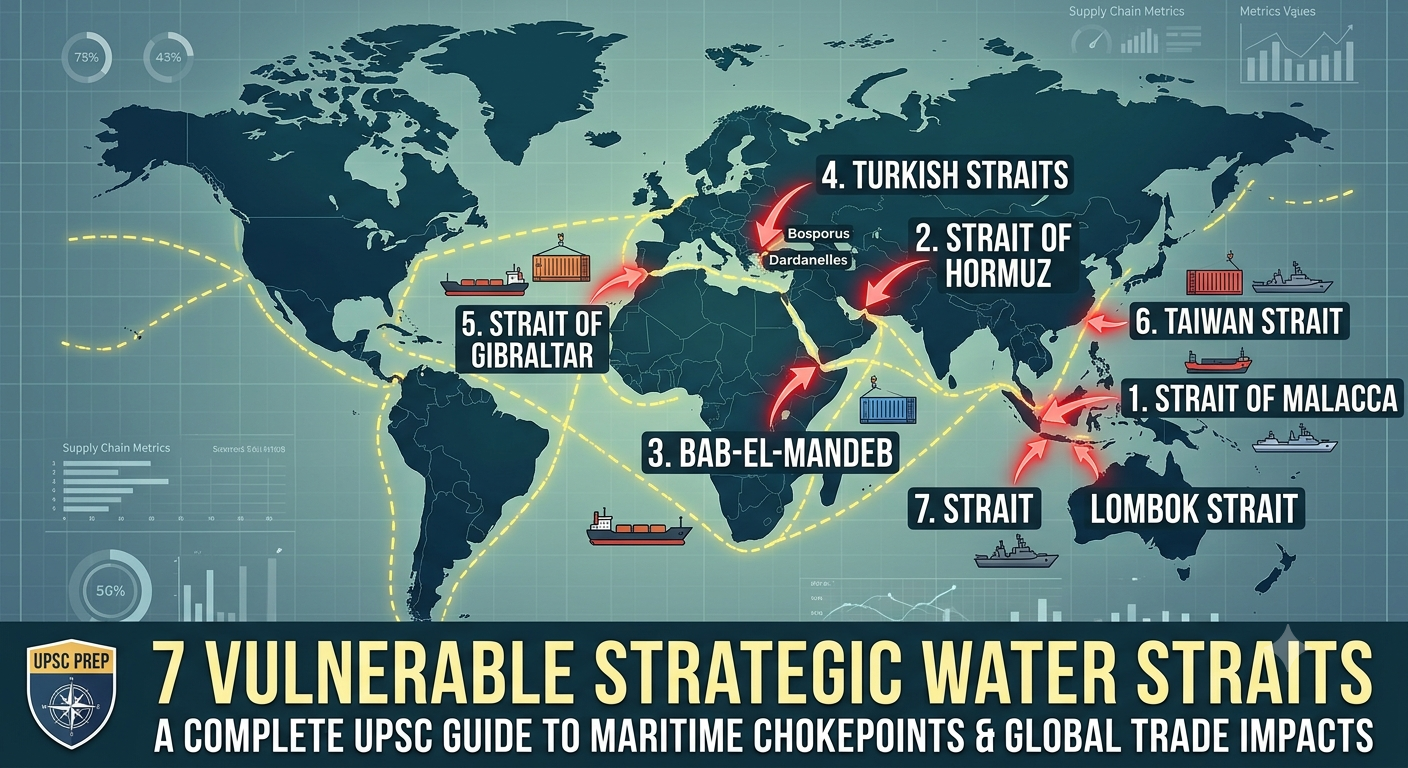
Global commerce relies heavily on the oceans, with over 80% of international trade by volume carried by sea. However, this massive network of global trade passes through narrow, highly congested geographical passages. For any civil services aspirant, understanding these maritime vulnerabilities is absolutely essential for both Prelims and Mains. In this comprehensive guide, we will analyze the most critical strategic water straits that dictate international relations, supply chains, and security paradigms across the globe.
Introduction to Maritime Chokepoints
A maritime chokepoint is a narrow channel, such as a strait or a canal, where global shipping traffic is forced to converge. Because alternative routes are often thousands of miles longer and economically prohibitive, any disruption at these points can trigger a massive shock to the global economy. Security challenges ranging from state-led blockades to piracy mean these strategic water straits remain hotbeds of geopolitical friction.
For India, maintaining open lines of communication through these corridors is vital for energy security, as the country imports the vast majority of its crude oil requirements through vulnerable waters.
Detailed Explanation of the 7 Critical strategic water straits
I. The Strait of Malacca
Connecting the Indian Ocean with the South China Sea, the Strait of Malacca is the shortest sea route between the Middle East and East Asia. Nearly one-third of global shipping passes through this narrow stretch of water running between Indonesia, Malaysia, and Singapore.
From a geopolitical lens, China suffers from the “Malacca Dilemma,” a term coined to describe its deep anxiety over a potential naval blockade of these strategic water straits by rival powers during a conflict. India’s Andaman and Nicobar Islands sit right at the western entrance of this strait, granting New Delhi significant strategic leverage.
II. The Strait of Hormuz
Often regarded as the world’s most vital energy artery, the Strait of Hormuz connects the Persian Gulf with the Gulf of Oman and the Arabian Sea. It is the only sea passage from the Persian Gulf to the open ocean, making it a critical transit route for oil exports from Saudi Arabia, Iran, the UAE, Kuwait, and Iraq.
Any geopolitical instability or escalation of conflict in West Asia immediately threatens traffic through these strategic water straits, causing global crude oil prices to skyrocket within hours.
III. The Bab-el-Mandeb
Located between Yemen on the Arabian Peninsula and Djibouti and Eritrea in the Horn of Africa, the Bab-el-Mandeb serves as the strategic gateway connecting the Red Sea to the Gulf of Aden and the Indian Ocean. It acts as a crucial link in the maritime highway that leads directly to the Suez Canal.
Recent drone and missile attacks on commercial shipping vessels by regional rebel factions highlight just how fragile these strategic water straits can be under modern asymmetric warfare conditions.
IV. The Bosporus and Dardanelles Straits
Together known as the Turkish Straits, the Bosporus and Dardanelles divide Europe from Asia and connect the Black Sea to the Mediterranean. The Bosporus connects the Black Sea to the Sea of Marmara, while the Dardanelles links the Sea of Marmara to the Aegean Sea.
Control over these strategic water straits is regulated by the historic 1936 Montreux Convention, which grants Turkey sovereign control over naval transits, particularly during times of war.
V. The Strait of Gibraltar
Connecting the Atlantic Ocean directly to the Mediterranean Sea, the Strait of Gibraltar separates Spain in Europe from Morocco in Africa. At its narrowest point, it is only about 14 kilometers wide.
This corridor serves as a crucial economic bridge for trade between Europe, Asia, and the Americas. Ensuring seamless transit through these strategic water straits is a major foreign policy priority for Mediterranean nations and global trade bodies alike.
VI. The Taiwan Strait
Separating the island of Taiwan from mainland China, this strait connects the East China Sea with the South China Sea. It is one of the busiest shipping lanes in the world, carrying container ships laden with semiconductors, electronics, and manufactured goods from East Asian hubs to global markets.
Ongoing geopolitical tensions between major superpowers mean that any military miscalculation within these strategic water straits could instantly cripple the global technology supply chain.
VII. The Sunda and Lombok Straits
As alternatives to the congested Strait of Malacca, the Sunda and Lombok straits pass through the Indonesian archipelago. The Sunda Strait sits between Java and Sumatra, while the Lombok Strait lies between Bali and Lombok.
Deep-draft vessels, such as massive oil supertankers that are too large to safely navigate the shallow waters of Malacca, routinely rely on these deeper strategic water straits to cross between the Indian and Pacific Oceans safely.
Real-World Examples of Geopolitical Friction
History is replete with examples where access to vital waterways was used as a tool of geopolitical coercion. The 1956 Suez Crisis stands out as a stark reminder of how closing a canal could trigger military interventions. In recent years, we have seen heightened naval patrols, piracy threats off the coast of Somalia, and aggressive posturing in East Asia.
These events prove that security frameworks governing strategic water straits must be continuously updated to match modern technological advancements in naval drone warfare.
UPSC Questions Trend
In the UPSC Civil Services Examination, geography and international relations are deeply intertwined. Over the past decade, the Union Public Service Commission has shifted away from purely static questions toward dynamic, map-based queries.
Prelims Pattern
Questions generally focus on matching the strait with the water bodies it connects or the countries bordering it. Aspirants are frequently required to identify the locations of these strategic water straits from West to East or North to South.
Mains Pattern (GS Paper 2 & 3)
Mains questions delve into the geopolitical implications of maritime choke points. Topics like India’s “Act East Policy,” the security of the Sea Lines of Communication (SLOCs), and the emergence of the Quad frequently require a deep conceptual analysis of how these strategic water straits impact India’s national security and trade architecture.
UPSC Nuggets
UPSC Nugget: The Montreux Convention (1936) The Montreux Convention Regarding the Regime of the Straits gives Turkey full control over the Bosporus and Dardanelles Straits. In peacetime, it guarantees the free passage of civilian vessels. However, during a conflict, Turkey has the legal authority to restrict the passage of naval warships belonging to any country, making it a critical element in Black Sea geopolitics.
Summary Table of Strategic Water Straits
| Strait Name | Connecting Water Bodies | Bordering Countries / Landmasses | Strategic Importance |
| Strait of Malacca | Indian Ocean & South China Sea | Indonesia, Malaysia, Singapore | Main route to East Asia; China’s Malacca Dilemma. |
| Strait of Hormuz | Persian Gulf & Gulf of Oman | Oman, Iran | World’s premier oil transit choke point. |
| Bab-el-Mandeb | Red Sea & Gulf of Aden | Yemen, Djibouti, Eritrea | Gateway to the Suez Canal; vulnerable to regional conflict. |
| Turkish Straits | Black Sea & Mediterranean Sea | Turkey | Regulated by Montreux Convention; critical for Black Sea trade. |
| Strait of Gibraltar | Atlantic Ocean & Mediterranean Sea | Spain, Morocco, UK (Gibraltar) | Primary entry point to the Mediterranean basin. |
| Taiwan Strait | East China Sea & South China Sea | China, Taiwan | Major semiconductor and electronics shipping highway. |
| Lombok Strait | Indian Ocean & Java Sea | Indonesia | Crucial deep-water alternative for mega-supertankers. |
Conclusion
Understanding global maritime chokepoints is not just about memorizing names on a physical map; it is about grasping the underlying currents of global power politics. As climate change opens up new northern sea routes and geopolitical rivalries intensify in the Indo-Pacific, these strategic water straits will continue to feature prominently in major international headlines. Keeping a close eye on these naval flashpoints will ensure you remain ahead in your UPSC preparation journey.
Frequently Asked Questions (FAQs)
Q1. What is the difference between a strait and a canal?
A strait is a naturally formed, narrow waterway that connects two larger bodies of water. In contrast, a canal is an artificial, man-made waterway constructed to facilitate navigation or irrigation, such as the Suez Canal or the Panama Canal.
Q2. Why is the Strait of Malacca so vital for India?
The Strait of Malacca is vital because a significant portion of India’s trade with East Asian nations passes through it. Furthermore, India’s naval presence near the strait via the Andaman and Nicobar Command allows India to act as a net security provider in the region.
Q3. How does the UPSC typically test this topic in the exam?
The UPSC tests this topic via map-based questions in the Prelims exam (e.g., matching straits to surrounding countries) and through conceptual questions on maritime security, international laws, and trade diplomacy in the Mains GS Paper 2.
[…] Master your map questions with our breakdown of Important Straits and Waterways of the World. […]