

Here is a comprehensive, deeply engaging, and UPSC-aligned breakdown of the Supreme Court expansion. The tone is vibrant and accessible for a younger audience, while the UPSC Nuggets sections provide the exact technical, constitutional, and structural data required for civil services preparation.
The Supreme Court Upgrade: Why India is Adding More Judges
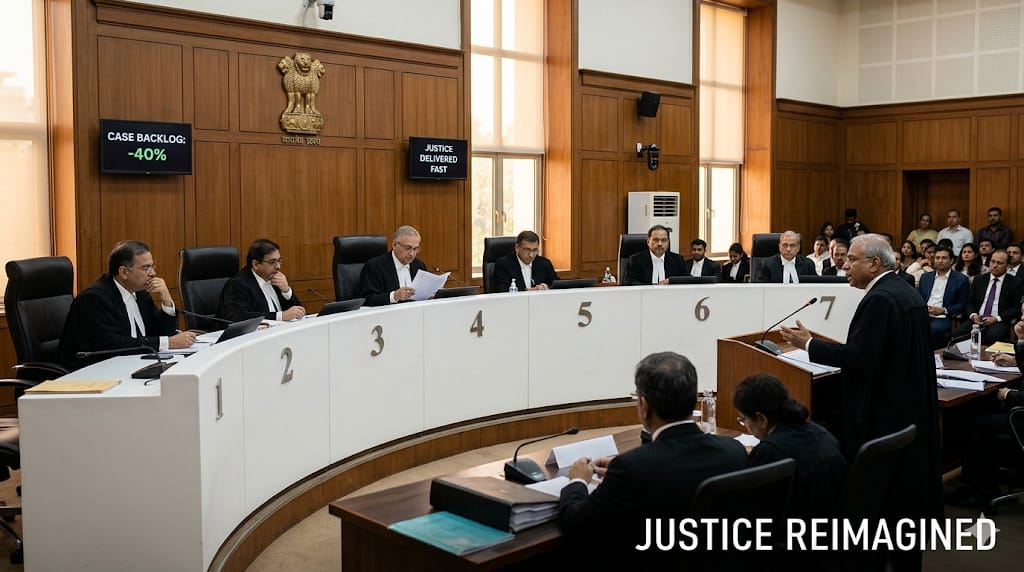
Let’s be honest: when you think of the legal system, you probably picture dusty files, endless court dates, and the famous cinematic cry of “Tareekh pe Tareekh” (date after date). It’s a well-known reality that getting justice in India can sometimes take generations. But things are finally moving. In a massive structural shift, an ordinance was recently introduced to increase the number of Supreme Court judges from 33 to 37 (excluding the Chief Justice of India). This isn’t just a routine administrative shuffle; it is a direct attempt to modernize and accelerate the country’s highest legal institution.
UPSC Nugget: The Constitutional Power Grid
Which Article? Under Article 124(1) of the Constitution of India, the power to increase or decrease the number of judges rests strictly with Parliament.
The Exception: While Parliament usually does this by passing a bill (like the Supreme Court Number of Judges Act), the executive can use the Ordinance route (Article 123) when Parliament is not in session, which must be approved later.
Why Does the Judge Count Matter to You?
You might wonder how adding four more individuals to a courtroom in New Delhi changes anything for a college student or a young entrepreneur. The reality is that a slow judiciary suffocates a nation’s growth. When businesses get stuck in legal battles for decades, innovation stalls. When citizens cannot resolve property, digital, or fundamental rights disputes quickly, trust in the system erodes. By expanding the Supreme Court, the government aims to create more judicial benches. This means more cases can be heard simultaneously, directly cutting down the time a regular citizen has to wait for a final verdict.
The Backlog Crisis: A Numbers Game
To understand why this expansion is necessary, we have to look at the staggering numbers defining the Indian judiciary. Currently, there are over 80,000 cases pending just within the apex court. When you look at the lower and high courts combined, that number skyrockets to over 50 million. A limited number of judges on the Supreme Court creates a massive bottleneck. Benches are constantly overwhelmed, forcing complex constitutional matters to be pushed aside to handle urgent daily appeals. This structural deficit slows down the evolution of laws that govern our modern, digital lives.
How Judges are Selected: The Collegium System
This expansion brings the spotlight back onto one of the most debated topics in Indian polity: how these new judges actually get their jobs. Unlike other democracies where the executive or legislature appoints judges, India uses the Collegium System. This is a forum consisting of the Chief Justice of India and the four senior-most judges of the Supreme Court. They recommend names for appointment to the government. While the government can send names back for reconsideration, if the Collegium reiterates those names, the executive is bound by custom to appoint them.
UPSC Nugget: Evolution of the Collegium
The system isn’t explicitly mentioned in the Constitution. It evolved through three landmark judgments known as the Three Judges Cases
First Judges Case (1981): Ruled that “consultation” with the CJI does not mean “concurrence” (agreement). Executive had the upper hand.
Second Judges Case (1993): Reversed the earlier ruling. CJI’s opinion is binding, creating the Collegium (CJI + 2 senior judges).
Third Judges Case (1998): Expanded the Collegium to its current form (CJI + 4 senior-most judges).
A History of Expansion
This is far from the first time India has expanded its top court to keep up with a growing population and rising litigation. When the Constitution was adopted in 1950, the Supreme Court started with just eight judges. As the country grew, Parliament stepped in repeatedly. The strength was raised to 10 in 1956, 13 in 1960, 17 in 1977, and 26 in 1986. The last major updates happened in 2009 (to 30 judges) and 2019 (to 34 judges, including the CJI). Raising the limit to 38 total seats in 2026 is simply the next logical step.
The Core Dilemma: Constitutional vs. Appellate Court
An underlying issue that adding more judges hopes to fix is the dual identity of India’s highest legal body. Primarily, it was designed to be a Constitutional Court a place to interpret the core principles of the nation’s foundational document. However, it has largely functioned as an Appellate Court, meaning any citizen dissatisfied with a High Court ruling tries to appeal here. This flood of daily appeals leaves the Supreme Court with very little time to sit in larger benches and resolve massive, country-altering constitutional questions, a problem more manpower should help alleviate.
UPSC Nugget: Original vs. Appellate Jurisdiction
Original Jurisdiction (Article 131): Cases the court hears directly, like disputes between the Center and States, or between different States.
Appellate Jurisdiction (Articles 132-134): Cases that come on appeal from High Courts regarding civil, criminal, or constitutional matters.
Advisory Jurisdiction (Article 143): The President can seek the court’s opinion on matters of public importance.
Is More Manpower the Only Solution?
While adding four new seats is a great step forward, legal experts argue that simply increasing numbers won’t completely fix the systemic issues. True judicial reform requires a multi-pronged approach. This includes upgrading infrastructure, digitizing court records, and reducing the government’s own footprint as the nation’s largest litigant. Furthermore, filling existing vacancies across various High Courts is just as critical as expanding the Supreme Court. Without fixing the lower levels of the pyramid, the top will always remain under intense structural pressure.
The Roadmap to Modern Justice
Ultimately, a fast-moving nation needs a fast-moving legal framework. Gen Z and the younger generation operate in a world of instant feedback and rapid digital transformation, and they expect their public institutions to match that speed. Expanding the Supreme Court is a clear signal that the state acknowledges the need for agility. If these new judicial positions are filled swiftly with diverse, forward-thinking legal minds, India takes a massive step closer to a future where justice is delayed no longer, making the legal system truly work at modern-day speed.
Quick Summary for Revision (UPSC CSE Focus)
| Feature | Details |
| Current Expansion | From 33 to 37 judges (plus the Chief Justice of India = 38 total). |
| Constitutional Basis | Article 124(1) gives Parliament the authority to alter judge strength. |
| Appointment Mechanism | Collegium System (CJI + 4 senior-most judges) recommends names to the President. |
| Historical Context | Started with 8 judges in 1950; progressively increased over the decades to manage caseloads. |
| Primary Goal | To clear a backlog of over 80,000 pending cases and expedite constitutional benches. |