

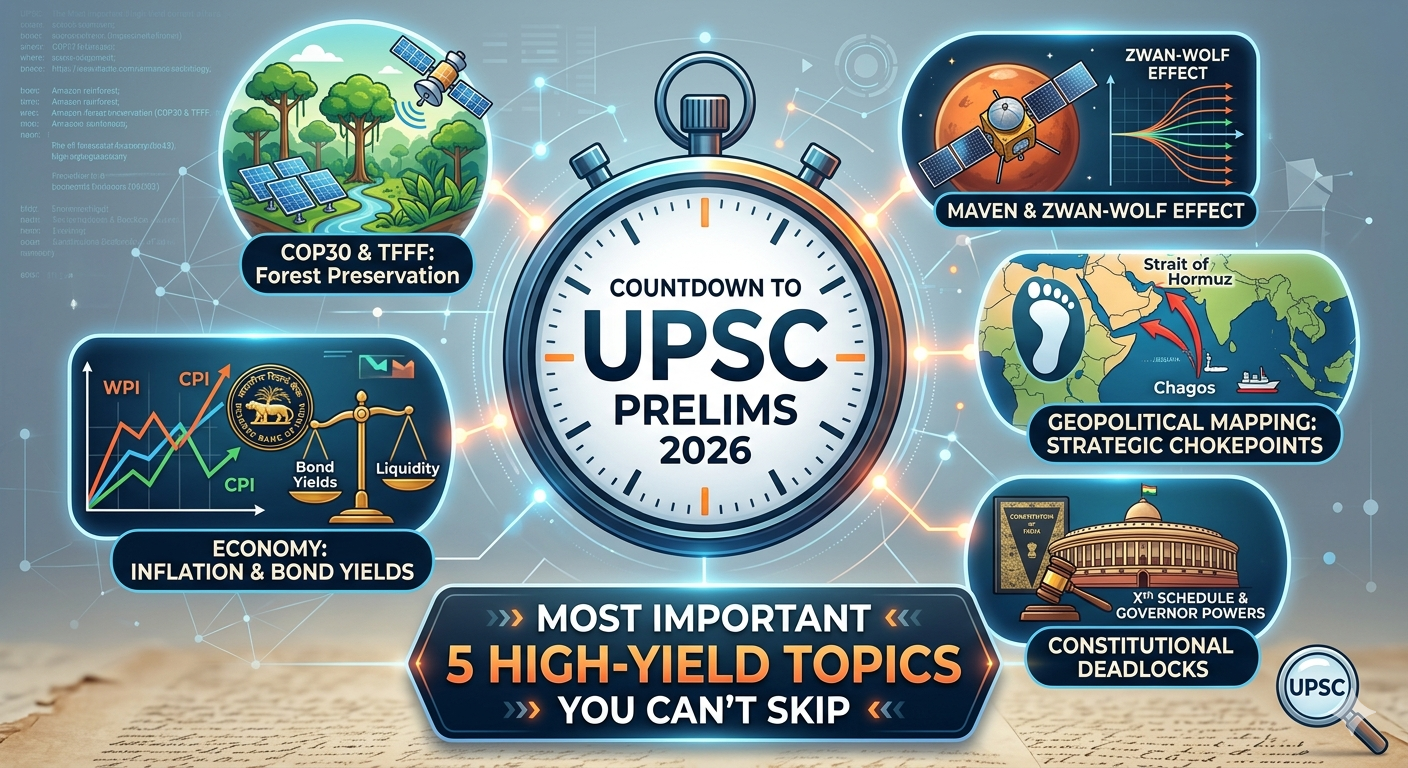
Every day, we break down Current affairs topics in India and around the world in the simplest way possible for UPSC Prelims 2026 with no heavy jargon, no confusing terms, just real talk. This page is built for Gen Z and young minds who want to stay updated but don’t want to read long articles or watch complicated debates. Here, you’ll get one important news story daily, explained like you’re talking to a friend.
The countdown has officially begun. If you are an aspirant aiming to clear the upcoming civil services examination, you already know that current affairs can make or break your scorecard. Every year, the Union Public Service Commission (UPSC) drops a paper that sends shocks through the coaching hubs of Old Rajinder Nagar and Mukherjee Nagar. Why? Because most students waste months collecting bulky monthly compilations instead of tracking high-yield core themes. And this UPSC Prelims 2026 could bring that to you as well
To secure your name on the final PDF list, your preparation must shift from extensive reading to targeted filtering. Let’s break down the 5 spiciest, most crucial high-yield current affairs topics that carry a massive probability of showing up in UPSC Prelims 2026.
1. Environment & International Conventions: The COP30 Belem Breakthroughs
Environment isn’t just an optional section for UPSC Prelims 2026 anymore; it dominates nearly 25% of the Prelims paper due to the common exam format with the Indian Forest Service (IFoS). The biggest buzz right now revolves around the historic outcomes of the UNFCCC COP30 held in Belem, Brazil.
UPSC loves structural mechanisms and international funding bodies. This year for UPSC Prelims 2026, the focus is squarely on the newly launched Tropical Forests Forever Facility (TFFF) ,a massive $125 billion initiative intended to pay developing tropical nations directly for preserving their standing forests.
[ Tropical Forests Forever Facility (TFFF) ]
├── Value: $125 Billion (Public & Private Mix)
├── Model: “Payment-for-Performance”
└── Verification: Standardized Satellite Monitoring
Additionally, keep a sharp eye on the Belem Health Action Plan which explicitly links climate change resilience to global public health infrastructure, and the heated debates surrounding Europe’s Carbon Border Adjustment Mechanism (CBAM), which India has fiercely opposed as a discriminatory trade barrier.
UPSC NUGGET: The CBAM & Paris Agreement Link
Under Article 9.1 of the Paris Agreement, developed nations possess a binding financial obligation to assist developing states. India’s core argument against CBAM is that placing tariffs on developing country imports violates the principle of Common But Differentiated Responsibilities (CBDR). Expect a conceptual statement-based question comparing CBAM mechanics with WTO non-discriminatory clauses.
2. Space Tech & Atmospheric Physics: Mars MAVEN and the Zwan-Wolf Effect
Science & Technology questions in Prelims have steadily moved away from direct textbook facts toward deep, conceptual space physics and planetary dynamics. For UPSC Prelims 2026 The spiciest current development comes straight from NASA’s MAVEN (Mars Atmosphere and Volatile EvolutioN) spacecraft.
For the first time in space exploration history, scientists have recorded the Zwan-Wolf Effect deep inside the Martian ionosphere (below 200 km).
| Feature | The Zwan-Wolf Effect |
| What is it? | A process where solar wind charged particles are squeezed and deflected along localized magnetic flux tubes. |
| Why on Mars? | Mars lacks a global, intrinsic magnetic field. Finding this effect deep inside its atmosphere redefines our understanding of how solar winds strip away planetary gases. |
| Terrestrial Status | On Earth, our global magnetosphere routinely uses this mechanism to shield us from severe solar radiation. |
If UPSC frames a question on space weather, solar flares, or planetary atmospheres, the Zwan-Wolf effect and MAVEN’s structural findings are your highest-yield targets.
3. Places in News & Strategic Mapping: Chagos Archipelago & West Asia Flashpoints
Geographical mapping remains a low-hanging fruit if you track international conflicts accurately. With geopolitics shifting rapidly, your atlas should be heavily marked around two distinct zones.
A. The Indian Ocean Shuffle: Diego Garcia
Following the UK’s high-profile announcement to hand over sovereignty of the Chagos Archipelago to Mauritius, the region has become strategically hyper-sensitive. Ensure you can identify these key geographical coordinates:
- Diego Garcia is the largest footprint in the Chagos chain.
- It sits roughly 500 km south of the Maldives and 2,000 km northeast of Mauritius.
- Its critical placement makes it a prime staging ground in the central Indian Ocean, drawing geopolitical attention and security risks.
B. West Asian Maritime Necks
The Strait of Hormuz is witnessing unprecedented strategic friction. It functions as the narrow choking point between Iran to the north and Oman/UAE to the south, routing nearly one-fifth of global petroleum liquids.
[Persian Gulf] ──> [Strait of Hormuz] ──> [Gulf of Oman] ──> [Arabian Sea]
|
(North: Iran | South: Oman/UAE)
Do not just memorize the names; memorize the adjacent land borders, separating bodies of water, and surrounding seas (Red Sea, Dead Sea, Caspian Sea, and Black Sea) from North to South.
4. Indian Polity: Tenth Schedule Loopholes & Governor-Legislature Tussles
Indian Polity could be a , major for UPSC Prelims 2026 as Static polity is deeply intertwined with current constitutional deadlocks. If you review the judicial trends of the past 12 months, the Supreme Court has consistently pulled up regional authorities over two major issues: the misuse of the Anti-Defection Law (Tenth Schedule) and the indefinite delay of Bills by State Governors.
[Constitutional Flashpoints]
┌───────────────────────┴───────────────────────┐
▼ ▼
[Tenth Schedule] [Article 200]
├── Speaker acts as Tribunal ├── Governor’s options on Bills
├── “Kihoto Hollohan” Case (1992) ├── SC Ruling: Cannot indefinitely
└── Issue: Timelines for disqualification withhold assent without action
Aspirants must Master:
- The Speaker’s Role as a Quasi-Judicial Tribunal: Revisit the landmark Kihoto Hollohan case (1992) to understand the boundaries of judicial review regarding a Speaker’s decision.
- Article 200 & 201: Understand the exact options a Governor has when a Bill is passed by the state legislature. The Supreme Court’s mandate states that a Governor cannot simply sit on a Bill indefinitely to bypass democratic mandates; if returned and passed again, assent is binding.
5. Economy: Monetary Policy Calibration, Core Inflation, and Bond Yields
With global supply chain re-alignments and changing domestic agricultural outputs, Indian macroeconomic indicators are highly volatile. UPSC Prelims 2026 has moved past simple definitions of inflation to complex, multi-layered analytical questions tracking currency dynamics and bond markets.
Keep your focus tight on these core economic pillars:
- The WPI vs. CPI Matrix: Understand why the Reserve Bank of India (RBI) utilizes CPI (Combined) as its primary anchor for inflation targeting rather than WPI. Dive into the weightage disparities—CPI is heavily weighted toward Food and Beverages (~45.86%), making it highly sensitive to erratic monsoons.
- The Dynamics of Bond Yields: Master the inverse relationship between interest rates and bond prices. When the RBI alters the Repo Rate or conducts Open Market Operations (OMO), how does it affect corporate bond yields and banking liquidity?
- The Skewflation Phenomenon: Unlike broad-based inflation, look closely at “Skewflation”—where price rises are sustained in a small, select group of commodities (like food or energy) while other sectors remain stable or experience dropping prices.
💡 The Daily Strategy Checklist for UPSC Prelims 2026
To convert this high-yield current affairs knowledge into marks UPSC Prelims 2026 on your OMR sheet, avoid passive reading. Apply the Rule of Three:
- The Static Anchor: Whenever you read a current affairs news snippet (e.g., a Supreme Court judgment on a Governor), immediately open your static textbook (e.g., Laxmikanth) and read the corresponding static chapter (e.g., Chapter on Governor).
- Reverse Engineering PYQs: Look at how UPSC asked questions on the 1991 LPG reforms or National Parks in previous years. Frame your own mock statements based on those exact patterns using the new 2026 data.
- Map It Down: Keep a blank map book on your study desk. Every time a location like Lipulekh Pass, Diego Garcia, or Somaliland hits the headlines, manually plot it with its surrounding geographical markers.
Stay focused for UPSC Prelims 2026, streamline your resources, and keep revising these core high-yield domains with dailyupscprep.in