

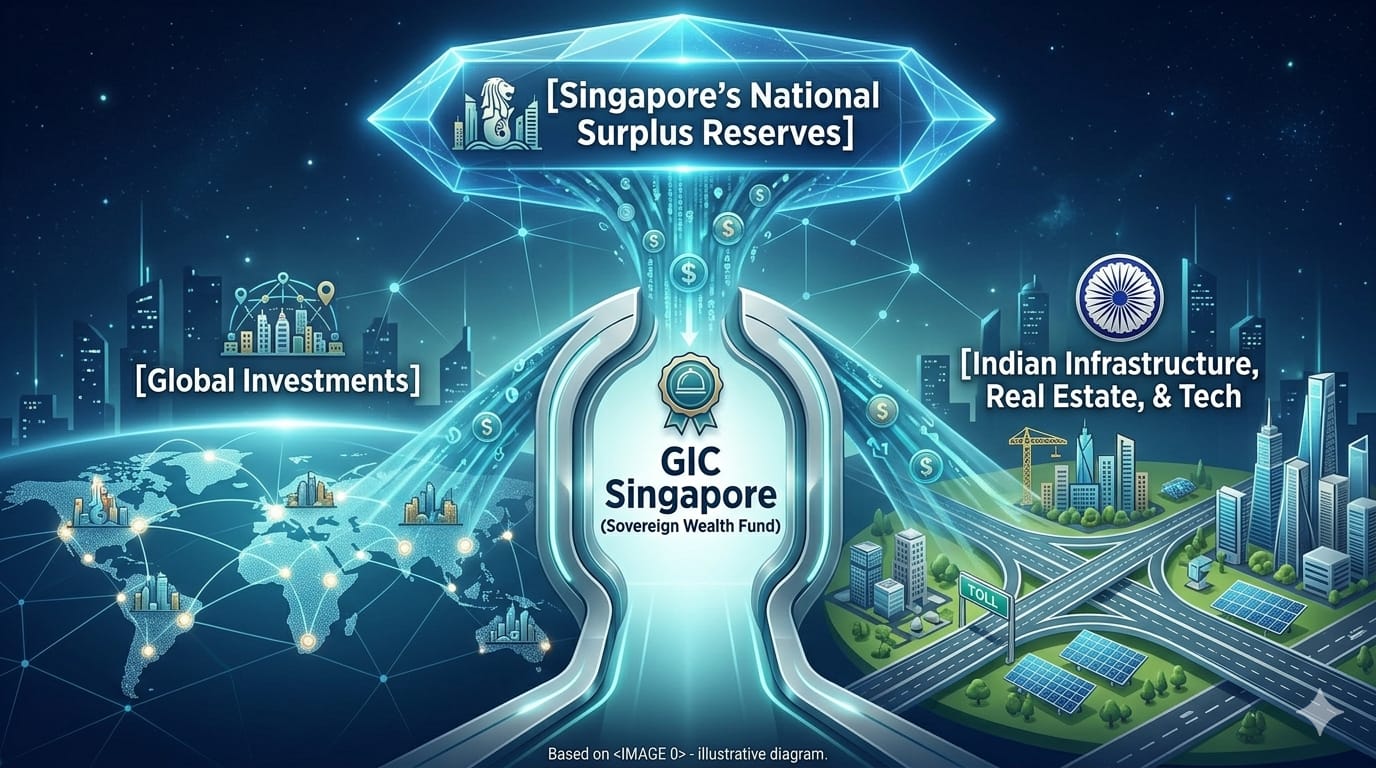
The Big Story: Why GIC Singapore is Betting Billions on India’s Growth
Imagine you have a giant piggy bank. Instead of letting that cash sit around eating dust, you decide to invest it in the most exciting, fast-growing neighborhood in town. That is exactly what Singapore is doing with India. But we aren’t talking about a few thousand rupees here. We are talking about billions of dollars moving from the financial hubs of Southeast Asia straight into Indian roads, tech startups, green energy grids, and massive real estate projects.
At the center of this financial romance is a global heavyweight that you need to know about: GIC Singapore.
If you are preparing for the UPSC Civil Services Examination, or if you just want to understand how global money shapes the world around you, this dynamic is a goldmine of insights. It sits right at the intersection of international relations, macroeconomics, and national development. Let’s break down exactly how this capital influx works, why India has become a magnet for it, and what it means for the future of our economy completely free of boring textbook jargon.
What Exactly is GIC Singapore?
Before analyzing the balance sheets, let’s understand the investor. GIC in GIC Singapore. stands for the Government of Singapore Investment Corporation. Established in 1981, it is a Sovereign Wealth Fund (SWF).
UPSC Nugget (Prelims & GS-III): A Sovereign Wealth Fund which is GIC Singapore is a state-owned investment fund comprised of money generated by the government, often derived from a country’s surplus reserves, foreign exchange reserves, or budgeting surpluses. Unlike central banks that focus on liquidity and currency stability, SWFs invest globally in high-yielding long-term assets to secure the nation’s financial future.
When Singapore accumulates structural financial surpluses through fiscal prudence, it hands over a significant chunk of those foreign reserves to GIC Singapore to manage.

With an estimated Assets Under Management (AUM) crossing over $900 billion, it ranks among the largest wealth management funds globally. The mandate is straightforward: beat global inflation and secure the financial future of Singapore across generations. To achieve this, the fund spreads its wings across public equities, private equity, fixed income, and real assets in more than 40 countries. Yet, over the last few years, a massive, disproportionate volume of its long-term conviction has landed squarely on Indian soil.
The Structural Blueprint: Where is the Money Flowing?
This institution does not trade casually on daily stock market trends. As a patient, long-term institutional investor, GIC Singapore focuses its capital on fundamental structural themes that align with India’s long-term developmental blueprint.
Infrastructure and National Highways
India’s infrastructure expansion requires trillions of dollars. Realizing this, the fund has pumped billions into InvITs (Infrastructure Investment Trusts). It holds massive stakes in entities like the National Highways Infra Trust (NHAI InvIT) and IRB Infrastructure Trust. By funding the construction and monetization of highways, the capital directly accelerates domestic physical connectivity.
Green Energy and Sustainability
As India targets net-zero carbon emissions by 2070, renewable energy has turned into a major investment focus. The fund is a prominent backer of leading green energy platforms in India, including Greenko Group and Acme Cleantech. These investments fuel large-scale solar, wind, and green hydrogen projects across the country.
Real Estate and Warehousing
With urbanization sweeping across tier-1 and tier-2 cities, commercial real estate is booming. Through joint ventures with domestic real estate leaders like DLF, GIC Singapore owns millions of square feet of prime commercial office spaces, operational IT parks, and logistics warehouses that form the backbone of India’s manufacturing and e-commerce supply chains.
Banking, Financial Services, and Technology
From holding significant stakes in top-tier private banks like HDFC Bank and ICICI Bank to backing digital-first fintech platforms, the fund plays an active role in India’s financial formalization. It also acts as a key institutional anchor for modern technology startups, digital infrastructure, and data centers.
Why India? The Core Economic Triggers
Why is a hyper-cautious, world-class sovereign wealth fund prioritizing India over other traditional developed markets? The answer lies in structural economic resilience.
While the developed West faces demographic contraction and slower growth cycles, India offers a unique narrative of structural expansion. The primary catalyst is India’s demographic dividend: a massive, young, working-age population driving consumption and digital adoption. This domestic demand insulates the Indian economy from external global shocks, turning it into a stable destination for foreign capital managed by GIC Singapore.
Additionally, political stability combined with systemic economic reforms has completely transformed India’s ease of doing business
UPSC Nugget (GS-III: Indian Economy): Key structural reforms like the introduction of the Goods and Services Tax (GST), the Insolvency and Bankruptcy Code (IBC), liberalized Foreign Direct Investment (FDI) norms, and the creation of scrip-less investment frameworks like InvITs and REITs have reduced institutional risks for global sovereign funds.
Furthermore, geopolitical shifts have prompted global institutions to diversify their supply chains and capital allocations away from a China-centric model. Under this “China+1” strategic shift, India stands out as the most viable alternative for large-scale industrial, digital, and financial capital deployments.
The Strategic Matrix: How This Benefits India
Foreign capital is not just about numbers on a spreadsheet; it acts as a core catalyst for real-world domestic transformation.
Here is the table in standard Markdown format, making it easy to copy and paste directly:
| Dimension | Real Impact on the Indian Economy |
| Capital Sufficiency | Fills the domestic savings gap, ensuring large-scale infrastructure projects get funded without straining the government’s fiscal deficit. |
| Balance of Payments | Acts as stable, non-debt-creating Foreign Direct Investment (FDI), boosting India’s foreign exchange reserves and stabilizing the Rupee. |
| Global Validation | Signals deep global institutional confidence, attracting other global pension funds, university endowments, and SWFs to India. |
| Job Creation | Directly funds physical construction, green energy plants, and corporate setups, creating millions of direct and indirect jobs for youth. |
When a prestigious sovereign wealth fund commits billions to long-term projects, it signals to the global financial ecosystem that India’s growth story is fundamentally sound. This validation encourages other global players to invest, lowering the cost of capital for Indian enterprises.
The Geopolitical Angle: The India-Singapore Corridor
For a UPSC aspirant, looking at this purely through an economic lens is incomplete. You must view it through the prism of GS-Paper II: Bilateral Relations.
The investment pipeline managed by GIC Singapore is backed by strong diplomatic and strategic ties. India and Singapore share a robust economic framework governed by the Comprehensive Economic Cooperation Agreement (CECA), signed way back in 2005. This agreement laid the foundation for institutional tax clarity, investment protection, and simplified financial flows between the two nations.
Moreover, GIC Singapore acts as the primary financial gateway for India into the broader ASEAN (Association of Southeast Asian Nations) region. Under India’s Act East Policy, deepening economic ties with Singapore is a strategic priority. The financial commitments made by Singaporean state entities reflect a shared geopolitical vision: a stable, prosperous, and multipolar Indo-Pacific region anchored by robust economic integration.
Challenges and The Way Forward
While the investment landscape appears highly promising, navigating India’s complex economic environment presents its own set of structural hurdles.
Global funds often run into regulatory delays, bureaucratic red tape, and sudden updates to local tax policies. For long-term projects like highways or renewable energy plants, acquiring land can be a slow, complex process that delays execution. Additionally, unexpected currency fluctuations can impact real returns when converting corporate earnings back into foreign currencies.
To keep attracting capital from institutions like GIC Singapore, India needs to keep refining its regulatory landscape. This means ensuring policy consistency, streamlining land acquisition through digital governance, and strengthening fast-track dispute resolution mechanisms like commercial courts.
Conclusion: Staying Sharp for UPSC
To wrap it up about GIC Singapore neatly for your exam preparation, remember that the influx of sovereign wealth capital into India is a prime example of structural economic integration. It shows how domestic policy reforms, demographic advantages, and proactive bilateral diplomacy combine to attract high-quality foreign investments.
As India targets a $5 trillion economy and beyond, patient capital will remain vital to funding our transition toward modern infrastructure and sustainable green energy.
UPSC Mains Practice Question
Q. Discuss the role of global (GIC Singapore) Sovereign Wealth Funds (SWFs) in addressing India’s infrastructure deficit. In this context, evaluate how India’s bilateral economic frameworks with nations like Singapore help catalyze long-term capital inflows.
Stay informed. Stay sharp with dailyupscprep.in
Turn on your notifications for daily, high-value breakdowns explained simply like talking to a peer.