

If you noticed Diesel Petrol Price Spiked just shot up by ₹3 overnight, you aren’t alone. But this isn’t just about the cost of your daily commute it’s about to change the price of almost everything you buy. This page breaks down exactly what is happening under the hood of the global economy without the drama.

The Trigger: Geopolitics Meets the Gas Pump
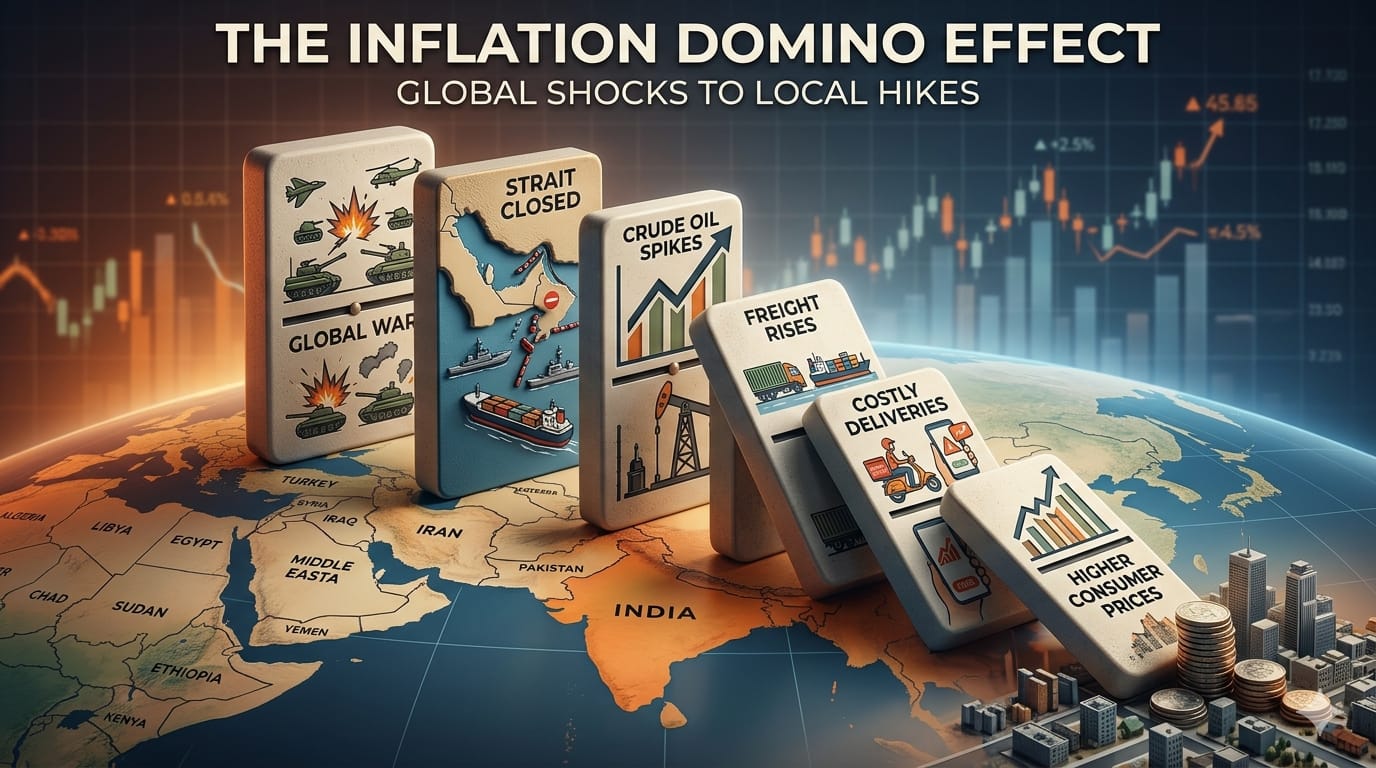
After keeping prices flat for nearly four years, Indian Oil Marketing Companies (OMCs) had to break the freeze. Petrol Price Spiked, The primary culprit is the intense conflict in West Asia, which culminated in the effective closure of the Strait of Hormuz. For context, this narrow waterway is the world’s most critical maritime oil choke point, handling roughly 20% of global seaborne crude oil and liquefied natural gas (LNG).
When a major trade corridor shuts down, supply collapses, and panic buying drives prices up. International Brent crude prices surged rapidly toward the $110 per barrel mark. Because India imports over 85% of its crude oil requirements, our domestic economy is deeply vulnerable to these external geopolitical shocks. When global crude gets expensive and Petrol Price Spiked, the raw cost of manufacturing petrol and diesel in India climbs instantly.
UPSC Nugget: The Indian Crude Basket
The Indian Crude Basket is a derived numerical value representing the weighted average of sour grade (Oman and Dubai average) and sweet grade (Brent) crude oils. It serves as the official benchmark utilized by the Ministry of Petroleum and Natural Gas to monitor international price movements and assess the import bill burden on the domestic economy.
Understanding the Backstage Losses: Under-Recoveries
You might wonder why a minor regional conflict halfway across the world forces an immediate ₹3 hike in Petrol Price Spiked at your local fuel station. The answer lies in the financial health of state-owned OMCs like Indian Oil, Bharat Petroleum, and Hindustan Petroleum. Legally, India operates under a dynamic fuel pricing mechanism established in 2017, which dictates that retail petrol prices should fluctuate daily in tandem with international market rates.
In reality, retail prices are frequently frozen for extended periods due to political economy considerations and state elections. While international oil prices and Petrol Price Spiked due to the West Asia crisis, domestic retail prices remained artificially suppressed. This gap between the expensive cost of importing crude and the capped retail price at the pump creates massive financial losses for oil companies, technically termed as “under-recoveries.”
UPSC Nugget: Under-Recoveries vs. Subsidies
Under-recoveries refer to the revenue lower-realizations incurred by OMCs when selling regulated commodities (like petrol, diesel, and domestic LPG) below the international market-linked cost price. Unlike an explicit fiscal subsidy, which is paid directly out of the Union Budget, under-recoveries initially strain the corporate balance sheets of public sector undertakings unless partially compensated by the government.
The Ripple Effect on Your Wallet: Freight and Logistics
A common mistake is thinking a fuel hike only penalizes vehicle owners. In a integrated modern economy, energy is the baseline input for literally everything. When the Petrol Price Spiked, the immediate casualty is the logistics sector. India relies heavily on road networks, powered by diesel-guzzling commercial trucks, to transport goods across state lines.
If Petrol Price Spiked it translate directly to elevated freight rates. If it costs a trucking company 15% more to transport a container of tomatoes from Maharashtra to Delhi, or apparel from manufacturing hubs to retail warehouses, that added cost does not disappear. It gets passed down the supply chain. This means your daily Zomato or Swiggy deliveries, quick-commerce grocery apps, and even fast-fashion clothing brands will face upward price revisions over the next two months because of Petrol Price Spiked.
UPSC Nugget: Wholesale Price Index (WPI) vs. Consumer Price Index (CPI)
Petrol Price Spiked influenced both inflation indices differently. WPI (published by the Office of Economic Adviser) reacts faster to crude spikes as ‘Fuel & Power’ holds a high direct weight of 13.15%. Conversely, CPI (retail inflation, published by the NSO) captures both the direct impact on transport and the secondary, cascading impact on items like food and manufactured goods.
The Macro Crisis: The Twin Deficit Trap
On a broader national level, a massive surge in international oil prices triggers an economic phenomenon known as the “Twin Deficit.” Because India buys its international oil using US Dollars, a higher crude import bill means we must send significantly more foreign exchange out of the country. This causes our Current Account Deficit (CAD) to widen substantially as Petrol Price Spiked.
Simultaneously, if the government tries to shield the public by cutting excise duties on fuel to keep prices low, it loses vital tax revenue. Alternatively, if it absorbs the losses of state-owned oil companies, its internal expenditure shoots up. This strains the government’s budget balance, expanding the Fiscal Deficit. When both the external trade account (CAD) and internal budget account (Fiscal Deficit) expand under stress at the same time, the national economy enters a tricky macro structural challenge.
UPSC Nugget: Twin Deficit Hypothesis
The Twin Deficit Hypothesis is an economic theory stating there is a strong causal link between a nation’s government budget balance and its current account balance. A worsening fiscal deficit often leads to a parallel expansion of the current account deficit, increasing vulnerability to capital flight and currency depreciation.
Defending the Home Market: Windfall Taxes
To mitigate these systemic pressures, the government has to get creative with fiscal policy. One tool deployed during global energy crises is the implementation of a Special Additional Excise Duty (SAED), colloquially known as a windfall tax. When global prices spike, private oil refiners inside India often prefer to export their fuel to western nations to book massive, unearned profits rather than selling it locally at capped rates.
To stop this domestic supply diversion, the government slaps a high windfall tax on exported fuel. This acts as a financial disincentive, making it less lucrative to export oil and forcing refiners to keep their products within India to maintain domestic fuel availability. It stabilizes the physical supply of fuel inside the country, ensuring that the ₹3 hike in Petrol Price Spiked doesn’t morph into an acute, structural domestic shortage.
UPSC Nugget: Windfall Tax
A Windfall Tax is a higher, temporary tax levy imposed by governments on specific industries when they experience sudden, outsized economic profits due to favorable external macroeconomic shifts rather than active corporate investment or expansion. Its objective is to redistribute super-normal profits to support public welfare and fiscal stability during crises.
The Path Ahead: Policy Adjustments
To offset the massive under-recoveries, which were tracking at nearly ₹1,000 crore per day across the oil sector prior to this Petrol Price Spiked times, further calibrated, small-scale hikes might be necessary over the upcoming quarters. The central bank (RBI) will be watching closely, as prolonged energy cost inflation risks pushing headline retail inflation past its upper comfort tolerance limit of 6%.
This is why the government has recently issued advisories emphasizing “voluntary austerity” encouraging citizens to adopt ridesharing, opt for public transit systems like the metro, and optimize energy habits. For the younger demographic, this current market reality highlights a fundamental truth: foreign policy, maritime checkpoints, and global conflicts aren’t just abstract ideas found in textbooks. They directly dictate the cost of living in your neighborhood.
UPSC Nugget: Strategic Petroleum Reserves (SPR)
India maintains Strategic Petroleum Reserves underground rock caverns managed by ISPRL located at Visakhapatnam, Mangaluru, and Padur, holding roughly 5.33 million metric tonnes of crude. These emergency stockpiles are explicitly designed to act as a physical buffer against severe global supply disruptions, ensuring national energy security during structural maritime blockades.
This Petrol Price Spiked brings a lot to the table, to read such informative daily current affairs, Stay updated with dailyupscprep.in .