

The Indian economy is treading a tightrope as it enters the second half of 2026. Although the Economic Survey 2025–26 highlighted a historic moderation in retail inflation over the past year, the latest retail inflation rise reflected in the National Statistics Office’s (NSO) data released on July 14, 2026, has sent a ripple of caution through India’s financial circles.
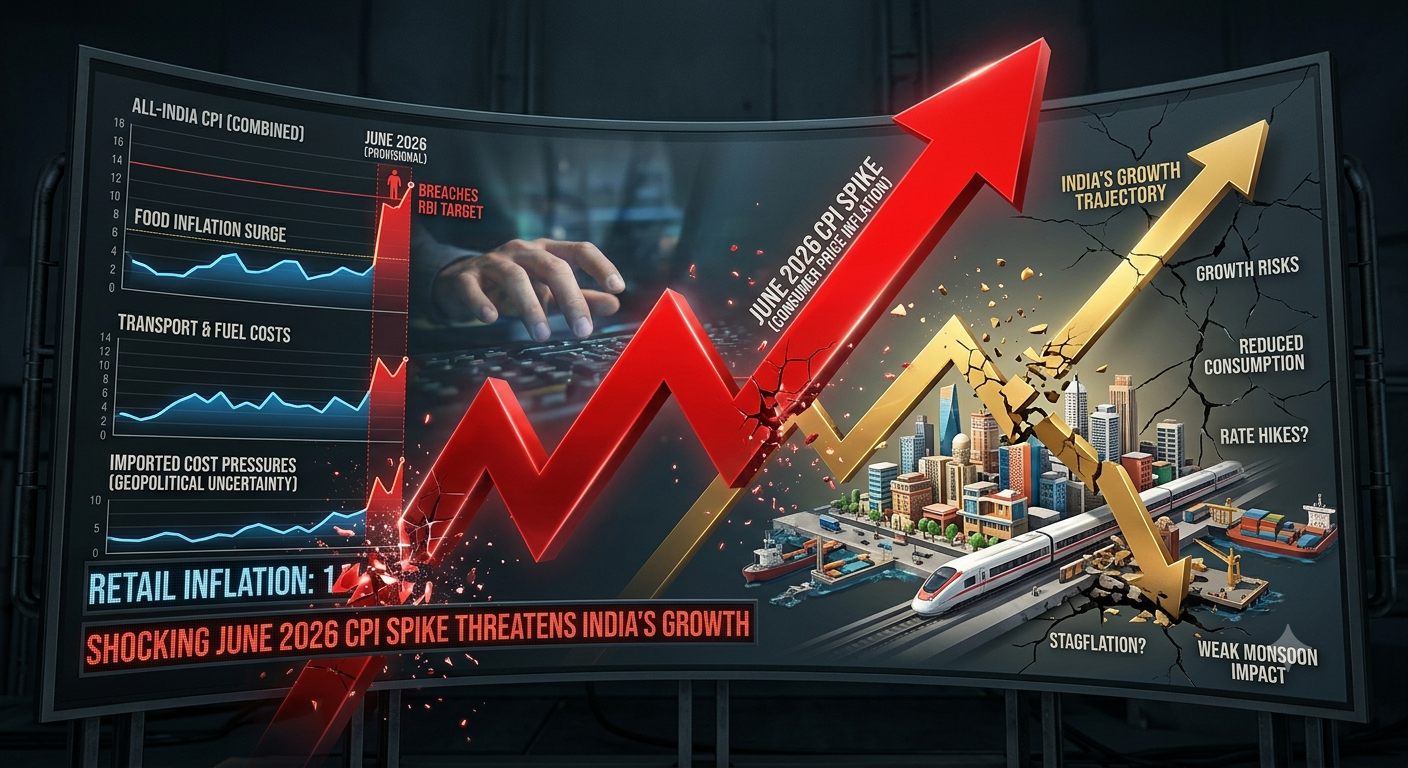
According to the latest reports, India’s retail inflation rose to 4.4% in June 2026, marking a sharp jump from the 3.93% recorded in May. For Civil Services aspirants, this macroeconomic shift is a crucial development. It represents the very first time retail inflation has crossed the Reserve Bank of India’s (RBI) medium-term target of 4.0% since the implementation of the new Consumer Price Index (CPI) series with the base year 2024.
Let us dive deep into what this retail inflation rise means, dissect its root causes, and understand the core implications for your UPSC GS-III preparation.
1. Event Summary: What Happened?
The NSO, under the Ministry of Statistics and Programme Implementation (MoSPI), released the CPI data for June 2026, revealing that headline retail inflation reached 4.38% (rounded off to 4.4%). This retail inflation rise broke a prolonged spell of comfortable disinflation.
May 2026: 3.93% =======> June 2026: 4.38% (4.4%)
– First breach of the 4% target under
the new CPI (Base Year 2024)
This uptick is particularly significant because the CPI base year was recently updated to 2024 (effective from January 2026). The spike indicates that despite the structural domestic reforms aimed at stabilizing supply chains, external global shocks and local weather anomalies continue to dictate India’s price stability.
2. Deciphering the Core Drivers Behind the Rise
A single economic event is rarely driven by an isolated factor. This sudden retail inflation rise is the result of a convergence of supply-side disruptions and global geopolitical developments:
- The Food Price Shock: Food inflation, which carries the heaviest weight (approximately 45.86%) in the CPI basket, jumped to 5.32% the highest level recorded under the newly introduced CPI series. Prices of staple vegetables like tomatoes, ginger, and raisins scaled new heights.
- A Deficit Monsoon: A major culprit behind the food price shock was a severe 42.8% rainfall deficit in June 2026. This severely hampered the sowing of Kharif crops, triggering immediate speculative price rises in agricultural markets.
- Geopolitical Flares & Fuel Hikes: Rising tensions in West Asia pushed international crude oil prices upward. Consequently, domestic petrol and diesel hikes pushed overall transportation and communication inflation to 4.31%.
- The Precious Metals Phenomenon: Due to global uncertainty, investors flocked to “safe-haven” assets. Silver jewellery inflation recorded an astronomical increase, directly impacting the core inflation calculations.
As aspirants tracking this retail inflation rise, you must note how supply-side bottlenecks (monsoon and global fuel) can quickly neutralize domestic monetary policy efforts.
3. Economic Significance and the RBI’s Tightrope Walk
The RBI’s Monetary Policy Committee (MPC) is legally mandated to maintain retail inflation at $4% pm 2%. While 4.4% is comfortably within the outer 6% tolerance band, breaching the 4% target rate under the new base year limits the central bank’s room to cut interest rates.
An immediate rate cut is now highly unlikely. To sustain India’s real GDP growth (projected at 7.3% for 2026), the RBI must ensure that this transient supply-side retail inflation rise does not seep into core expectations and lead to generalized inflation.

4. Government Interventions & Policy Measures
The Government of India and the RBI are utilizing a mix of monetary and administrative tools to check this retail inflation rise:
- Forex Interventions: To prevent a depreciating Rupee from importing further inflation (especially via crude oil), the RBI has actively managed market liquidity. India’s foreign exchange reserves rose to $674.19 billion in early July 2026, providing a robust cushion against external shocks.
- Encouraging Import Substitutions: In the Union Budget 2026-27, the government rationalized duties on basic inputs and emphasized reducing import dependence in critical sectors.
- Agricultural Portals and AI: Through tools like Bharat-VISTAAR (introduced in the 2026 Budget), the administration is aiming to build resilient agricultural supply networks to counter monsoon vulnerabilities.
Managing the current retail inflation rise requires addressing the underlying supply blockages rather than relying solely on interest rate hikes, which could inadvertently stifle industrial capital expenditure.
5. UPSC Nuggets: Quick Revision Bytes
To help you seamlessly integrate this current affairs topic into your UPSC civil services preparation, here is a highly curated revision card:
UPSC High-Yield Nugget: Consumer Price Index (CPI)
- Released By: National Statistics Office (NSO), Ministry of Statistics and Programme Implementation (MoSPI).
- The New Series: Effective January 2026, the base year is 2024 (updating the old 2011-12 base).
- Weightage distribution: Food and Beverages hold the largest chunk at roughly 45.86%.
- Monetary Policy Tool: The RBI uses CPI-Combined as its nominal anchor to formulate monetary policy decisions.
- Core Inflation vs. Headline Inflation: Core inflation excludes volatile components like Food and Fuel. However, keep in mind that under the current trend, extreme volatility in precious metals is also heavily influencing core inflation calculations.
Keeping a close tab on these technicalities is vital because direct conceptual questions on CPI composition and the base year update are highly anticipated in the upcoming prelims.
6. Prelims & Mains Practice Perspective
Prelims Practice Question (MCQ)
Q. Consider the following statements regarding the Consumer Price Index (CPI) in India:
- The CPI series currently used for policy formulation has 2011-12 as its base year.
- The Food and Beverages group holds more than 40% weightage in the CPI basket.
- The CPI data is compiled and released monthly by the Reserve Bank of India (RBI).
Which of the statements given above is/are correct? A) 1 and 2 only
B) 2 only
C) 2 and 3 only
D) 1, 2, and 3
- Answer: B) 2 only
- Explanation: Statement 1 is incorrect because the new CPI series has 2024 as its base year (effective January 2026). Statement 3 is incorrect because CPI is released by the National Statistics Office (NSO), not the RBI. Statement 2 is correct as Food and Beverages account for approximately 45.86% of the basket.
Mains Analytical Framework (GS-III)
Q. “The recurring conflict between external supply-side shocks and domestic monetary targets makes inflation targeting in India a complex task.” Analyze this statement in the context of the recent retail inflation rise in 2026.
How to structure your answer:
- Introduction: Mention the June 2026 CPI spike to 4.4% and the transition to the 2024 base year.
- Body Paragraph 1 (The Supply-Side Vulnerability): Discuss how a 42.8% rainfall deficit and rising crude prices due to West Asian tensions act as external triggers that monetary policy cannot directly solve.
- Body Paragraph 2 (The Structural Reforms): Discuss the role of fiscal policy (Buffer stock management, import duty rationalization, AI tools like Bharat-VISTAAR).
- Conclusion: Conclude by highlighting the need for a coordinated fiscal-monetary approach to safeguard India’s 7% GDP growth target.
7. Frequently Asked Questions (FAQs)
Q1. Why did the government change the CPI base year to 2024?
Ans. A base year change is standard practice to capture changing consumer spending patterns over time. The older 2011-12 base year did not accurately represent modern consumption habits, such as digital transactions and shifts in services spending.
Q2. How does a weak monsoon cause a retail inflation rise?
Ans. India’s agriculture is highly dependent on monsoon rains. A deficit in June (like the 42.8% deficit in 2026) delays Kharif sowing, causing supply shortages and immediate speculative hikes in the wholesale and retail prices of food crops.
Q3. What is the difference between Core and Headline Inflation?
Ans. Headline inflation measures the total inflation in an economy, including volatile food and fuel prices. Core inflation strips out these volatile elements to observe the underlying long-term inflation trend.
8. Conclusion
The June 2026 retail inflation rise to 4.4% serves as a timely reminder that India’s economic growth story cannot take price stability for granted. While macroeconomic indicators remain fundamentally resilient boosted by strong Forex reserves and fiscal consolidation targets supply-side vulnerabilities like monsoons and geopolitical tensions will continue to challenge policymakers. For UPSC aspirants, understanding the dynamic relationship between CPI, monetary policy, and domestic growth is crucial for tackling both Prelims and Mains economic papers.