

On July 14, 2026, India and Australia achieved a historic milestone in their Comprehensive Strategic Partnership. The two nations finalized the critical Administrative Arrangement to operationalize the long-term supply of Australian uranium to India. This breakthrough, originating from the Third India-Australia Annual Summit held in Melbourne, marks a monumental shift in the Indo-Pacific geopolitical landscape. For civil services aspirants, understanding this development is essential, as it directly impacts India’s energy security and foreign policy. The strategic implementation of the India-Australia Nuclear Deal underscores how environmental commitments and bilateral diplomacy intersect to redefine national capabilities.
1. The Recent Geopolitical Development
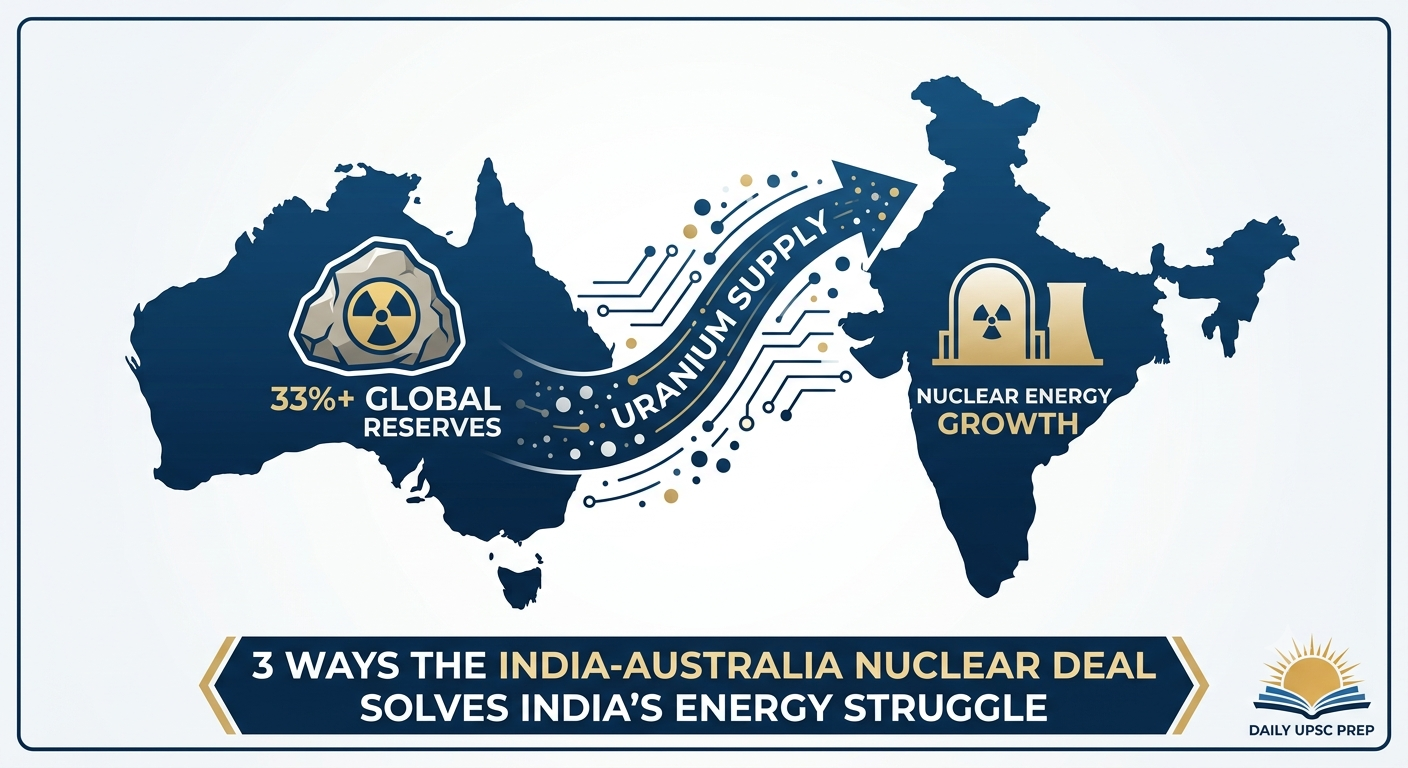
During the high-level bilateral summit in Melbourne, both leaderships successfully cleared the final administrative hurdles preventing the seamless export of Australian uranium. Australia possesses over one-third of the world’s known uranium reserves, making it an indispensable partner for India’s ambitious nuclear energy expansion. Since India is not a signatory to the Non-Proliferation Treaty (NPT), this bilateral arrangement requires specialized International Atomic Energy Agency (IAEA) safeguards. The signing of these administrative protocols ensures that fuel supplies remain uninterrupted while adhering to strict global non-proliferation norms. This development under the India-Australia Nuclear Deal marks India’s acceptance as a responsible nuclear power.
2. Historical Background and the Shift in Policy
Historically, Australia maintained a strict policy of not exporting uranium to countries that had not signed the NPT. This stance created a diplomatic bottleneck for India after its peaceful nuclear tests. However, realizing India’s immaculate non-proliferation record and the mutual necessity to counter regional unilateralism, Australia systematically altered its policy framework. The initial civil nuclear cooperation agreement was signed in 2014, but actual operationalization faced prolonged regulatory and safety verification delays. Now, the newly signed administrative guidelines finally unlock the actual shipment pipelines, turning the India-Australia Nuclear Deal into a functional geopolitical reality.
3. Key Stakeholders and Regulatory Safeguards
The operationalization of this agreement involves multiple domestic and international stakeholders working in close coordination. On the Indian side, the Department of Atomic Energy (DAE) and the Nuclear Power Corporation of India Limited (NPCIL) are the prime executing agencies. On the Australian side, the Australian Safeguards and Non-Proliferation Office (ASNO) monitors compliance. Additionally, the IAEA plays a critical third-party role by ensuring that all imported Australian uranium is strictly utilized for peaceful civilian power generation and is kept separate from military facilities. These robust institutional mechanisms form the foundational bedrock of the modern India-Australia Nuclear Deal.
UPSC Nuggets: India’s Three-Stage Nuclear Programme
To write an impactful Mains answer, you must understand where this imported uranium fits into India’s long-term strategy:
- Stage 1: Pressurized Heavy Water Reactors (PHWRs)
- Fuel: Natural Uranium; Moderator: Heavy Water.
- Uranium imports from Australia directly fuel this stage, generating plutonium-239 as a byproduct.
- Stage 2: Fast Breeder Reactors (FBRs)
- Fuel: Plutonium-239 and Uranium.
- Milestone: India’s indigenously built 500 MWe Prototype Fast Breeder Reactor (PFBR) at Kalpakkam attained first criticality on April 6, 2026, kickstarting this vital second stage.
- Stage 3: Breeder Reactors
- Fuel: Thorium-232 (abundant in India’s monazite sands) converted to fissile Uranium-233.
By securing a steady supply of uranium via the India-Australia Nuclear Deal, India stabilizes Stage 1, ensuring enough byproduct plutonium is generated to successfully power the next stages.
4. Strategic Impact on India’s Energy Goals
India has set an ambitious target of achieving 100 GW of nuclear power capacity by the year 2047. Furthermore, India’s Nationally Determined Contributions (NDCs) aim for net-zero carbon emissions by 2070. To achieve these goals, relying solely on solar and wind is insufficient due to their intermittent nature. Nuclear energy provides the necessary clean, low-carbon baseload power to support heavy industrialization and expanding digital data centers. Additionally, the landmark SHANTI Act, enacted in December 2025, allows private sector participation in building and operating nuclear plants, further magnifying the commercial impact of the India-Australia Nuclear Deal.
5. Geopolitical Implications in the Indo-Pacific
Beyond clean energy, this agreement represents a deeper strategic alignment within the Quadrilateral Security Dialogue (QUAD). Both New Delhi and Canberra are committed to ensuring a free, open, and rule-based Indo-Pacific region. By assisting India in securing its energy demands, Australia strengthens a major democratic anchor in South Asia, balancing China’s growing footprint. It showcases that democratic partnerships can deliver tangible, high-technology resource solutions. Thus, the successful execution of this bilateral arrangement proves that the geopolitical utility of the India-Australia Nuclear Deal extends far beyond simple trade.
6. Key Challenges and Obstacles
Despite the optimism, several structural challenges persist on the ground. First, India’s Civil Liability for Nuclear Damage (CLND) Act, 2010, contains strict liability clauses that make international suppliers hesitant to engage. Second, local community protests regarding land acquisition and radiation safety often delay the setup of new reactors. Third, the high initial capital expenditure required for nuclear plant installation remains a fiscal challenge for developing economies. Navigating these legal, financial, and social roadblocks will determine how effectively India can utilize the resource pipelines opened by the India-Australia Nuclear Deal.
7. Syllabus Alignment for UPSC Aspirants
This topic fits perfectly across multiple papers in the UPSC Civil Services Examination:
- GS Paper II (International Relations): Bilateral, regional, and global groupings and agreements involving India and/or affecting India’s interests. Effect of policies and politics of developed and developing countries.
- GS Paper III (Technology & Infrastructure): Energy security, nuclear technology, and scientific achievements of India.
- UPSC Interview: Opinion-based questions regarding India’s non-NPT status and its clean energy foreign policy.
Understanding the administrative and strategic nuances of the India-Australia Nuclear Deal will help you draft highly structured answers that stand out to the examiner.
Frequently Asked Questions (FAQs)
Q1. Why does India need Australian uranium when it has its own reserves?
India has vast thorium reserves but limited domestic uranium deposits, which are also of low grade. To run its Stage-1 PHWRs efficiently, India must import high-grade uranium from resource-rich countries like Australia.
Q2. Is India a member of the Non-Proliferation Treaty (NPT)?
No, India is not a signatory to the NPT, as it views the treaty as discriminatory. However, India maintains a voluntary, unilateral moratorium on nuclear testing and has a strict “No First Use” policy.
Q3. How does the SHANTI Act of 2025 impact this deal?
The SHANTI Act allows Indian private entities and joint ventures to build, own, and operate nuclear power facilities, creating a massive domestic market for uranium imported under the India-Australia Nuclear Deal.
Conclusion on India-Australia Nuclear Deal
The operationalization of the uranium supply chain between Canberra and New Delhi is a watershed moment for India’s clean energy transition. By resolving regulatory hurdles under strict international monitoring, both nations have demonstrated that strategic trust can overcome complex historical policy barriers. For India, this agreement provides the fuel security necessary to drive its industrial future while sticking to its climate promises. As UPSC aspirants, keeping a close eye on these changing dimensions of global energy diplomacy is vital, as the geopolitical success of the India-Australia Nuclear Deal sets a new precedent for international relations.