

The redistribution of parliamentary and assembly seats has emerged as one of the most intensely debated topics in Indian polity. As the year 2026 marks the expiration of the frozen freeze on seat allocation, understanding the delimitation process in India becomes absolutely vital for civil services aspirants. This mechanism, designed to ensure equal representation based on population changes, carries significant geopolitical, democratic, and regional implications. In this comprehensive guide, we will unpack how the delimitation process in India functions, its deep-rooted historical context, and why it remains a highly sensitive issue across various states.
Definition of Delimitation
Delimitation literally means the act or process of fixing limits or boundaries of territorial constituencies in a country to reflect population changes. Under this framework, the delimitation process in India is carried out by an independent, high-powered body known as the Delimitation Commission. The primary objective is to provide equal representation to equal segments of the population, ensuring that no single political faction or regional bloc gains an unfair democratic advantage. Essentially, the delimitation process in India ensures the foundational democratic principle of “One Vote, One Value” is strictly upheld across all states and Union Territories.
Historical Background
Historically, constituency boundaries have been redrawn multiple times to mirror demographic shifts. Delimitation Commissions have been set up four times in India’s independent history: 1952, 1963, 1973, and 2002. However, the delimitation process in India faced a massive structural shift through the 42nd Amendment Act of 1976, which froze the allocation of seats in the Lok Sabha based on the 1971 census. This temporary freeze was later extended by the 84th Amendment Act in 2001 until the year 2026, aimed at encouraging states to actively pursue population stabilization measures. Consequently, the delimitation process.
CHRONOLOGY OF DELIMITATION COMMISSIONS
1952 Commission –> Based on the 1951 Census Data
1963 Commission –> Based on the 1961 Census Data
1973 Commission –> Based on the 1971 Census Data
2002 Commission –> Based on the 2001 Census Data
Constitutional and Legal Basis
The legal architecture governing this exercise is deeply embedded within the Constitution. Article 82 mandates that the Parliament enacts a Delimitation Act after every decennial census is completed. Once the Act is passed, the executive constitutes the Commission to initiate the delimitation process in India seamlessly. Correspondingly, Article 170 deals with the composition and allocation of seats in State Legislative Assemblies. Furthermore, the orders issued by the Delimitation Commission carry the force of law and cannot be challenged or questioned before any court of law, ensuring that the delimitation process in India remains insulated from protracted legal deadlocks.
Key Features of the Delimitation Commission
The Delimitation Commission is a uniquely powerful entity appointed directly by the President of India. It functions in close collaboration with the Election Commission of India to execute the delimitation process in India accurately. The commission typically consists of a retired Supreme Court judge as its chairperson, the Chief Election Commissioner, and the respective State Election Commissioners. During the delimitation process in India, the body analyzes structural geographic shifts, listens to public objections, and finalizes boundary maps, ensuring total transparency while preventing political gerrymandering of administrative borders.
Advantages of Regular Delimitation
Regularly updating constituency borders brings massive democratic benefits to a growing nation. First, it rectifies regional imbalances caused by rapid urbanization, migration, and unequal population growth rates. Through the delimitation process in India, voters living in heavily populated, newly developed urban sectors receive fair democratic representation. Second, it systematically strengthens minority representation by ensuring Scheduled Castes (SCs) and Scheduled Tribes (STs) seats are reserved in areas where their population concentration is highest, validating that the delimitation process in India promotes institutional inclusivity.
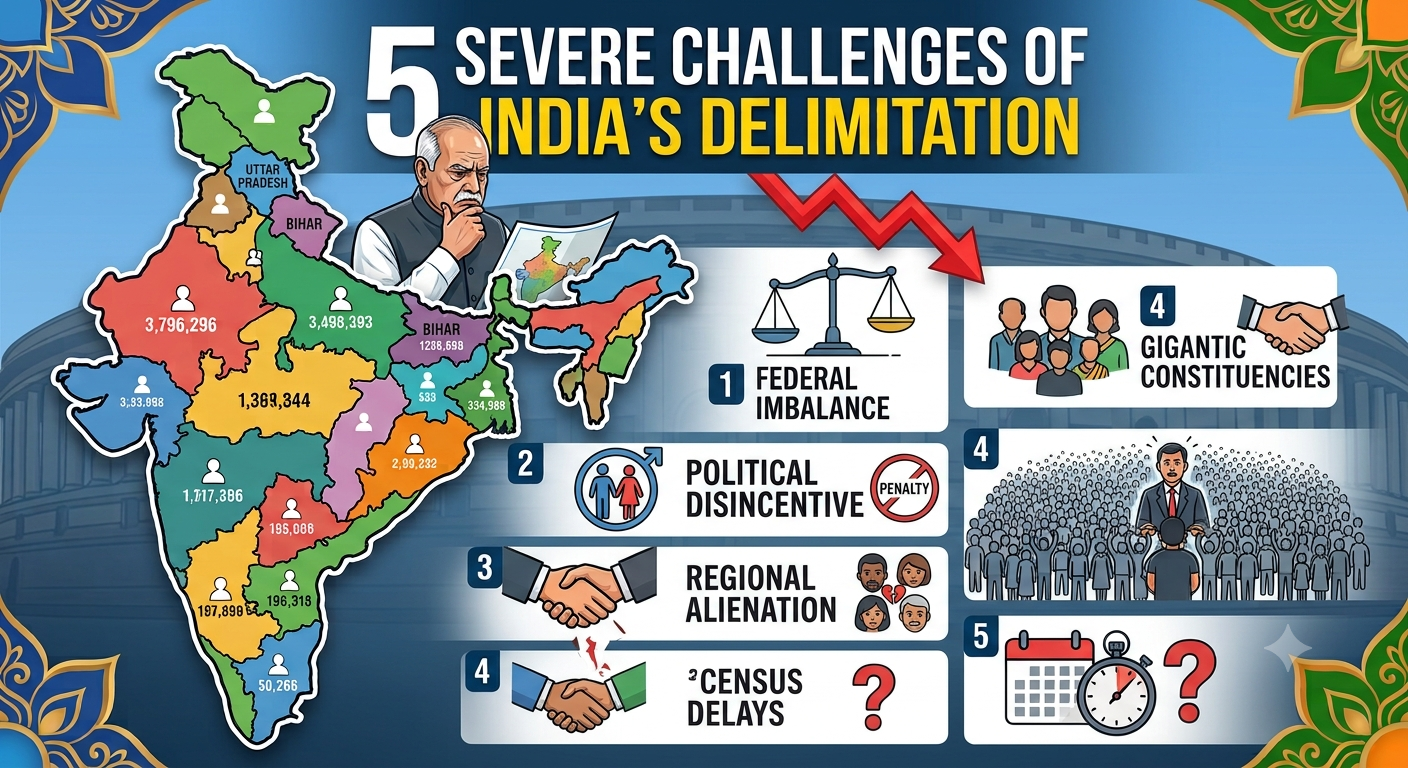
5 Severe Challenges Facing the Delimitation Process
Despite its democratic advantages, lifting the seat freeze introduces critical structural complexities. Here are the 5 major challenges:
- The Federal Imbalance: States that successfully implemented family planning policies (primarily Southern states) fear losing seats, while Northern states with higher population growth stand to gain massive parliamentary representation through the delimitation process in India.
- Political Disincentivization: Rewarding states for population expansion directly penalizes progressive states for achieving economic and demographic stabilization goals.
- Vast Linguistic and Cultural Divides: A dramatic shift in seat share toward specific regions could trigger deep political alienation among minority linguistic groups during the delimitation process in India.
- Gigantic Constituency Sizes: Managing massive physical constituencies creates severe administrative bottlenecks for elected Members of Parliament trying to govern effectively.
- Absence of Updated Census Data: The delay in the standard census timeline complicates the baseline statistical metrics required to execute a fair delimitation process in India.
UPSC NUGGETS
Article 82: Deals with allocation of Lok Sabha seats after each census.
Article 170: Explains assembly seat alignment.
The 84th Amendment: Frozen structural reallocation until 2026.
Judicial Immunity: Orders cannot be struck down by courts to avoid electoral disruption.
Importance for UPSC Aspirants
For civil services candidates, this topic is highly relevant across General Studies Paper-II (Polity, Governance, and Federalism). Questions regarding the delimitation process in India regularly appear in the Prelims exam focusing on constitutional provisions, amendment numbers, and commission compositions. In the Mains examination, aspirants are expected to analyze the delicate balance between democratic representation and federal symmetry. Understanding how the delimitation process in India intersects with cooperative federalism will help you write analytical, balanced answers that score exceptionally well.
Conclusion
The upcoming delimitation exercise will test the resilience of India’s constitutional framework. While ensuring equal voting power is a democratic necessity, safeguarding the political voice of states that championed social development is equally critical. Navigating the delimitation process in India requires immense political consensus, creative governance solutions such as expanding seats without reducing any state’s current share and absolute transparency to preserve our diverse federal structure.
Frequently Asked Questions (FAQs)
Q1: Can the judiciary intervene in the final decisions of the Delimitation Commission?
No, the orders of the Delimitation Commission cannot be challenged in any court. This is done to ensure the electoral cycle is not delayed by endless litigation.
Q2: Why is the year 2026 significant for the delimitation process in India?
The 84th Constitutional Amendment placed a strict freeze on altering the number of seats until 2026. This makes the delimitation process in India an urgent legislative focus now.
Q3: Which census data was used during the last boundary adjustments?
The last boundary adjustment exercise completed in 2008 was based strictly on the 2001 census data, though it did not alter the total number of seats per state.
To stay updated with such current affairs, stay tuned with dailyupscprep.in !
[…] have made delimitation such a politically sensitive issue. Check out our detailed article on “5 Severe Challenges of the Delimitation Process in India: A Critical Explainer“ to learn about the constitutional, political, and federal issues that continue to shape […]