

Today, we’re diving deep into a topic that sounds like a sci-fi movie but is actually happening in our own backyard.
The “Green” Gold Rush: India’s Lithium Leap
Imagine a mineral so powerful it can drive your car, power your phone, and decide the fate of a country’s economy. That’s Lithium for you. Often called “White Gold” because of its silvery-white appearance and skyrocketing value, lithium is the heart of the global energy transition.
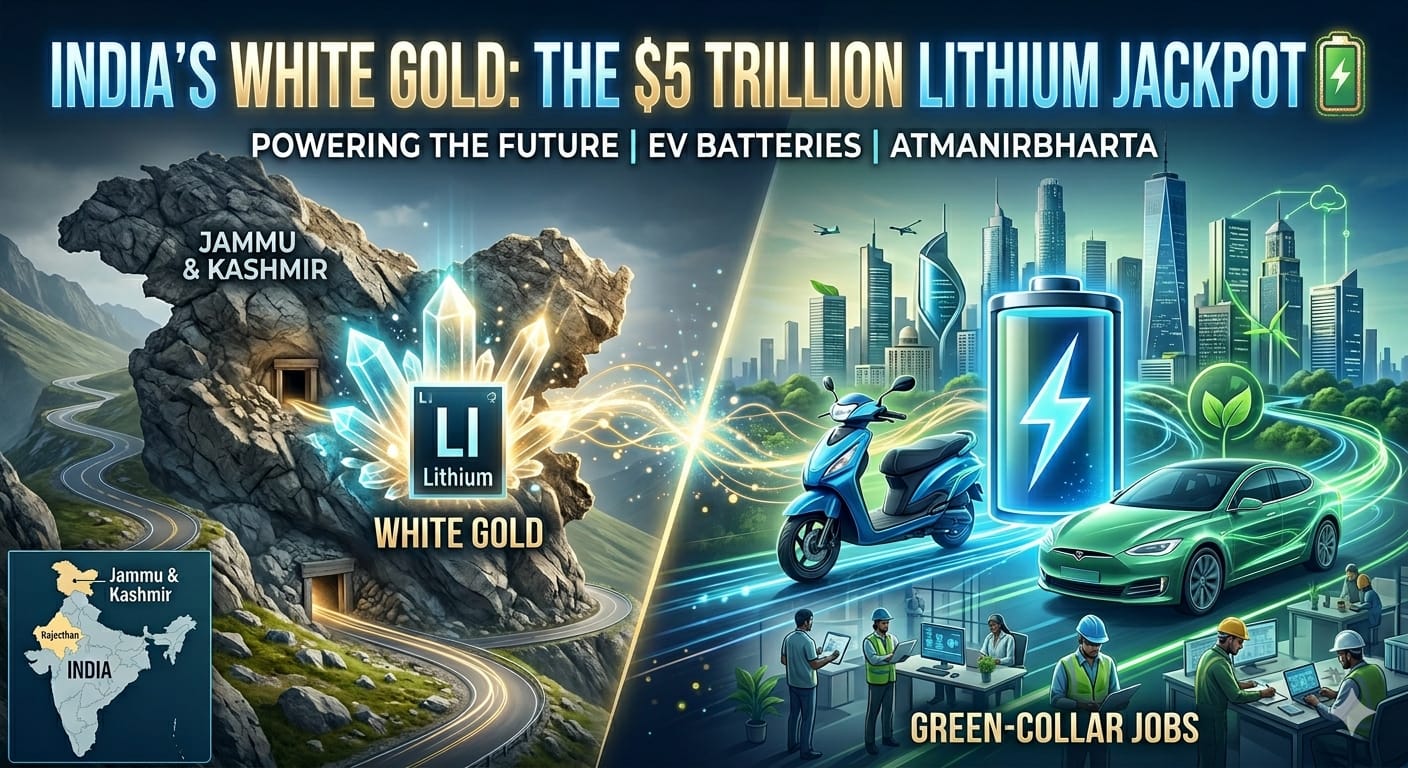
For decades, India has been a spectator in the global lithium race, watching countries like China, Australia, and Chile dominate the supply chains. But the tide is turning. Recently, the Geological Survey of India (GSI) discovered massive “inferred” lithium resources about 5.9 million tonnes in the Salal-Haimana area of Reasi district in Jammu & Kashmir (Jayaram, 2024). This was followed by more potential findings in the Degana area of Rajasthan.
Why the sudden rush?
The world is moving away from petrol and diesel. India has set a bold target to become a “Net Zero” emitter by 2070. To get there, we need millions of Electric Vehicles (EVs) on the road. Currently, India imports nearly 70-80% of its lithium-ion cells, mostly from China (Goel, 2024). This dependency is a huge strategic risk. By mining our own, we aren’t just digging for rocks; we are digging for “Atmanirbharta” or self-reliance.
The discovery in J&K is a game-changer because it puts India among the top nations with the largest reserves. However, “inferred” is a technical term meaning we’ve found the treasure map, but we haven’t opened the chest yet. Moving from discovery to actual extraction requires advanced technology and massive investment (Jayaram, 2024).
Real Impact:
Cheaper Tech: Currently, the battery is the most expensive part of an EV (around 40% of the cost). If we produce Lithium locally, the price of electric scooters and cars could drop significantly. Even your next iPhone or laptop might get a price cut.
Green-Collar Jobs: This isn’t just about labor in mines. We need battery engineers, chemical researchers, and sustainable tech experts. This “Green Gold Rush” is creating a whole new career path for our generation.
Geopolitical Power: When India stops being dependent on others for Lithium, we gain a seat at the big table. We become a provider, not just a consumer.
UPSC Nuggets
Critical Mineral Status:* The Ministry of Mines has identified 30 minerals as “critical” for India’s economic development and national security, with Lithium being a priority (Jayaram, 2024).
The MMDR Act: In 2023, the government amended the Mines and Minerals (Development and Regulation) Act to allow the private sector to mine six atomic minerals, including Lithium, which were previously reserved for the state (SECRETARIAT, 2025)
KABIL: To secure minerals abroad, India formed *Khanij Bidesh India Ltd (KABIL), a joint venture of three CPSEs (NALCO, HCL, and MECL). KABIL recently signed a deal with Argentina for five *Lithium blocks (Jayaram, 2024).
The “Lithium Triangle”: This refers to the three South American countries , i.e Chile, Argentina, and Bolivia which hold more than half of the world’s known Lithium reserves.
Environmental Concerns: Extraction is water-intensive. One ton of Lithium requires approximately 2.2 million liters of water. Balancing development with the fragile ecology of the Himalayas (J&K) is a major “General Studies” debate topic.
As we push forward, the goal is clear: transition from a “resource explorer” to a “processing powerhouse.” India isn’t just looking for Lithium; we are building a decentralized manufacturing ecosystem for battery cells to reduce our carbon footprint by up to 7% by 2030 (Jayadevan, 2026).
Being aware is powerful. Understanding the news should be easy.
Stay informed. Stay sharp with dailyupscprep.in.
References
Goel, S. (2024). Unlocking Supply Chains for Localizing Electric Vehicle Battery Production in India. International Institute for Sustainable Development (IISD). https://www.iisd.org/system/files/2024-11/electric-vehicle-battery-production-india.pdf
Jayadevan, A. (2026). A perspective on carbon footprint of decentralized manufacturing of lithium-ion cells industrialization. Frontiers in Environmental Science. https://doi.org/10.3389/fenvs.2026.1630913
Jayaram, D. (2024). India’s critical minerals strategy: Geopolitical imperatives and energy transition goals. Finnish Institute of International Affairs (FIIA). https://fiia.fi/en/publication/indias-critical-minerals-strategy
Amendment Bill, 2025. Rajya Sabha Floor Debates. https://cms.rajyasabha.nic.in/UploadedFiles/Debates/OfficialDebatesDatewise/Floor/268/1982025/19082025.pdf