

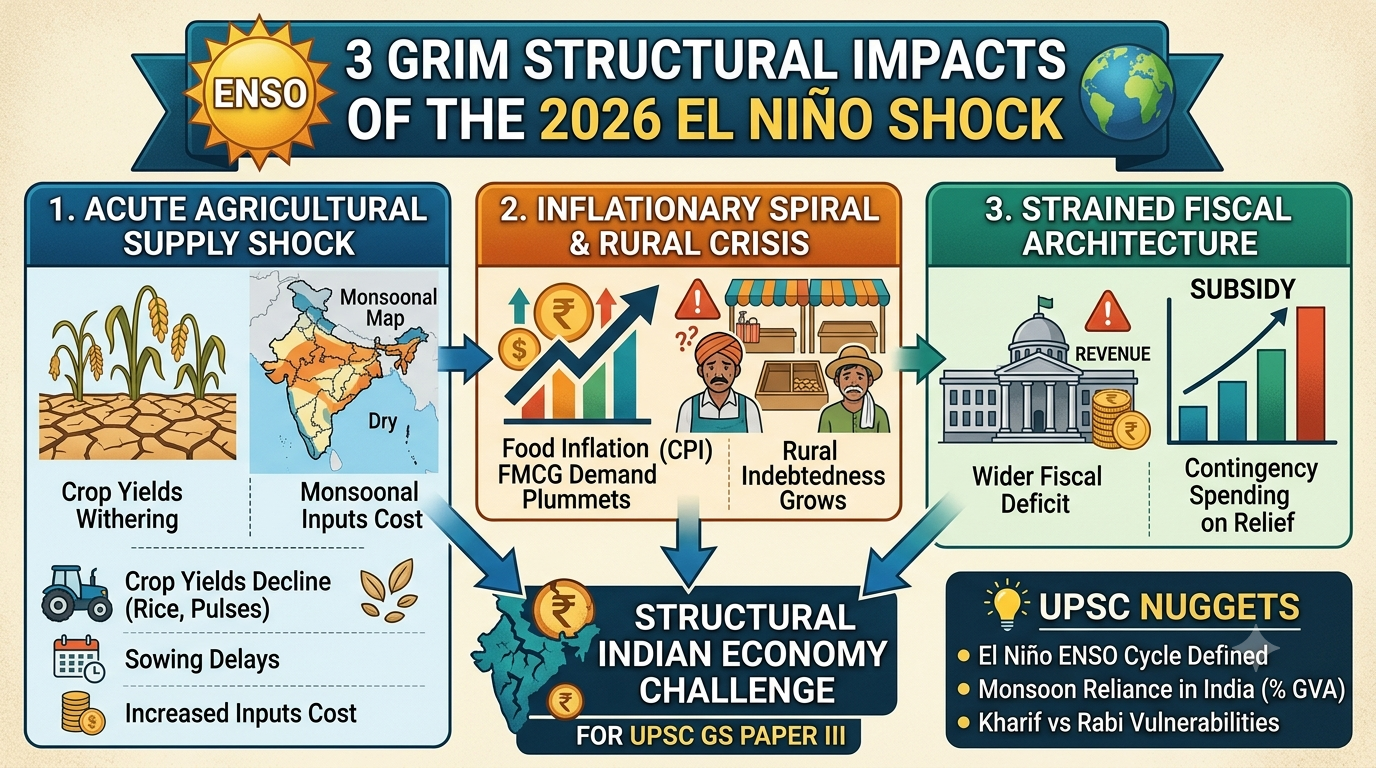
The evolving Indian economy challenge demands a rigorous analytical lens from civil services aspirants, especially as agriculture remains the backbone of the nation’s growth story. Today, on this Wednesday Current Affairs / Economy dispatch, we peel back the layers of a developing macroeconomic issue. A high-level Prime Minister’s Office (PMO) review meeting recently sounded an urgent alarm regarding a weak-to-moderate El Niño cycle disrupting the vital Kharif sowing season.
For a UPSC aspirant, understanding this phenomenon goes beyond basic meteorology; you must master how these climate anomalies translate into an active Indian economy challenge affecting fiscal targets and inflation. Despite an early monsoonal delay that left a pan-India rainfall deficit of -12% in early July, water distribution patterns remain highly erratic across major agricultural belts. Let us systematically unpack the economic mechanics of this climate event to structure a high-scoring Mains answer.

1. The Monsoonal Disruption: An Event Summary
The primary sector is currently facing unexpected meteorological headwinds due to a shifting equatorial Pacific climate pattern.
The Delays in Sowing
Official data indicates an initial delay in monsoon onset by about 10 days across major central yield belts, including Gujarat, Madhya Pradesh, Chhattisgarh, and Maharashtra. Even though subsequent precipitation in the first week of July recovered to above-normal levels, the cumulative shortfall acts as a massive bottleneck for early-stage crop germination. This initial lag creates a compounding Indian economy challenge because farmers face compressed timelines to complete their primary agricultural operations before winter.
The July-August Threshold
Meteorologists have explicitly warned that weak-to-moderate El Niño conditions will persist throughout July and August. Because the single month of July typically accounts for well over 30% of the entire country’s total monsoonal precipitation, any systemic deficit during this window poses an immediate threat to high-water-intensity crops like paddy, pulses, and coarse cereals.
2. Macroeconomic Significance for India
When the performance of the monsoon becomes highly volatile, the wider financial system feels the ripple effects almost immediately. The current monsoonal stress creates a distinct Indian economy challenge that influences several critical variables:
- Food Inflation Dynamics: Agriculture contributes nearly 17.7% to India’s total Gross Domestic Product (GDP) and accounts for roughly 44% of total national employment. When output drops, food inflation spikes, complicating the Reserve Bank of India’s (RBI) benchmark interest rate management.
- The Twin Deficit Strain: If domestic production of essential oilseeds and pulses contracts, India is forced to step up imports to stabilize local supply. This increase in imports widens the merchandise trade deficit and applies structural pressure on our current account balance.
- Rural Demand Compression: A lower harvest directly hurts rural disposable incomes, causing a decline in fast-moving consumer goods (FMCG) sales, tractor purchases, and overall secondary-sector consumer goods demand.
3. Any Silver Linings? Assessing Policy Buffers
While a monsoonal deficit is generally negative, India’s current institutional frameworks offer several built-in structural defenses against this evolving Indian economy challenge:
- Substantial Buffer Stock Reserves: The Department of Consumer Affairs maintains strategic public buffers of essential commodities, including rice, wheat, and pulses, which can be strategically released into wholesale channels to damp down localized price surges.
- Resilient Non-Farm Rural Growth: The steady formalization of the rural landscape through digital payments and schemes like the Viksit Bharat-Guarantee for Rozgar has decoupled parts of the rural economy from pure crop cycles.
- Optimized Rabi Preparedness: Early contingency planning allows the Department of Fertilizers to lock in healthy opening balances of key inputs, preparing the agricultural ecosystem to recoup any Kharif shortfalls during the subsequent winter cropping season.
4. Deep-Seated Systemic Concerns
Despite administrative buffers, letting a monsoonal deficit spiral poses a severe risk to our core developmental goals. It acts as an active Indian economy challenge by creating structural imbalances across regional markets:
- Declining Reservoir Storage Levels: Water levels across central and southern peninsular reservoirs are being closely watched. If these levels fail to replenish, it creates long-term drinking water scarcity and limits the availability of rabi irrigation water later in the fiscal year.
- Escalating Fiscal Subsidy Outlays: To insulate vulnerable small and marginal farmers, the government must scale up emergency capital allocations for crop insurance claims under the Pradhan Mantri Fasal Bima Yojana (PMFBY). This shifts valuable capital away from long-term infrastructure investment into immediate revenue expenditure.
5. Institutional and Administrative Response
To insulate the rural landscape against this emerging downside risk, the central government has deployed several rapid administrative mechanisms:
Enhanced Financial Coverage
The government has launched aggressive campaigns to expand the coverage of the Kisan Credit Card (KCC) and PMFBY across vulnerable, non-irrigated districts to ensure timely credit delivery and risk mitigation.
Regular Inter-Ministerial Oversight
The Crop Weather Watch Group is convening weekly coordination meetings with state governments to dynamically monitor input availability, localized pest outbreaks, and reservoir statuses to execute localized contingency plans.
6. The Core UPSC Angle: Syllabus Mapping
For civil services aspirants, parsing these macroeconomic developments directly feeds into your primary preparation for Prelims and Mains. It represents an excellent, real-world case study of an unresolved Indian economy challenge.
For Prelims
Focus on the technical components of the Index of Industrial Production (IIP) versus the newly planned Index of Services Production (ISP) scheduled for a July rollout. Understand the criteria for declaring an agricultural drought, the mechanisms of the National Monsoon Mission, and the atmospheric physics of the El Niño Southern Oscillation (ENSO) cycle.
For Mains (GS Paper III)
This topic directly addresses the core themes of Major Cropping Patterns, Issues of Food Security, and Inflationary Management. Utilize these current statistics on rainfall deficits and sector-wise GVA contributions to elevate your answer presentation.
UPSC Nuggets: High-Yield Fact File
- The July Monsoon Factor: July typically accounts for over 30% of total monsoonal precipitation in India. This makes timely rainfall in July the absolute anchor for successful nationwide Kharif sowing.
- GVA Benchmark: Agriculture contributes approximately 17.7% to India’s total Gross Value Added (GVA), making macro-stability highly sensitive to primary sector disruptions.
- The ISP Launch: The Ministry of Statistics and Programme Implementation (MoSPI) is set to launch the Index of Services Production (ISP) on July 14, 2026, using 2024-25 as the base year to better track high-frequency service sector trends.
High-Yield Practice Questions for Aspirants
Prelims Practice Question
Q. Consider the following statements regarding the economic impacts of an El Niño phenomenon on India:
- It generally causes a sharp appreciation of the Real Effective Exchange Rate (REER) due to an increase in agricultural exports.
- It can directly impact the fiscal deficit by increasing government revenue expenditure on rural safety nets and agricultural subsidies.
Which of the statements given above is/are correct?
A) 1 only
B) 2 only
C) Both 1 and 2
D) Neither 1 nor 2
- Answer: B
- Explanation: Statement 1 is incorrect because an El Niño event leads to domestic supply shortages, which reduces agricultural exports. Statement 2 is correct because the government must scale up emergency funding for rural insurance and safety nets, which applies pressure to the fiscal deficit.
Mains Analytical Prompt
Q. Assess how global climate anomalies create an immediate Indian economy challenge across primary and secondary sectors. Suggest structural policy measures to decouple domestic food security from the vagaries of the southwest monsoon. (15 Marks, 250 Words)
Frequently Asked Questions (FAQs)
Q1: Does every El Niño year automatically result in a severe nationwide drought?
A1: No. Historical data shows that an El Niño year does not necessarily lead to deficient rainfall below normal across the entire subcontinent, as localized factors like the Indian Ocean Dipole (IOD) can offset its impacts.
Q2: Why is the month of July considered the make-or-break period for Kharif sowing?
A2: July receives more than 30% of the entire southwest monsoon’s total seasonal rainfall, providing the essential soil moisture required for widespread crop transplantation.
Q3: How does a deficit in the agricultural sector impact urban industrial demand?
A3: A drop in rural output dampens rural purchasing power, which directly reduces consumer demand for industrial products like manufactured goods, automobiles, and electrical appliances.
Conclusion
Managing a structural environmental anomaly like El Niño remains a core Indian economy challenge that tests our administrative and fiscal resilience. While early monsoonal deficits highlight our continuing vulnerability to climate variations, robust buffer stocks and active public monitoring networks provide key safety buffers. For long-term macroeconomic stability, India must continue to prioritize investments in climate-resilient agriculture and micro-irrigation networks.
The connection you draw between delayed Kharif sowing and broader macroeconomic pressures is particularly importantEl Niño Impact Analysis because many people view El Niño as only an agricultural issue. It will be interesting to see how policymakers balance inflation control with support for affected farmers if rainfall continues to remain uneven across key crop-producing regions. The regional variation in rainfall distribution seems like a critical factor to watch in the coming months.