

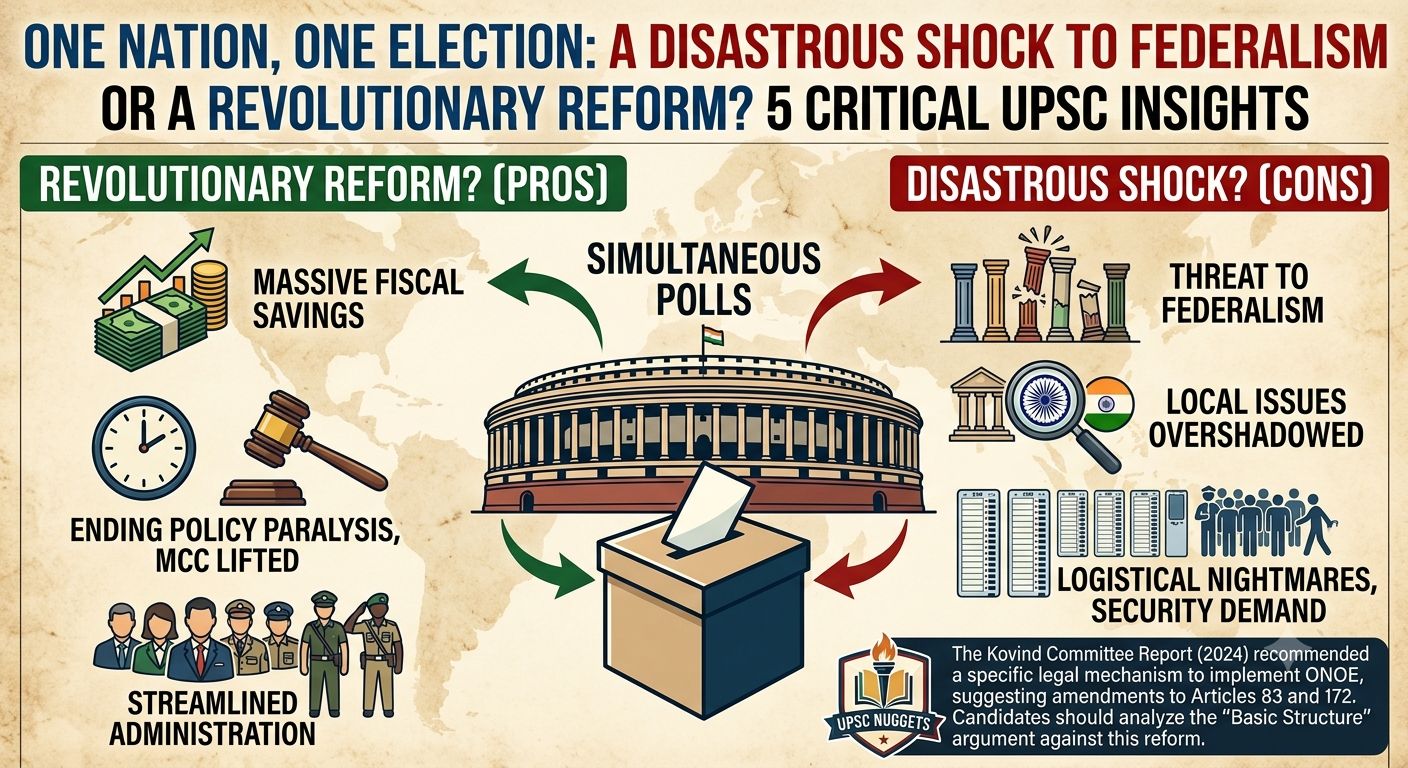
The debate surrounding electoral reforms in India has reached a boiling point in 2026. With the Joint Parliamentary Committee (JPC) actively reviewing the proposed changes, the concept of holding simultaneous polls across the country has shifted from a theoretical discussion into a fast-tracked legislative reality. As a civil services aspirant, understanding the mechanics of this proposed transition is vital for mastering General Studies Paper II. At the core of this structural transformation lies a complex legislative mechanism known as the simultaneous elections framework, which aims to synchronize the mandates of the Lok Sabha and state assemblies.
Definition: What is One Nation, One Election?
In simple terms, One Nation, One Election (ONOE) refers to an electoral governance model where voting for both the Lok Sabha (the lower house of Parliament) and all State Legislative Assemblies takes place within a synchronized window. Instead of India being in a state of perpetual election mode where five to six states go to the polls every single year voters would cast their ballots for both central and state representatives concurrently. To turn this proposal into reality, the government introduced the Constitution (129th Amendment) Bill in Parliament. This bill sets up a legal mechanism called the simultaneous elections framework to systematically realign differing assembly tenures without permanently fracturing democratic representation.
UPSC NUGGETS: The Kovind Committee Findings
To lay down the groundwork for this massive transition, a High-Level Committee was formed under the chairmanship of former President Ram Nath Kovind. The committee’s comprehensive report strongly recommended a two-step implementation strategy. In the first phase, Lok Sabha and State Assembly polls will be synchronized. In the second phase, municipal and panchayat elections will be aligned within 100 days of the general elections. This blueprint serves as the structural foundation for the simultaneous elections framework currently being deliberated by the JPC
Historical Background: The Broken Cycle
Simultaneous polls are not a completely novel experiment for the Indian polity. In fact, after the adoption of the Constitution, the first four general elections held in 1951-52, 1957, 1962, and 1967 were conducted simultaneously without major administrative friction. However, this synchronized cycle completely broke down between 1968 and 1969. The premature dissolution of several State Legislative Assemblies due to political instability, combined with the early dissolution of the Lok Sabha in 1970, permanently decoupled the national and state election calendars. Restoring this historic alignment requires an intricate legal structure, which is exactly why parliamentary committees are working on a new simultaneous elections framework.
The Modern Resurgence
Since 2014, the central government has consistently pushed to restore the synchronized voting cycle, citing massive governance bottlenecks. The introduction of the 129th Amendment Bill marks the final legislative push to operationalize this vision.
Key Features of the 129th Amendment Bill
The Constitution (129th Amendment) Bill introduces several unprecedented provisions designed to bring all 28 states and 8 Union Territories into a singular voting timeline.
- The Appointed Date: The President will notify a specific “Appointed Date” following a general election to trigger the synchronized cycle.
- Curtailed Tenures: The terms of any State Assemblies formed after this appointed date will automatically expire alongside the standing Lok Sabha’s term.
- Provisional Mid-term Solutions: If a house is dissolved early due to a no-confidence motion, fresh elections will be held only for the remainder of the five-year term, thereby preserving the simultaneous elections framework.
Constitutional and Legal Basis (simultaneous elections framework)
Implementing this reform is a monumental legal task that cannot be accomplished through a simple executive order. Experts point out that it will require at least 18 constitutional amendments, heavily impacting several core articles that define the duration and structure of Indian legislatures.
| Article Impacted | Constitutional Area Affected |
| Article 83 | Duration of the Houses of Parliament |
| Article 85 | Dissolution of the Lok Sabha by the President |
| Article 172 | Duration of the State Legislative Assemblies |
| Article 174 | Dissolution of State Assemblies by the Governor |
| Article 356 | Provisions in case of failure of constitutional machinery |
Beyond these parliamentary alterations, introducing a unified electoral roll requires amending Article 325. This change empowers the Election Commission of India (ECI) to build a single database in coordination with State Election Commissions. Ratifying these changes across a diverse political landscape remains the biggest test for the newly proposed simultaneous elections framework.
Major Advantages of the Reform
Proponents of the 129th Amendment point to massive administrative and economic advantages that could accelerate India’s developmental trajectory.
Ending Policy Paralysis
Whenever an election is announced, the Model Code of Conduct (MCC) is instantly enforced. This stops the government from launching new welfare schemes, approving infrastructure projects, or making major policy decisions. By consolidating voting into a single window, the MCC would only restrict governance once every five years.
Unprecedented Fiscal Savings
Recent projections by the Joint Parliamentary Committee estimate that moving away from continuous election cycles could save the public exchequer up to ₹7 lakh crore over multiple cycles, potentially providing a 1.6% boost to national GDP. These economic benefits heavily depend on the structural efficiency of the simultaneous elections framework.
[Perpetual Elections Model] ──> Frequent MCC Imposition ──> Disrupted Governance
[Synchronized Elections Model] ──> Consolidate Voting Window ──> Sustained Development
Critical Challenges and Concerns on simultaneous elections framework
Despite the clear economic incentives, the proposed bill faces intense opposition from regional political parties and constitutional scholars who fear it undermines basic democratic principles.
The Threat to Federalism
The most glaring criticism is that forcing state assemblies to cut their democratically elected tenures short directly violates the federal spirit of the Constitution. India is a “Union of States,” and critics argue that subordinating state political cycles to the national calendar reduces the distinct constitutional identity of individual states within the simultaneous elections framework.
Shifting Focus to National Issues
Data from past localized synchronized polls indicates that voters tend to support the same political party at both the state and central levels when voting happens concurrently. This raises concerns that crucial local issues like regional unemployment, water disputes, or distinct cultural narratives will be overshadowed by dominant national security or foreign policy campaigns.
Logistical Nightmares
The Election Commission of India will need to acquire millions of Electronic Voting Machines (EVMs) and Voter Verifiable Paper Audit Trails (VVPATs) simultaneously. Managing the massive deployment of central paramilitary forces across hundreds of thousands of polling booths in a tight window poses a huge logistical challenge to the simultaneous elections framework.
UPSC Importance of simultaneous elections framework: Relevance for Mains & Prelims
For civil services aspirants, this topic combines elements of constitutional law, federalism, and statutory bodies.
- Prelims Link: Watch for questions on the specific articles governing the duration of houses (Articles 83 and 172) and the exact composition of the High-Level Committee on ONOE.
- Mains Link (GS Paper II): Be prepared for analytical questions regarding whether simultaneous polls compromise the “Basic Structure” of the Constitution, specifically concerning the principle of federalism. When writing your answers, always balance the economic benefits against the potential dilution of regional democratic accountability under the simultaneous elections framework.
Conclusion
The Constitution (129th Amendment) Bill represents one of the most radical structural overhauls of India’s democratic machinery since independence. While the promise of saving trillions of rupees and ending permanent policy paralysis is appealing, the challenges it presents to federalism and local representation are serious. To succeed, the government must build a deep political consensus rather than rushing the legislation through. Ultimately, India’s democratic resilience will depend on whether this transition can protect the delicate balance between federal diversity and administrative efficiency under a unified simultaneous elections framework.
Frequently Asked Questions (FAQs) – simultaneous elections framework
Q1: Does One Nation, One Election mean all of India votes on a single day?
No. The Chairman of the JPC has clarified that voting will still be conducted in multiple phases based on logistical feasibility and security assessments. However, the entire national exercise will be wrapped up within a synchronized window.
Q2: What happens if a state government falls before completing its 5-year term?
Under the proposed rules, if a government falls early, fresh mid-term elections will be held. However, the newly elected assembly will only serve out the remainder of the original 5-year cycle, ensuring the state stays aligned with the national calendar.
Q3: Do all states need to ratify the 129th Amendment Bill?
Yes. Since the bill modifies provisions that alter the powers of state legislatures and the role of State Election Commissions, it requires ratification by the legislatures of at least half of the states, as mandated by Article 368 of the Constitution.