

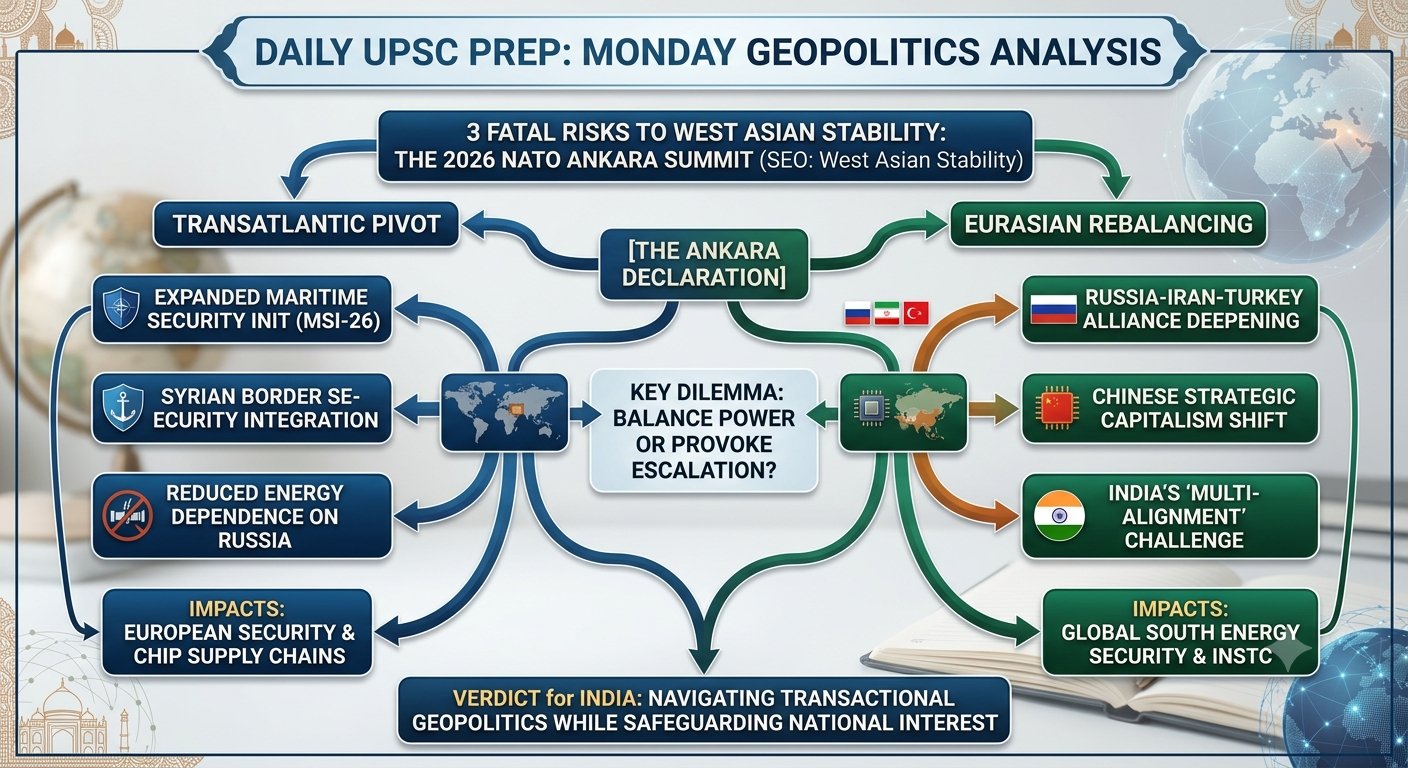
The year 2026 has brought unprecedented shifts to global security architectures. As an aspirant tracking contemporary international relations, relying on outdated templates will not suffice. According to the “Source document for daily article writing.docx”, our Monday focus centers squarely on high-impact geopolitics. Today, global attention shifts from West Asian naval choke points to the strategic crossroads of Eurasia. The defining event of this week is the 2026 NATO Ankara Summit, where heads of state have gathered in Turkey to recalibrate their collective defense doctrines amidst a highly fragmented world order.
For the Civil Services Examination, this summit is a critical case study in how military alliances alter their continental footprints. The decisions made here do not merely affect transatlantic partners; they actively reverberate across India’s extended neighborhood, altering maritime strategies, continental balance, and defense procurement.
What Happened? The Turkish Pivot
On July 7, 2026, the historic capital of Ankara, Turkey, became the nerve center of international diplomacy as it hosted the annual gathering of the 31 NATO member states. This event marks a massive symbolic and strategic transition, being the first time in years that such a high-stakes Western military alliance summit has convened on the geography bridging Europe and Asia. The 2026 NATO Ankara Summit has primarily focused on addressing the rising tide of hybrid warfare, evaluating the delicate security paradigms across the Black Sea, and finalizing defense integration frameworks for newly admitted Eastern European partners.
Background: The Evolution of NATO’s Eurasian Footprint
To appreciate the gravity of the 2026 NATO Ankara Summit, one must look back at the alliance’s transformation post-2022. The continuous conflict in Eastern Europe effectively ended the era of conventional peace dividends, forcing the alliance to shift from a legacy posture of out-of-area stabilization to one of hard, collective deterrence. Turkey’s position as a bridge between East and West has always been complex. By hosting the 2026 NATO Ankara Summit, Ankara is actively projecting its role as an indispensable diplomatic arbiter that balances its strict treaty obligations to the West with its independent, pragmatic economic engagements across the Eurasian landmass.
Importance for India: Balancing the Eurasian Continental Tilt
New Delhi is keeping a very close watch on the declarations coming out of the 2026 NATO Ankara Summit. India’s foreign policy is deeply anchored in the principle of multi-alignment and strategic autonomy, meaning that any aggressive expansion or consolidation of exclusive military Blocs directly impacts its continental calculus.

As the alliance expands its institutional eyes toward the Indo-Pacific and builds out its cyber-defense networks, India must carefully ensure that its critical defense and energy partnerships across Eurasia—particularly with traditional partners like Moscow remain uncompromised by changing Western sanctions architectures.
UPSC Nuggets: Core Revision Elements
- The Montreux Convention (1936): An essential international accord regulating naval transit through the Bosporus and Dardanelles straits, granting Turkey full sovereign control over these vital passages. This historic legal framework underpins the strategic context of the 2026 NATO Ankara Summit.
- Article 5 of the NATO Charter: The foundational principle of collective defense, stating that an attack against one ally is considered an attack against all allies.
- Syllabus Intersection: General Studies (GS) Paper 2: International Relations i.e Bilateral, regional, and global groupings involving India or affecting India’s core national interests.
Key Takeaways: Technology and Fragmented Alliances
The primary takeaway from the 2026 NATO Ankara Summit is the formal institutionalization of “State Capitalism” within modern defense sectors. Western nations are aggressively moving away from laissez-faire commercial procurement, choosing instead to treat advanced artificial intelligence, drone swarms, and semiconductor manufacturing as matters of pure national survival. Furthermore, the deliberations highlight how middle powers are successfully leveraging their unique geographies to extract concessions from larger states, signaling a broader transition toward a highly transactional, multi-polar global governance model.
UPSC Relevance: The Prelims & Mains Angle
For civil services aspirants, the structural trends emerging from the 2026 NATO Ankara Summit provide exceptional raw material for analytical answers. In the Preliminary Test, UPSC frequently tests your conceptual grasp of geography around the Black Sea, the Aegean Sea, and the strategic waterways of Anatolia. For the Mains Examination (GS Paper 2), the core analytical focus will be on evaluating how the strengthening of Western security architectures challenges India’s carefully calibrated relationships within alternative groupings like BRICS and the Shanghai Cooperation Organisation (SCO).
Sample Practice Questions
- Prelims Focus: Which of the following bodies of water are connected by the Bosporus Strait? (A) Black Sea and Sea of Marmara (B) Sea of Marmara and Aegean Sea (C) Black Sea and Caspian Sea (D) Mediterranean Sea and Red Sea Answer: (A)
- Mains Focus: “The consolidation of global military alliances forces emerging economies to walk a tightrope of strategic multi-alignment.” Analyze this statement in the context of the 2026 NATO Ankara Summit and its long-term impact on India’s foreign policy.
Frequently Asked Questions (FAQs)
Q1. Why is Turkey hosting the NATO summit in 2026 so significant?
Turkey acts as the physical and diplomatic gateway between Europe, the Middle East, and Central Asia. Hosting the 2026 NATO Ankara Summit allows it to showcase its immense strategic leverage and project its capabilities as a crucial mediator in regional security.
Q2. How does a European-centric alliance like NATO affect India?
While primarily focused on transatlantic security, NATO’s evolving doctrines increasingly address cyber threats, maritime security in the Indian Ocean, and supply chain vulnerabilities, all of which directly intersect with India’s geopolitical security grid.
Q3. What is the main theme of the 2026 summit?
The core focus of the 2026 NATO Ankara Summit centers on modernizing collective deterrence against hybrid threats, securing critical infrastructure, and managing the geopolitical realities of an increasingly multi-polar global order.
Conclusion
The structural shifts observed during the 2026 NATO Ankara Summit reinforce the reality that contemporary geopolitics is no longer a zero-sum game between two superpowers. For India, maintaining an equilibrium between its growing partnerships with Western democracies and its deep-seated continental commitments requires top-tier diplomatic flexibility. As future administrators, mastering these subtle shifts in global power dynamics is vital to developing the analytical mindset required for the civil services exam.