

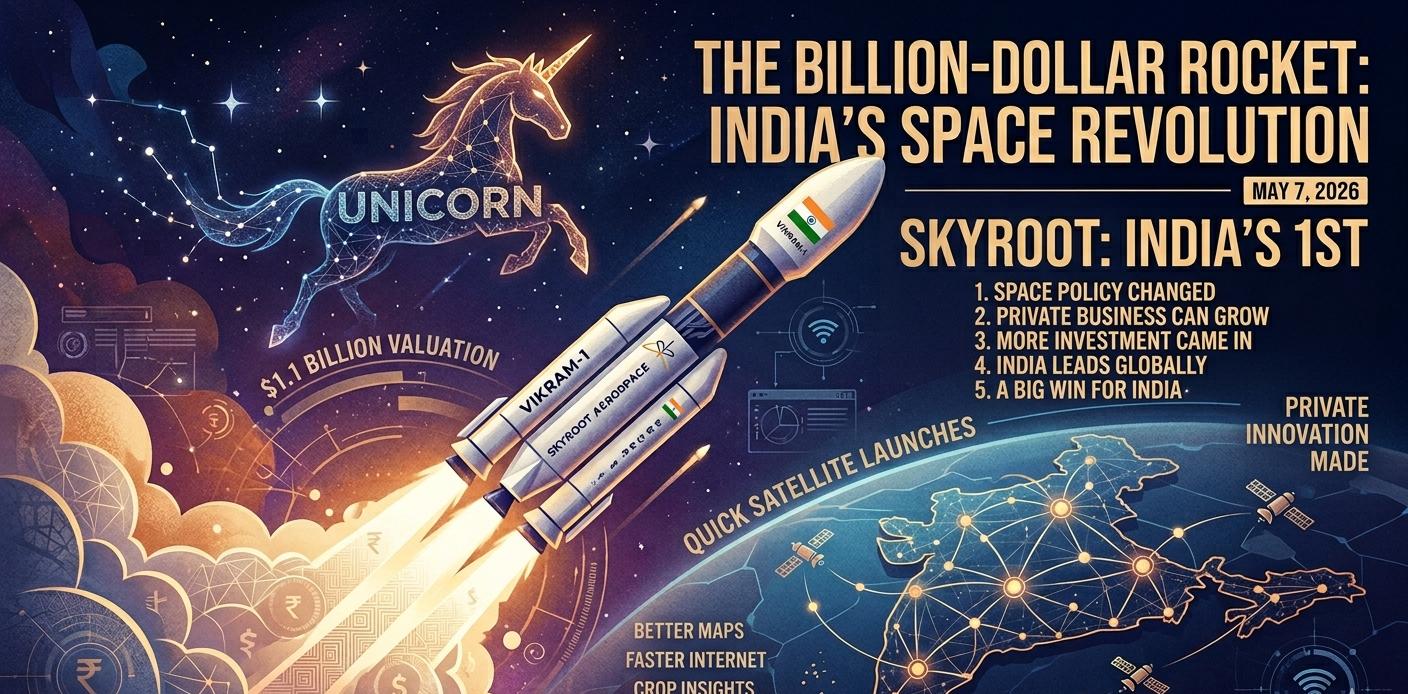
Today is May 7, 2026, and a historic milestone has just been reached in the Indian startup ecosystem. Skyroot Aerospace, the Hyderabad-based startup that made waves with India’s first private rocket launch in 2022, has officially become India’s first space-tech Unicorn, reaching a valuation of $1.1 billion.
This isn’t just about a “billion-dollar” tag; it is a signal that India’s space industry has moved from being a government monopoly to a global commercial powerhouse.
Skyroot’s “Unicorn” Leap
Skyroot Aerospace announced today that it has raised $60 million in a funding round co-led by GIC (Singapore’s sovereign wealth fund) and Sherpalo Ventures, with participation from the world’s largest asset manager, BlackRock.
This massive influx of capital is timed perfectly. The company is currently preparing for the maiden orbital flight of Vikram-1, its first commercial-class rocket, scheduled for next month. Unlike their previous test flight (Vikram-S), Vikram-1 is designed to carry actual satellites into orbit, effectively turning Skyroot into a “Space Taxi” for the global market.
Why This Matters: The Big Picture
For the average citizen, space news often feels like “billionaire hobbies” or “government experiments.” But Skyroot Aerospace’s success has a direct impact on your life and the nation’s economy:
The “Uber-ization” of Space: Currently, if a company wants to launch a small satellite for weather tracking or 5G, they have to wait months for a “ride-share” on a massive ISRO or SpaceX rocket. Skyroot offers “on-demand” launches, making it faster and cheaper to put satellites in orbit.
Precision Living: More satellites mean better data for agriculture (predicting crop yields), disaster management (tracking cyclones in real-time), and connectivity (high-speed internet in the most remote corners of Ladakh or Kerala).
High-Tech Jobs: This milestone proves that Indian engineers don’t need to go to NASA to build rockets. The “Space-Tech” sector is now a viable, high-paying career path right here in India.
The UPSC Edge: Connecting to the Syllabus
If you are an aspirant, Skyroot Aerospace can be a textbook case study for GS Paper III (Economy & S&T) and GS Paper II (Governance). Here is how you should frame this in your notes:
- Shift in National Space Policy (GS-II)
Skyroot Aerospace’s success is the direct outcome of the Indian Space Policy 2023. For years, the Department of Space (DoS) was the player, the umpire, and the stadium owner. The 2023 policy changed that:
ISRO’s New Role: ISRO is transitioning from a “launch provider” to a “research and development” agency. It now focuses on deep-space exploration (like the Gaganyaan and Venus missions).
IN-SPACe: The Indian National Space Promotion and Authorization Centre acted as a single-window clearance for Skyroot, allowing a private company to use ISRO’s launch pads at Sriharikota.
2. The Economic Multiplier (GS-III)
India currently holds about 2% of the global space economy (valued at roughly $8.4 billion). The government’s goal is to reach 8% to 10% by 2033.
FDI Reforms: In 2024, India allowed 100% FDI in satellite manufacturing. Skyroot’s $60 million round led by global giants like BlackRock shows that international capital is finally betting on Indian hardware, not just software.
Cost Advantage: Indian rockets like Vikram-1 are built at a fraction of the cost of Western counterparts, giving India a comparative advantage in the $500 billion global space market.
3. Science and Technology (GS-III)
Vikram-1 Technicals: It is a multi-stage launch vehicle with 3D-printed engines. This highlights India’s progress in Additive Manufacturing, a key pillar of Industry 4.0.
Small Satellite Launch Vehicle (SSLV) vs. Vikram-1: While ISRO has its own SSLV, Skyroot’s Vikram series provides the “private competition” necessary to drive down costs through innovation.
The Critical View: Challenges Ahead
While we celebrate the “Unicorn” status, an aspirant must look at the gaps:
Launch Failures: Space is hard. In early 2026, the PSLV-C62 mission faced setbacks, reminding us that one failure can wipe out years of investor confidence.
Insurance & Liability: India still lacks a comprehensive Space Liability Law. If a private rocket crashes, who pays? This legal gray area needs urgent governance.
Dependency: India still imports 12 times more space-grade electronics than it exports. Real “Atmanirbharta” will only come when we make the chips that go inside these rockets.
Summary for your “Daily Diary”
What: Skyroot Aerospace becomes India’s first Space-Tech Unicorn.
When: May 7, 2026.
Significance: Proves the success of the 2023 Space Policy and opens the door for private orbital launches.
UPSC Keywords: IN-SPACe, NewSpace India Ltd (NSIL), FDI in Space, Additive Manufacturing, Vikram-1.
Do you think India should prioritize funding for private “Space Taxis” like Skyroot, or should the focus remain strictly on ISRO’s deep-space scientific missions?